
Solana Price Volatility: A Behavioral Economics Lens on Investor Sentiment and Risk Perception


 Aime Summary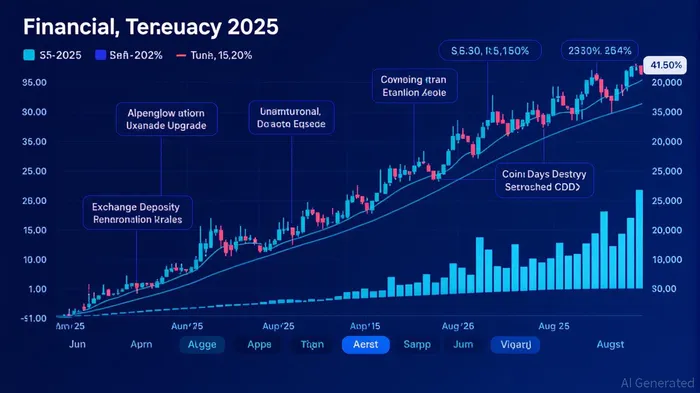
The SolanaSOL-- (SOL) market in 2025 has been a theater of contradictions: a six-month high of $216 coexisting with $432 million in exchange deposits, bullish technical indicators clashing with a Fear & Greed Index score of 49, and institutional adoption surging alongside profit-taking by long-term holders. To decode this volatility, we must turn to behavioral economics, where domain-specific decision-making and the reflection effect reveal how investors navigate risk and reward in a high-stakes, fast-moving asset class.
The Reflection Effect and Solana's Price Action
The reflection effect, a cornerstone of prospect theory, posits that individuals become risk-averse when facing gains but risk-seeking when facing losses. This duality is evident in Solana's recent price action. After a 32% monthly surge, many investors locked in profits by depositing 2 million SOL ($432 million) onto exchanges—a classic risk-averse move in a perceived gain scenario. Conversely, the Coin Days Destroyed (CDD) metric, which spiked to a three-month high, suggests that long-term holders—historically risk-averse—were forced into risk-seeking behavior as they sold accumulated tokens. This duality creates a self-reinforcing cycle: profit-taking pressures prices downward, while the fear of missing out (FOMO) on future gains drives renewed buying.
Domain-Specific Decision-Making: Fundamentals vs. Heuristics
Investor behavior in Solana's ecosystem is shaped by domain-specific heuristics. For instance, technical traders fixate on patterns like the ascending triangle breakout and Fibonacci extensions, while fundamentalists highlight the Alpenglow upgrade's 100x speed boost and institutional purchases by DeFi DevelopmentDFDV-- Corp. These divergent lenses create a fragmented perception of risk.
Consider the recent institutional adoption: thirteen public firms now hold 1.44% of the total SOL supply, leveraging 7–8% staking yields. This fundamental strength should, in theory, stabilize the price. Yet, the same period saw a 14% weekly price drop, driven by profit-taking and macroeconomic jitters. Here, domain-specific biases clash: fundamentalists view the dip as a buying opportunity, while technical traders see it as a warning sign. This dissonance amplifies volatility, as seen in Solana's 7.45% volatility over 30 days.
Investor Psychology and the “Rational” Price Action
Is Solana's current price action rational or a product of behavioral bias? The data suggests a hybrid reality. On one hand, the network's fundamentals—$11.5 billion in TVL, 65,000 TPS, and real-world integrations like the U.S. Commerce Department's GDP data on Pyth Network—justify a bullish outlook. On the other, behavioral biases like anchoring (fixating on the $200 psychological level) and overconfidence (assuming the Alpenglow upgrade alone will sustain growth) cloud judgment.
For example, the pending U.S. spot Solana ETF approval by October 2025 is a rational catalyst, yet its impact is being overestimated by some investors. Meanwhile, the rise of competing projects like Layer Brett—a meme-driven EthereumETH-- Layer 2 token—has triggered a reflection effect: investors who once saw Solana as a “safe” bet are now reassessing their portfolios, fearing they might miss out on higher-growth alternatives.
Investment Strategy: Navigating the Behavioral Maze
For near-term investors, the key lies in balancing domain-specific insights with behavioral safeguards. Here's how:
- Hedge Against Profit-Taking: Use options or futures to protect against short-term volatility. The current Parabolic SAR below $203 and Fibonacci targets at $240 suggest a bullish bias, but a stop-loss below $201 could mitigate downside risk.
- Leverage Institutional Confidence: Allocate a portion of capital to staking (7–8% yields) while holding a smaller speculative position in Solana's price action. This mirrors the strategyMSTR-- of public firms like DeFi Development Corp.
- Monitor Behavioral Triggers: Track CDD and exchange deposit trends. A sustained drop in CDD (indicating reduced selling by long-term holders) could signal a bottom, while a rise in exchange deposits might justify caution.
Conclusion: The Future of Solana and Behavioral Economics
Solana's price in 2025 is a microcosm of broader behavioral dynamics in crypto markets. The reflection effect and domain-specific decision-making create a volatile yet fertile ground for growth. While the current price action reflects both rational fundamentals and irrational exuberance, investors who recognize these biases can position themselves to capitalize on the next phase of Solana's evolution. As the network inches closer to $221 resistance and the pending ETF approval, the interplay between risk perception and investor psychology will remain the ultimate determinant of its trajectory.
In the end, Solana's story is not just about technology or economics—it's about human behavior. And in that arena, the most disciplined and adaptive investors will thrive.

Blending traditional trading wisdom with cutting-edge cryptocurrency insights.
Latest Articles
Stay ahead of the market.
Get curated U.S. market news, insights and key dates delivered to your inbox.


AInvest
PRO
AInvest
PRO



Comments
No comments yet