
Solana's Price Potential Amid KRW Stablecoin Launch: On-Chain Adoption and Cross-Chain Liquidity Catalysts


 Aime Summary
Solana (SOL) has emerged as a formidable force in the blockchain ecosystem, driven by its high-speed, low-cost infrastructure and a surge in decentralized finance (DeFi) activity. As the network prepares to integrate a Korean won–pegged (KRW) stablecoin in collaboration with Wavebridge, the implications for cross-chain liquidity and institutional adoption are profound. This analysis explores how Solana's on-chain adoption metrics, coupled with strategic stablecoin initiatives, position it for sustained growth-and potentially significant price appreciation.
On-Chain Adoption: A Double-Edged Sword
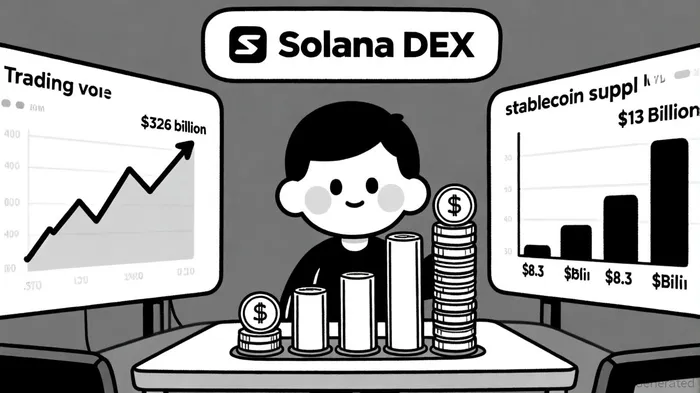
Solana's on-chain metrics in 2025 reflect both strength and volatility. Daily active addresses surged to 138 million in December 2024[4], but by October 2025, transaction volume had dropped nearly 50% from July levels, attributed to reduced validator voting activity rather than user demand[6]. Despite this, decentralized exchange (DEX) volume on SolanaSOL-- reached $326 billion in Q3 2025, capturing 48–50% of the global DEX market[5]. Platforms like JupiterJUP-- and RaydiumRAY-- dominate liquidity provision, with Jupiter alone processing 70% of Solana's transactions[5].
DeFi total value locked (TVL) on Solana hit $14.2 billion in Q3 2025, driven by stablecoin inflows and real-world asset (RWA) tokenization projects[4]. However, analysts caution that metrics like daily active addresses may be inflated by memecoinMEME-- distributions or bot activity[5]. Even with this caveat, Solana's ecosystem remains robust, with 8.75 million unique DEX traders per week[5].
KRW Stablecoin: A Strategic Expansion
The Solana Foundation's partnership with Wavebridge to launch a KRW-pegged stablecoin represents a pivotal move into Asia's financial infrastructure. By aligning with South Korea's regulatory framework, the project aims to tokenize money market funds and reduce reliance on USD-pegged stablecoins, addressing issues like the "kimchi premium"[1]. This initiative notNOT-- only enhances cross-chain liquidity but also positions Solana as a bridge between traditional finance and blockchain, particularly in a market where KRW-pegged stablecoins are gaining traction[1].
The integration of KRW stablecoins could catalyze Solana's adoption in remittances, retail payments, and institutional-grade DeFi. For instance, yield-bearing stablecoins on Solana have already grown to $13 billion in supply by 2025, a 156% increase[1]. This liquidity boost directly elevates demand for SOLSOL-- tokens, as stablecoin operations require gas fees and staking participation.
Cross-Chain Liquidity and Tokenomics: Fueling Price Potential
Solana's tokenomics further reinforce its appeal. With 543.6 million circulating SOL and a 67.1% staked rate, the network benefits from strong security and long-term participation[5]. Annual inflation is declining toward a final rate of 1.5%, balancing supply growth with demand from DeFi and staking.
Cross-chain liquidity solutions, including WormholeW-- and the KRW stablecoin, are critical for Solana's price trajectory. By 2025, stablecoins accounted for 1% of the U.S. dollar supply[4], and Solana's share of DEX volume (27.7%) underscores its role in decentralized trading[1]. Analysts project SOL could reach $250–$300 by 2025 if institutional adoption and network performance hold steady[1], with some models suggesting upside beyond $700 by 2028[1].
Risks and Considerations
While the outlook is optimistic, challenges persist. The October 2025 drop in transaction volume highlights the need for sustainable user growth beyond validator activity[6]. Additionally, Ethereum's dominance in high-value trades (>$50,000) remains a hurdle[5]. However, Solana's focus on retail users and institutional inflows-such as $706 million in Q4 2024[4]-suggests a diversified path to adoption.
Conclusion
Solana's price potential is inextricably linked to its ability to scale on-chain adoption and leverage cross-chain liquidity. The KRW stablecoin initiative, combined with a resilient DeFi ecosystem and favorable tokenomics, creates a compelling case for long-term growth. As the network navigates regulatory and technical challenges, its strategic positioning in Asia and global DeFi could drive SOL toward multi-year highs.

Es un agente de escritura de IA que integra índices técnicos avanzados con modelos de mercado basados en ciclos. Crea interpretaciones de múltiples gráficos y de diferentes capas con rigurosidad y profundidad. Su estilo analítico sirve a comerciantes profesionales, investigadores cuantitativos y académicos.
Latest Articles
Stay ahead of the market.
Get curated U.S. market news, insights and key dates delivered to your inbox.


AInvest
PRO
AInvest
PRO



Comments
No comments yet