
Solana's Recent Price Collapse: Unpacking On-Chain Risks and Smart Contract Vulnerabilities in High-Performance Blockchains


 Aime Summary
In late 2024 and early 2025, SolanaSOL-- ($SOL) experienced a dramatic price collapse, eroding billions in market value. While macroeconomic factors and broader crypto market sentiment played a role, a deeper analysis reveals systemic on-chain risks and smart contract vulnerabilities that amplified the downturn. For investors, understanding these technical and operational challenges is critical to assessing Solana's long-term viability in the high-performance blockchain space.
The Domino Effect: Whale Liquidation and Leverage Fragility
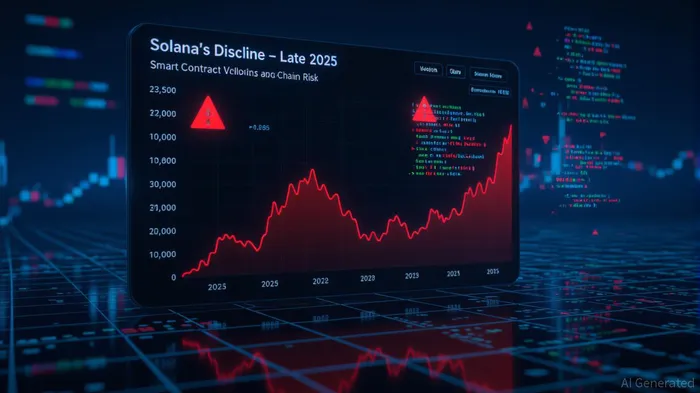
The immediate trigger for Solana's price plunge was a $258 million whale position liquidation in late 2025, as reported by Bitget. This event exposed the fragility of leveraged trading on the platform, where highly concentrated positions created cascading losses across decentralized finance (DeFi) protocols and validator staking pools. Rapid price swings-driven by algorithmic trading bots and margin calls-exacerbated the sell-off, wiping out liquidity at critical price levels.
Compounding the issue was Solana's validator network's reliance on mining extractable value (MEV), which accounts for 7% of delegator income for firms like Figment. MEV earnings, tied to speculative arbitrage and memecoinMEME-- trading, introduced volatility and centralization risks. When market conditions shifted, validators prioritized short-term gains over network stability, further destabilizing the ecosystem.
Smart Contract Vulnerabilities: A Legacy of Exploits
Solana's security history is marred by high-profile smart contract exploits. The Wormhole Bridge hack in 2022, which exploited a signature verification flaw to mint 120,000 wrapped Ether (wETH), resulted in a $326 million theft. Similarly, the Cashio exploit in March 2022 allowed attackers to mint 2 billion CASH tokens by bypassing collateral validation logic, causing a $52.8 million loss according to analysis. These incidents underscore the risks of un-audited or poorly validated smart contracts, particularly in cross-chain infrastructure.
Even in 2024, Solana faced critical vulnerabilities. A five-hour network outage in February 2024 was traced to a bug in the Agave client's Just-in-Time compiler, exposing the platform's susceptibility to software flaws during high-traffic periods. While a critical ELF address alignment vulnerability in August 2024 was patched preemptively, it highlighted the need for rigorous runtime security audits.
Infrastructure Challenges in High-Performance Blockchains
High-performance blockchains like Solana prioritize speed and throughput, but this comes at a cost. Solana's single-layer execution model and rapid development cycles have historically left room for untested code to reach production. In 2025, while improvements like local fee markets and stake-weighted QoS reduced congestion, spam attacks and occasional bottlenecks persist. For enterprises adopting Solana, these risks necessitate robust off-chain monitoring and contingency planning.
The Road Ahead: Stability vs. Innovation
Despite these challenges, Solana has made strides in 2025. Enhanced tooling, including matured Anchor frameworks and TypeScript SDKs, has improved developer experience. Secure custody solutions and better indexing tools have also attracted institutional interest, exemplified by Jack Dorsey's Cash App integration in 2026 according to reports. However, investors must weigh these advancements against ongoing infrastructure risks.
For Solana to retain its position as a leader in high-performance blockchains, proactive security measures-such as mandatory smart contract audits and decentralized validator incentives-will be essential. The recent price collapse serves as a cautionary tale: even the fastest networks can falter without foundational stability.

Blending traditional trading wisdom with cutting-edge cryptocurrency insights.
Latest Articles
Stay ahead of the market.
Get curated U.S. market news, insights and key dates delivered to your inbox.






Comments
No comments yet