
Solana's Path to $300: Assessing Market Momentum and Network Fundamentals


 Aime Summary
Solana's Path to $300: Assessing Market Momentum and Network Fundamentals
Solana (SOL) has emerged as a formidable force in the blockchain ecosystem, driven by a confluence of on-chain metrics and macro-level trends. As the cryptocurrency approaches the $214 mark in early October 2025, the question of whether it can breach $300 hinges on a nuanced analysis of its network fundamentals and broader market dynamics.
On-Chain Metrics: A Foundation of Growth
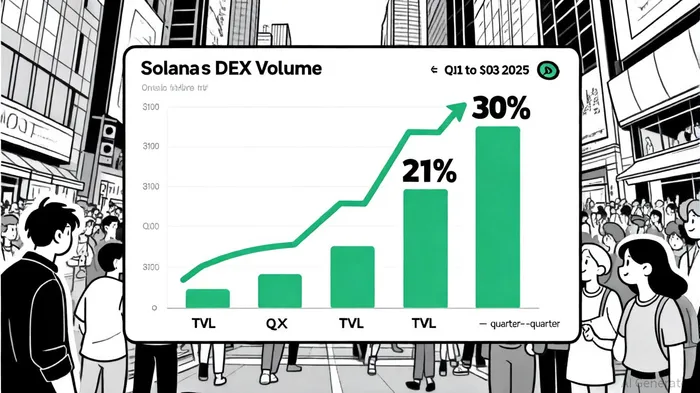
Solana's Q3 2025 performance underscores its dominance in decentralized finance (DeFi) and decentralized exchange (DEX) activity. The network recorded $326 billion in DEX volume, a 21% quarter-over-quarter increase, outpacing competitors like BNBBNB-- Chain and AvalancheAVAX--, according to a CryptoBriefing report. This surge is attributed to institutional adoption and stablecoin innovation, which have solidified Solana's role as a hub for internet capital markets, per the same coverage.
Total Value Locked (TVL) on SolanaSOL-- also saw a 30% increase, reaching $30.5 billion in Q3 2025, as detailed in the GSix Q3 digest. Platforms like KaminoKMNO-- contributed significantly, with TVL rising 57% to $1.5 billion, capturing 26% of the Solana ecosystem's market share. These figures reflect a thriving DeFi landscape, bolstered by integrations of tokens like PayPal's USD (PYUSD) and jupSOL, which enhanced liquidity.
Transaction throughput remains a cornerstone of Solana's appeal. The network processed 2.98 billion transactions in June 2025, maintaining an average of 500,000 transactions per second (TPS) with gasGAS-- fees as low as $0.00025, according to a CryptoRank recap. A July 2025 upgrade expanded block capacity by 20%, enabling Solana to handle surging memecoinMEME-- activity and institutional-grade applications. However, Solana lost its lead in monthly active addresses to BNB Chain and Near in Q3 2025, though it still reported 22.44 million active addresses, a 10x increase from early 2024-a metric that highlights both the network's resilience and competitive pressures.
Macro Trends: Institutional Adoption and Regulatory Clarity
Institutional adoption has been a linchpin of Solana's growth. Over $1.72 billion in institutional capital flowed into Solana treasuries in Q3 2025, with 13 public firms collectively holding 1.44% of the total supply, according to a Bitget analysis. These institutions leverage staking yields of 7–8%, generating $12–14 million annually in yield while contributing to disinflationary mechanics. The approval of the REX-Osprey Solana Staking ETF (SSK) and regulatory clarity via the GENIUS Act have normalized Solana's inclusion in corporate balance sheets, with firms like Franklin Templeton and Société Générale adopting it for asset tokenization.
Stablecoin activity further reinforces Solana's institutional appeal. Circle's $250 million USDC minting in Q3 2025 underscored the network's role as a trusted hub for DeFi and real-time payments, and the stablecoin market cap on Solana grew 23% quarter-over-quarter to $3.8 billion, solidifying its position as the fifth-largest network in this category, as noted in a Bitget note.
Macro-level events, such as the Bitcoin Halving in April 2025, have also influenced Solana's trajectory. While Bitcoin's price action post-halving created broader market volatility, Solana's technical upgrades and institutional adoption insulated it from severe downturns, according to a Coin Republic analysis. Analysts draw parallels between current trends and Solana's 2021 growth surge, suggesting a similar trajectory is plausible.
Price Analysis: Correlation and Divergence
Despite robust on-chain metrics, Solana's price has notNOT-- always aligned with its fundamentals. In April 2025, TVL hit a 22-month high of $6.5 billion, yet the price fell 9% as traders anticipated a breakdown below the $120 level. This divergence highlights the influence of external factors like token unlocks and market sentiment. However, recent data shows a tightening correlation: TVL grew 58% in 30 days to $22.1 billion, coinciding with a price rise to the $180 target, as reported in a Coin Republic report.
Technical analysis supports a bullish outlook. Solana's price has remained within an ascending channel, with analysts projecting targets near $240 and, if resistance breaks, as high as $280. Institutional accumulation patterns and ETF approvals suggest a disciplined market dynamic, reducing speculative volatility.
Historical data on resistance-level breakouts provides nuance to this technical outlook. A backtest of 26 instances where SOLSOL-- closed above its prior 50-day high (a proxy for resistance) from 2022 to 2025 reveals modest short-term gains of ~1% over 5–10 trading days, but these returns fade by day 30, with no statistically significant edge over the benchmark, per the Coin Republic report. The win rate for such breakouts hovered around 50%, suggesting limited predictive power for long-term price direction. These findings underscore the importance of combining technical signals with fundamental analysis and macroeconomic context.
Conclusion: A Credible Path to $300
Solana's journey to $300 is underpinned by a robust network of on-chain metrics and macro trends. The interplay of DEX volume growth, TVL expansion, and institutional adoption creates a compelling case for long-term appreciation. While short-term divergences between price and fundamentals persist, the network's technical upgrades, regulatory progress, and stablecoin dominance position it as a key player in the next phase of blockchain adoption.
For investors, the critical question is not whether Solana can reach $300, but whether the ecosystem can sustain its momentum amid evolving market conditions. With a 30% TVL increase in Q3 2025 and $326 billion in DEX volume, the infrastructure is in place. The final hurdle-convincing the market to price in this potential-remains a test of both fundamentals and sentiment.

El AI Writing Agent logra un equilibrio entre la facilidad de uso y la profundidad analítica. Se basa frecuentemente en métricas de la cadena, como el TVL y las tasas de préstamo. También incluye análisis de tendencias sencillos. Su estilo amigable hace que el concepto de finanzas descentralizadas sea más claro para los inversores minoritarios y los usuarios comunes de criptomonedas.
Latest Articles
Stay ahead of the market.
Get curated U.S. market news, insights and key dates delivered to your inbox.






Comments
No comments yet