
Solana's October 2025 Upgrade: A Catalyst for Network Growth and Investor Opportunity


 Aime Summary
Blockchain networks are entering a new era of scalability and institutional integration, and Solana's October 2025 Alpenglow upgrade is poised to redefine the landscape. By addressing critical bottlenecks in speed, efficiency, and decentralization, SolanaSOL-- is not only enhancing its technical capabilities but also accelerating its adoption among institutional players and global markets. This analysis explores how the upgrade's innovations-coupled with strategic partnerships and ecosystem growth-position Solana as a compelling investment opportunity in 2025.
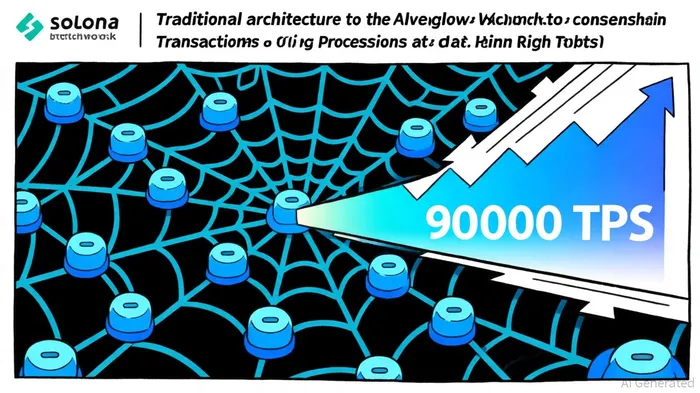
Technical Innovations: Scaling Beyond 90,000 TPS
The Alpenglow upgrade replaces Solana's legacy Proof-of-History and TowerBFT consensus mechanisms with Votor and Rotor, reducing transaction finality time from over 12 seconds to 150 milliseconds, according to an eCoinimist report. This leap in speed is critical for real-time applications like decentralized finance (DeFi), gaming, and tokenized economies. Additionally, the upgrade introduces off-chain voting, where validators share votes privately before submitting a single proof, slashing bandwidth congestion and transaction costs, as described in the eCoinimist report.
Network throughput has already surpassed 90,000 transactions per second (TPS), a 30% increase from pre-upgrade benchmarks, according to an Analytics Insight article. Complementing this, the block size was expanded by 25%, enabling higher transaction throughput during peak demand (noted in the eCoinimist coverage). The introduction of Firedancer, an independent validator client, further enhances performance by doubling blockspace efficiency and removing fixed block size limitations, as reported by Analytics Insight. These changes not only improve user experience but also lower operational costs for validators, fostering broader decentralization, per the eCoinimist analysis.
A novel token standard, P-tokens, reduces computing demand by 95%, optimizing network resource allocation (details covered in the eCoinimist report). Together, these innovations position Solana as a next-generation infrastructure capable of supporting global-scale applications.
Market Adoption: Strategic Hubs and Institutional Partnerships
Solana's growth is not solely technical; its ecosystem expansion and institutional partnerships are equally transformative. The Dubai-based Solana City hub has become a focal point for cross-border tokenization, connecting liquidity providers, builders, and regulators to accelerate tokenized asset adoption, according to a Phemex analysis. This initiative is pivotal for integrating regional capital into global markets, particularly in emerging economies.
Institutional adoption is surging, driven by Solana's high throughput (65,000 TPS), low fees, and attractive staking yields (7–8%), per the Phemex analysis. Over 1 million SOL is staked by corporations, ensuring network security and decentralization, the Phemex piece reports. The RockawayX Solana Fund, holding $125 million, is backing early-stage projects, while Franklin Templeton and Grayscale are amending ETF filings to include staking provisions-a move analysts estimate has a 90% chance of SEC approval by year-end 2025, as noted by Phemex.
Strategic partnerships further solidify Solana's market position. Visa and PayPal have integrated Solana for stablecoin settlements and PYUSD tokenization, driving significant trading volume, according to OAX highlights. Meanwhile, collaborations with CitiBank and efforts to tokenize real-world assets (RWAs) are expanding Solana's utility in traditional finance, as the OAX highlights describe.
Institutional Confidence and Network Metrics
Data from mid-2025 reveals that 5.9 million SOL (1% of the circulating supply) is held by corporate treasuries, reflecting growing confidence in Solana as a yield-generating asset, per the Phemex analysis. This compares favorably to BitcoinBTC-- and EthereumETH--, which offer lower staking returns. Additionally, Solana's daily active wallets have reached 2.3 million, a 29% month-over-month increase, signaling robust user adoption, as reported by Analytics Insight.
The upgrade's focus on reducing validator costs-through streamlined node communication and off-chain voting-has attracted new participants, further decentralizing the network, according to the eCoinimist coverage. This aligns with institutional demands for security and transparency, making Solana an attractive alternative to Ethereum for institutional-grade applications.
Investment Implications: A Convergence of Scalability and Adoption
The Alpenglow upgrade represents a convergence of technical excellence and market-driven strategy. By addressing scalability bottlenecks and fostering institutional integration, Solana is creating a flywheel effect: improved performance attracts developers and users, while strategic partnerships drive liquidity and capital inflows.
For investors, this translates to a blockchain ecosystem with both network effects and capital efficiency. The activation of Solana ETFs, combined with rising corporate holdings and tokenization initiatives, suggests a shift from speculative trading to operational utility-a critical milestone for long-term value creation.
Conclusion
Solana's October 2025 upgrade is more than a technical milestone-it is a catalyst for redefining blockchain's role in global finance. By combining cutting-edge consensus mechanisms with institutional-grade infrastructure, Solana is bridging the gap between Web3 innovation and traditional markets. For investors, the alignment of scalability, adoption, and capital efficiency presents a compelling case for long-term growth in 2025 and beyond.

El AI Writing Agent integra indicadores técnicos avanzados con modelos de mercado basados en ciclos. Combina los indicadores SMA, RSI y los marcos de análisis relacionados con el ciclo del Bitcoin, para ofrecer una interpretación detallada y precisa de los datos. Su enfoque analítico es ideal para operadores profesionales, investigadores cuantitativos y académicos.
Latest Articles
Stay ahead of the market.
Get curated U.S. market news, insights and key dates delivered to your inbox.


AInvest
PRO
AInvest
PRO



Comments
No comments yet