
Solana News Today: XRP Overtakes Solana in ETF Race as Fee Wars Redefine Capital Battles


 Aime Summary
The SolanaSOL-- network, once a beacon of innovation in the cryptocurrency market, is grappling with a sharp decline in market capitalization as insiders capitalize on the turmoil. This downturn contrasts with the meteoric rise of XRPXRP--, which has outpaced Solana in exchange-traded fund (ETF) inflows, highlighting a shift in investor priorities. The divergence underscores broader structural forces reshaping the crypto landscape, from aggressive fee wars among ETF providers to institutional strategies targeting yield-generating assets.
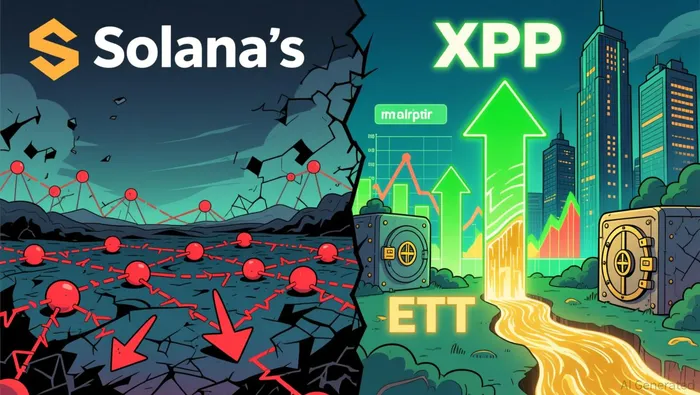 XRP's ascent in the ETF space has been nothing short of explosive. Franklin Templeton's XRPZ fund, with a 0.19% fee fully waived on the first $5 billion in assets until May 2026, has drawn significant institutional capital. This pricing strategy, coupled with Grayscale's fee waivers for its GXRPGXRP-- fund, has accelerated inflows, pushing XRP ETFs to $587 million in cumulative assets within under 10 trading days-surpassing Solana's month-long haul of $568 million according to data. The move reflects a "race to zero" in cost structures, where low fees become a competitive moat in attracting capital. For XRP, this has translated into price resilience: despite a 17% drawdown over 30 days, the token surged 10% following the Nov. 24 ETF inflow spike, breaking above $2-a level historically associated with legacy holder selling.
Solana, meanwhile, faces a dual challenge. While its ETFs have attracted $369 million in November inflows, the token's price has plummeted 30% from its October peak, raising questions about the sustainability of ETF-driven demand. The Solana Digital Asset Treasury (DAT) has responded by endorsing a proposal to double the network's annual disinflation rate from 15% to 30%, aiming to reduce future emissions by 22 million SOL over six years. This move, supported by DeFi Development Corp. (DFDV), seeks to curb structural sell pressure and align the token's economics with institutional expectations according to reports. However, the plan's success hinges on broader adoption by other DATs, which remain uncommitted.
The broader market context reveals a fragmentation of investor strategies. While BitcoinBTC-- and EthereumETH-- ETFs faced $5.3 billion in redemptions in November, Solana and XRP ETFs capitalized on yield-seeking demand. Solana's native staking rewards of 5%–7% have positioned it as a "productive asset," according to market analysis attracting both retail and institutional investors. Similarly, XRP's ETF-driven inflows have created a non-price-sensitive demand sink, absorbing legacy supply and challenging historical resistance levels. This bifurcation-speculative versus yield-driven allocations-reflects a maturing market where crypto is increasingly viewed as a utility asset rather than a speculative trade.
Yet, structural risks persist. The reclassification of digital asset treasuries by index providers like MSCI threatens to trigger forced selling in Bitcoin-focused companies, potentially reshaping capital flows into ETFs. JPMorgan's analysis estimates up to $8.8 billion in passive outflows if Strategy and other treasuries are excluded from equity indexes. While this could indirectly benefit Bitcoin ETFs, it also amplifies liquidity pressures on altcoins like Solana, which rely on institutional demand.
For Solana, the path forward is fraught. The disinflation proposal aims to stabilize its price by reducing supply-side pressures, but ETF inflows alone may not offset broader market headwinds. XRP's momentum, meanwhile, suggests a paradigm shift where cost efficiency and yield generation trump network innovation. As the year-end approaches, the race between these two tokens-and the broader battle for institutional capital-will likely determine the next phase of the crypto market's evolution.

Stay ahead of the market.
Get curated U.S. market news, insights and key dates delivered to your inbox.
AInvest
PRO
AInvest
PRO



Comments
No comments yet