
Solana News Today: Solana's Resilience Amid $1.1B Crypto Liquidation Storm


 Aime Summary
The cryptocurrency market experienced one of its most turbulent 24-hour periods in recent history, with over $1.1 billion in futures liquidations wiping out leveraged positions across major assets. BitcoinBTC-- (BTC) and EthereumETH-- (ETH) bore the brunt of the losses, while SolanaSOL-- (SOL) showcased unexpected resilience amid the chaos, highlighting both the fragility and adaptability of crypto markets according to analysis.
The liquidation wave, triggered by a combination of macroeconomic pressures and sudden price reversals, saw $1.1 billion in leveraged positions forcibly closed. Bitcoin alone accounted for $65.63 million in liquidations, with a single BTC-USDT position collapsing under margin calls. Ethereum lost $90.07 million, and over 246,000 traders globally faced forced exits. The event marked one of the largest liquidation events since the 2022 FTX collapse, though improved infrastructure mitigated broader systemic risks according to market data.
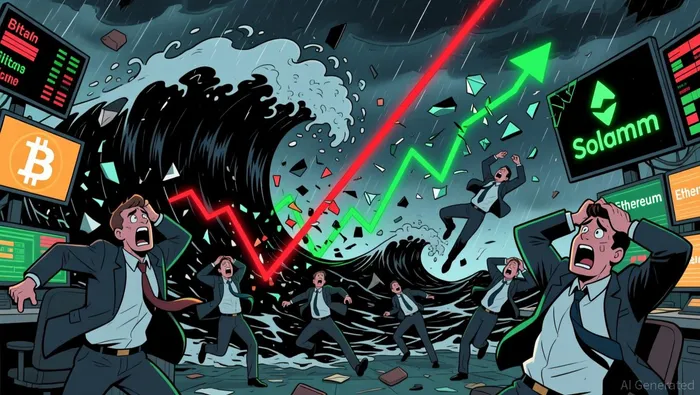 Long positions, which bet on price increases, dominated the losses, reflecting widespread optimism that turned into a liability. In the Bitcoin liquidation event, 82.54% of closures came from longs, while Ethereum and Solana saw 71.49% and 90.72% of their liquidations from bullish bets, respectively. The imbalance stemmed from sharp price drops that triggered margin calls, as traders' positions failed to maintain required collateral. Short positions, conversely, were less impacted, underscoring the asymmetric risks of leveraged trading according to market analysis.
The sell-off was fueled by deteriorating macroeconomic conditions. Chinese industrial production slowed to 4.9% year-on-year, while global equity markets tumbled, dragging crypto prices lower. Meanwhile, fading hopes for a December Federal Reserve rate cut-now priced at less than 50%-exacerbated risk-off sentiment according to market data. These factors created a "perfect storm" for leveraged traders, as thin liquidity and cascading liquidations accelerated price declines according to financial analysis.
Amid the turmoil, Solana's blockchain demonstrated robustness under stress. During a separate $19.5 billion liquidation event, Solana processed 6–10,000 transactions per second without service degradation, even as median fees remained stable at $0.007 according to technical reports. In contrast, Ethereum and its layer-2 solutions faced latency and surging gas fees, with some transactions spiking to $100. Solana's localized fee markets, which isolate congestion to specific accounts, proved a critical advantage according to infrastructure analysis.
The event underscores the perils of high-leverage trading. Experts recommend using stop-loss orders, avoiding over-leveraging during volatile periods, and diversifying strategies to mitigate liquidation risks according to market guidance. For institutional players, liquidation intensity charts-tools that identify clusters of forced closures-can help anticipate market volatility according to platform resources.
While painful, large-scale liquidations often signal market resets. Traders may find opportunities in oversold conditions, though caution remains warranted until volatility subsides. As Solana's performance illustrates, infrastructure resilience will be key to navigating future shocks in an increasingly interconnected crypto-ecosystem.

Stay ahead of the market.
Get curated U.S. market news, insights and key dates delivered to your inbox.


AInvest
PRO
AInvest
PRO



Comments
No comments yet