
Solana News Today: Solana ETFs Draw Inflows as Bitcoin, Ethereum ETFs Lose $437M


 Aime Summary
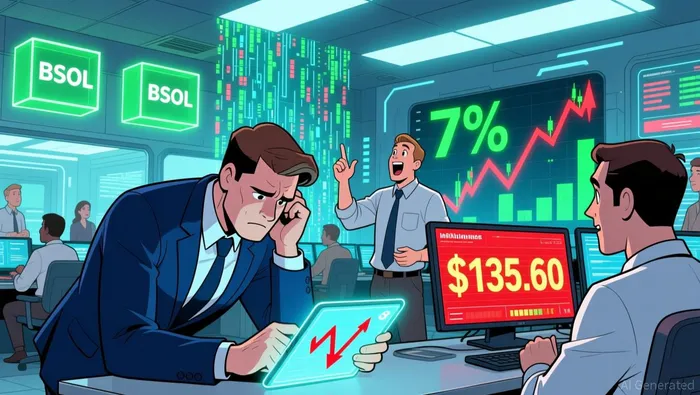
The SolanaSOL-- token (SOL) has seen a sharp price correction in recent weeks, trading at $135.60 as of November 18, 2025, with a 3.5% dip on the day according to market data. Despite the bearish trend, the launch of multiple Solana-focused exchange-traded funds (ETFs) has sparked investor optimism, with inflows into these products outpacing outflows in BitcoinBTC-- and EthereumETH-- ETFs. Bitwise's BSOLBSOL-- ETF, launched on October 28, has attracted $365.1 million in inflows, significantly outperforming Grayscale's GSOL which has drawn just $25.3 million. VanEck's VSOLVSOL-- and Fidelity's FSOL, launched on November 17 and 18 respectively, have further intensified competition in the space, with Fidelity's product entering as the largest traditional asset manager in the category.
The surge in ETF activity reflects a strategic shift in investor behavior. Bitwise CEO Hunter Horsley argues that lower SOL prices are attracting buyers who see entry points and staking yields of around 7% annually. This dynamic contrasts with the broader market, where Bitcoin and Ethereum ETFs have recorded outflows of $254.51 million and $182.80 million, respectively, as of November 17. Analysts attribute the shift to the structured, institutional-grade custody and yield features of Solana ETFs, which appeal to both retail and institutional investors.
Fidelity's entry into the market with FSOL charging a 0.25% fee has accelerated competition. The firm waived management and staking fees until May 2026, positioning the ETF as a cost-efficient option. Meanwhile, VanEck's VSOL offers fee waivers on its first $1 billion in assets until February 2026, with staking yields of ~6.6%. These incentives have drawn attention as Solana's price nears critical support levels, with analysts warning that a break below current thresholds could trigger further declines.
The absence of BlackRock, the world's largest asset manager, from the Solana ETF race has raised questions. BlackRock's leadership, including Robert Mitchnick, has emphasized its focus on Bitcoin and Ethereum ETFs, citing the need for market maturity and liquidity in altcoins. The firm's Bitcoin ETF, IBIT, and Ethereum ETF, ETHA, have dominated inflows, but recent outflows in these products suggest a potential pivot toward Solana. However, BlackRock's stance remains cautious, with executives noting that the next-largest cryptocurrency accounts for just 3% of the total market cap - far below thresholds for ETF viability.
Market participants are closely watching open interest in Solana futures, which has risen ahead of Fidelity's ETF launch, signaling heightened institutional activity. Canary Capital's SOLC ETF, which began trading on November 18, and Grayscale's continued presence further underscore the sector's expansion. Yet, the price trajectory of SOLSOL-- remains pivotal. Analysts highlight that sustained inflows into ETFs could stabilize the token, but a prolonged bearish trend risks testing lower support levels, potentially pushing prices toward $128–$122.
As the ETF landscape evolves, the interplay between product innovation and price volatility will define Solana's market narrative. With major players like Fidelity and VanEck vying for dominance, the race to capture institutional and retail demand is intensifying - a development that could reshape crypto investing strategies in 2026.

Stay ahead of the market.
Get curated U.S. market news, insights and key dates delivered to your inbox.
AInvest
PRO
AInvest
PRO



Comments
No comments yet