
Solana News Today: Regulatory Clarity Fuels Surge in Solana ETFs


 Aime Summary
A surge of new Solana-linked exchange-traded funds (ETFs) has entered U.S. markets this week, with Fidelity Investments and Canary Capital leading the charge to broaden institutional and retail access to the fast-growing blockchain ecosystem. The launches, including Fidelity's FSOL and Canary's staking-enabled SOLC, reflect a strategic shift by major asset managers to capitalize on rising demand for altcoin exposure and staking-linked products according to reports.
The ETFs are part of a broader wave of chain-specific strategies aimed at diversifying beyond Bitcoin's dominance. VanEck's VSOL debuted with zero fees on Monday, while Canary Capital, in partnership with Marinade Finance, introduced SOLC on Tuesday, integrating on-chain staking within a commodity-trust structure according to reports. Fidelity's FSOL, the first SolanaSOL-- product from a major traditional asset manager, charges a 0.25% annual fee and follows the footsteps of earlier entrants like Bitwise's BSOLBSOL-- and Grayscale's GSOLGSOL--, launched in late October according to reports.
The rapid proliferation of Solana ETFs underscores a competitive landscape where firms are differentiating themselves through fee structures, staking mechanisms, and custody models. Analysts note that the launches are partly a response to regulatory clarity in the U.S., which has eased the path for spot crypto ETFs. "These products are a by-product of regulatory easing rather than immediate market demand," said Stan Low, operations lead at privacy-focused decentralized exchange Grvt. 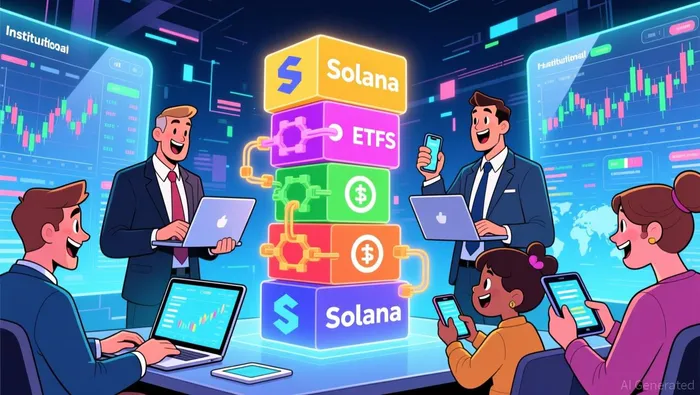
The trend extends beyond Solana, with issuers exploring other digital assets. 21Shares filed for a Canton Network ETF tied to Canton Coin, and Franklin Templeton updated its XRP ETF proposal, signaling expanding interest in non-Bitcoin tokens according to reports. Kanny Lee of SecondSwap warned, however, that early flows may be skewed by liquidity providers rather than long-term investors, with the true test of these funds' viability expected in early 2026 according to reports.
Fidelity's entry into the Solana market is particularly significant given its $6.4 trillion in assets under management. The firm's disciplined approach to validator selection and active staking management, as detailed in its recent earnings call, highlights a focus on risk-controlled growth. "We aim to compound value per share through disciplined accumulation and selective yield enhancement," the company stated, emphasizing sustainability over short-term gains.
Regulatory momentum appears to be a key catalyst. The cluster of ETF filings aligns with the Securities and Exchange Commission's (SEC) recent approval of spot BitcoinBTC-- ETFs, which has emboldened firms to test the boundaries of crypto product innovation. Bloomberg analysts Eric Balchunas and James Seyffart first flagged the expected Solana ETF releases in mid-November, noting the competitive race among firms to capture market share.
As the market digests these developments, the long-term success of these funds will hinge on their ability to attract sticky capital amid a volatile altcoin environment. For now, the ETF launches underscore a pivotal moment in the institutionalization of blockchain assets, with Solana positioned as a key beneficiary of the post-Bitcoin ETF boom.
---

Stay ahead of the market.
Get curated U.S. market news, insights and key dates delivered to your inbox.
AInvest
PRO
AInvest
PRO



Comments
No comments yet