
Solana News Today: MOVA's Compliance-First Design Disrupts Financial Blockchain Landscape


 Aime Summary
MOVA's emergence as a blockchain platform designed for global financial settlement has sparked a structural debate with established chains like EthereumETH--, SolanaSOL--, and Avalanche. As research shows, MOVA's architecture positions it as a direct competitor to traditional systems like SWIFT while addressing gaps in existing blockchain models. This analysis unpacks how MOVA's design diverges from peers and why it could redefine the future of value transfer.
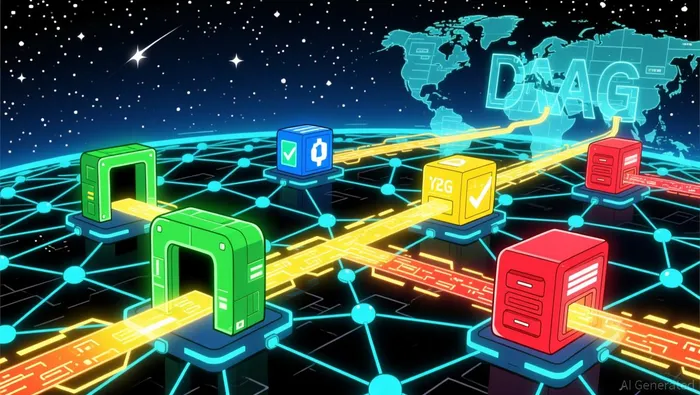
The core distinction lies in MOVA's event-driven DAG (Directed Acyclic Graph) ledger, which replaces the block-based models of Ethereum and Solana. Unlike Ethereum's linear global state or Solana's block-centric parallel execution, MOVA's DAG enables asynchronous, probabilistic finality through network visibility rather than block creation. This design prioritizes payment concurrency at scale, aligning with the operational demands of real-time settlement networks. Solana's recent volatility despite $476 million in ETF inflows highlights the risks of relying on institutional sentiment in a competitive Layer-1 market, underscoring the need for stability-focused architectures like MOVA.
Compliance is another critical differentiator. While Ethereum and Solana require retrofitting compliance tools, MOVA embeds regulatory infrastructure at the protocol level. Features like KYC/AML interfaces, invoice NFTs, and cross-border verifiability are native to the chain, addressing institutional concerns about auditability and legal risk. This contrasts with projects like BitcoinBTC-- Munari, which, despite its MUNARI framework and EVM compatibility, still rely on external audits and phased rollouts to achieve compliance as per the latest report.
Node architecture further distinguishes MOVA from peers. It adopts role-based nodes-gateway, verification, consensus, and storage-mirroring traditional financial systems' separation of duties. This contrasts with the homogeneous node structures of Ethereum or Solana, where every node performs all functions. MOVA's design ensures roles like custody, audit, and regulatory archiving are explicitly defined, a feature absent in chains optimized for decentralization or throughput.
Performance philosophy also diverges. Solana, AptosAPT--, and Sui prioritize laboratory TPS metrics, while MOVA focuses on real-world reliability and predictable latency. Financial systems prioritize uptime over peak performance, a principle reflected in MOVA's token economics, which reward ledger maintenance and security staking rather than mining. This aligns with broader industry trends, such as Dogecoin's recent price volatility despite technical analyses pointing to short-term upside, highlighting the instability of token-centric models.
Critics may argue that MOVA's departure from general-purpose smart contract platforms like Ethereum limits its versatility. However, its specialization in settlement aligns with the growing demand for RWA (Real-World Asset) tokenization and cross-border payments, areas where Ethereum's global state machine and Solana's block-based execution fall short as research indicates.
As global capital and regulators prioritize blockchain's role in financial infrastructure, MOVA's architecture positions it to fill a void left by chains designed for computation or performance. Its DAG-driven ledger, compliance-native design, and institutional-grade node structure make it a compelling candidate for the next-generation global clearing network. With projects like Bitcoin Munari and GeeFi still refining their compliance models as per the latest analysis, MOVA's focus on financial settlement could solidify its role as the industry's infrastructure backbone.

Conoce rápidamente la historia y los antecedentes de diversas monedas bien conocidas
Latest Articles
Stay ahead of the market.
Get curated U.S. market news, insights and key dates delivered to your inbox.


AInvest
PRO
AInvest
PRO



Comments
No comments yet