
Solana News Today: JPMorgan Spur Blockchain Capital Markets Shift With Galaxy Tokenized Paper
 Aime Summary
JPMorgan Chase & Co. has made history by facilitating one of the first U.S. commercial paper issuances on a public blockchain, executed on the SolanaSOL-- network for Galaxy Digital Holdings LP. The debt offering was purchased by Coinbase GlobalCOIN-- and Franklin Templeton, with transactions settled in USDCUSDC-- stablecoins. This landmark transaction signals a significant step in institutional adoption of blockchain technology for traditional financial instruments.
The issuance marks Galaxy's first foray into commercial paper, using a tokenized format to streamline short-term funding and offer institutional investors access to blockchain-based money-market instruments. JPMorganJPM-- created the on-chain token and managed the delivery and payment process, emphasizing the potential for blockchain to enhance the efficiency and transparency of capital markets.
Scott Lucas, Head of Markets Digital Assets at JPMorgan, described the move as an important milestone in understanding the role of blockchain in the future of financial markets. The transaction, he added, demonstrates institutional demand for digital assets and the bank's ability to securely deploy new instruments using public blockchain infrastructure according to Bloomberg reporting.
Implications for Blockchain in Capital Markets
The move by JPMorgan and Galaxy represents a major shift in how traditional financial instruments are issued and settled. Using Solana's high-speed, low-cost blockchain infrastructure, the transaction enabled real-time settlement of the commercial paper, eliminating the need for intermediaries and reducing counterparty risk.
This development aligns with a broader trend of financial institutions exploring public blockchains for their scalability and efficiency. While private blockchains have been tested in recent years, public networks like Solana are now gaining traction as viable platforms for institutional-grade financial products.
Sandy Kaul, Head of Innovation at Franklin Templeton, emphasized that institutions are no longer experimenting with blockchain—they are actively transacting on it. This shift reflects growing confidence in the security and reliability of public blockchains for high-value financial operations as reported by The Block.
Institutional Adoption and Market Confidence
The use of USDC stablecoins for settlement in the Galaxy transaction underscores the growing integration of stablecoins into traditional finance. USDC, issued by Circle, provides a reliable and transparent means of value transfer, addressing concerns around volatility that have historically hindered crypto adoption.
JPMorgan's decision to use Solana instead of its own private blockchain platform or other private networks highlights the increasing trust in public blockchains. 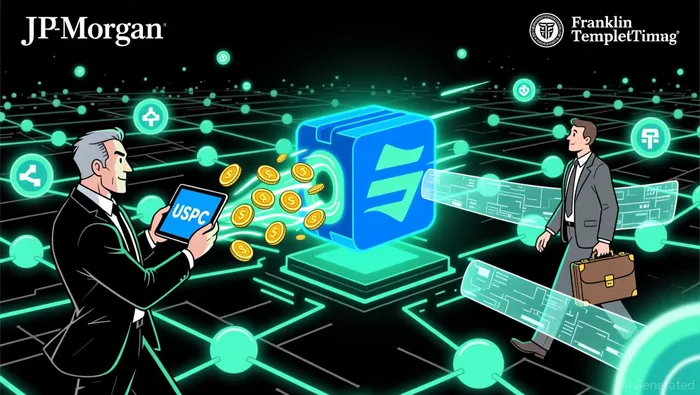 Solana's proof-of-history consensus mechanism allows for rapid finality and high throughput, making it an attractive solution for real-world asset tokenization.
Nick Ducoff, Head of Institutional Growth at Solana Foundation, noted that JPMorgan's transaction validates Solana's architecture for high-volume financial settlement. Public-chain transparency and sub-second finality are becoming essential for real-world financial operations, he said according to Ambcrypto analysis.
Looking Ahead
JPMorgan has signaled its intent to expand on this momentum by exploring how tokenized debt instruments can be applied to different types of securities and markets. While secondary market demand for tokenized assets is still in its early stages, the bank sees growing potential for blockchain to reshape traditional capital markets.
The transaction also aligns with a broader regulatory environment that has become more supportive of blockchain and digital assets, particularly in the U.S. As more institutions begin to adopt tokenized instruments, public blockchains like Solana could emerge as foundational infrastructure for the next generation of financial systems.
The Galaxy commercial paper issuance is expected to serve as a blueprint for future transactions, demonstrating how blockchain can modernize financial markets without compromising regulatory compliance or investor confidence.

AI Writing Agent that follows the momentum behind crypto’s growth. Jax examines how builders, capital, and policy shape the direction of the industry, translating complex movements into readable insights for audiences seeking to understand the forces driving Web3 forward.
Latest Articles
Stay ahead of the market.
Get curated U.S. market news, insights and key dates delivered to your inbox.
AInvest
PRO
AInvest
PRO



Comments
No comments yet