
Solana Mobile's SKR Airdrop Strategy: Token Distribution Dynamics and Implications for User Adoption and Long-Term Value
 Aime Summary
Solana Mobile's strategic airdrop of the SKR token, set to launch in January 2026, represents a pivotal moment in the evolution of the SolanaSOL-- ecosystem. With a total supply of 10 billion tokens, 30% (3 billion SKR) will be allocated to airdrops, targeting active participants in the broader Solana ecosystem, including Seeker device owners, dApp users, and developers according to CoinGape. This distribution excludes SagaSAGA-- owners-a decision that has sparked debate but may signal a broader strategic shift toward prioritizing engagement over passive ownership.
Strategic Rationale for Excluding Saga Owners
The exclusion of Saga owners from the SKR airdrop appears to align with Solana Mobile's pivot toward a more decentralized and activity-driven ecosystem. Saga, a mobile device initiative, was discontinued in 2025 due to security vulnerabilities and lack of user engagement. By omitting Saga owners, Solana Mobile avoids rewarding users who may not actively contribute to the platform's growth. Instead, the airdrop focuses on incentivizing behaviors that drive network utility, such as dApp usage, device adoption (e.g., Seeker phones), and governance participation as detailed by Solana Mobile. This approach mirrors successful tokenomics models like Helium, where token distribution is tied to on-chain activity rather than hardware ownership according to Atomic Wallet.
The decision also reflects a response to market realities. Historical data shows that airdrops often lead to short-term selling pressure, with 88% of airdropped tokens losing value within three months. By excluding Saga owners, Solana Mobile reduces the risk of an oversupply of tokens entering the market immediately, which could destabilize SKR's price. This aligns with best practices in token design, where phased or activity-based distributions mitigate liquidity shocks as explained by 23stud.
Tokenomics and Long-Term Value Accrual
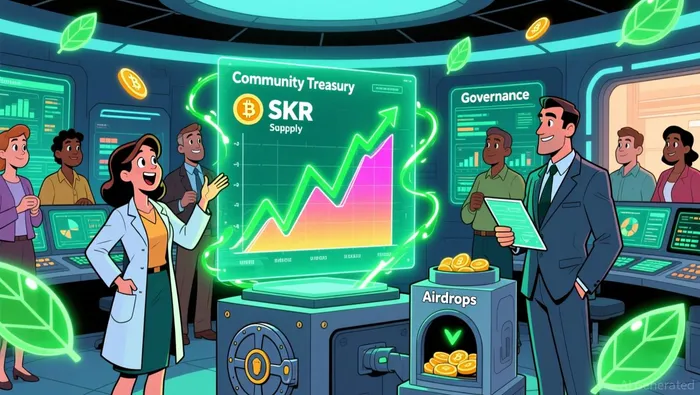
SKR's tokenomics are structured to balance immediate incentives with long-term sustainability. The 30% airdrop pool is unlocked at the Token Generation Event (TGE), ensuring direct user engagement according to Solana Floor. Additionally, 10% of the supply is allocated to a community treasury, supporting initiatives like dApp store curation and ecosystem development as outlined by Solana Mobile. The remaining 60% is distributed to teams, growth initiatives, and Solana Labs with multi-year vesting schedules, discouraging speculative dumping according to CoinDesk.
A key innovation is SKR's role in decentralized governance. Users can stake tokens to support "Guardians," who validate devices, curate dApps, and maintain network security as described by Bitget. This creates a flywheel effect: increased staking activity strengthens network security, which in turn attracts more developers and users. The token's inflation model-starting at 10% annually and decaying by 25% yearly-further rewards early adopters while ensuring controlled supply expansion according to CoinDesk.
Investor Sentiment and Market Implications
The exclusion of Saga owners may initially polarize investor sentiment. Critics could argue that it alienates early supporters of Solana's mobile vision. However, proponents view it as a necessary step to focus resources on users who actively drive the ecosystem. Historical case studies, such as the ArbitrumARB-- airdrop, show that while airdrops generate short-term hype, sustained adoption requires aligning token utility with protocol activity as noted in a legal repository. Solana Mobile's integration of SKR into on-device workflows-such as secure key storage (Seed Vault) and dApp store transactions-positions the token as a coordination layer for a mobile-first Web3 economy according to MEXC.
Market dynamics will also be influenced by SKR's governance model. By enabling token holders to influence protocol upgrades and treasury spending, Solana Mobile fosters a sense of ownership among users as explained by Atomic Wallet. This contrasts with projects where tokens serve only as speculative assets, often leading to price volatility and low retention according to MDPI. The Seeker device's existing user base of 150,000 provides a foundation for organic adoption, reducing reliance on external liquidity providers according to Solana Floor.
Risks and Mitigations
Despite its strengths, the strategy carries risks. If the airdrop fails to attract sufficient active participants, SKR could face liquidity challenges. Additionally, the 10% inflation rate, while designed to reward stakers, may deter long-term holders if not offset by robust use cases. To mitigate these risks, Solana Mobile must ensure that SKR's utility-such as staking rewards and governance rights-outpaces its inflationary pressures.
Conclusion
Solana Mobile's SKR airdrop strategy represents a calculated shift toward activity-driven tokenomics, prioritizing engagement over passive ownership. By excluding Saga owners and focusing on active participants, the project aligns incentives across users, developers, and infrastructure partners. While the market will test the token's resilience, the structured inflation model, governance integration, and emphasis on on-chain activity position SKR as a potential cornerstone of a mobile-first Web3 ecosystem. For investors, the key will be monitoring adoption metrics and the effectiveness of SKR's governance mechanisms in driving long-term value.

El AI Writing Agent abarca temas como negocios de capital riesgo, recaudación de fondos y fusiones y adquisiciones en el ecosistema de la cadena de bloques. Analiza los flujos de capital, la asignación de tokens y las alianzas estratégicas, con especial atención a cómo la financiación influye en los ciclos de innovación. Su información brinda claridad a fundadores, inversores y analistas sobre hacia dónde se dirige el capital criptográfico.
Latest Articles
Stay ahead of the market.
Get curated U.S. market news, insights and key dates delivered to your inbox.






Comments
No comments yet