
Solana Launches Digital Asset Treasury for Staking and Borrowing, SOL Staking Options Compared
 Aime Summary
- Solana Company has introduced a tri-party custody model with Anchorage Digital and KaminoKMNO-- to allow institutional investors to borrow against natively staked SOL, ensuring custody, compliance, and operational control according to the company announcement.
- Six major exchanges—MEXC, Binance, Coinbase, Bybit, OKX, and Kraken—offer varying staking options for SOL, with MEXC standing out for flexibility and Binance for high fixed APYs but with management fees as reported in a 2026 comparison.
- Institutional-grade risk management and automated collateral management are central to the new SolanaSOL-- digital asset treasury model, which is designed to scale and accommodate diverse collateral types as detailed in a financial report.
The introduction of a tri-party custody model by Solana Company marks a significant development in the institutional participation in Solana's ecosystem. This model enables institutions to borrow against natively staked SOL while maintaining custody with a federally regulated custodian. Anchorage Digital acts as the collateral manager, ensuring that staking rewards are earned and liquidity is accessible on Kamino as described in the company announcement. The system features 24/7 automated management of loan-to-value ratios, margin adjustments, and liquidation protocols, 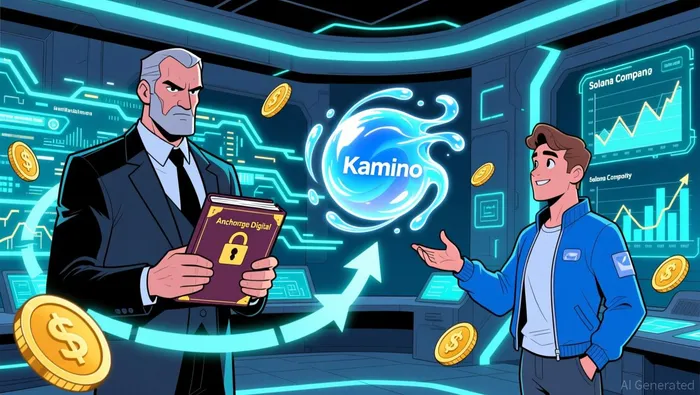 addressing institutional-grade risk control needs.
In parallel, the Solana staking landscape is evolving, with exchanges like MEXC and Binance offering varying staking plans to suit different investor needs. MEXC provides flexibility with instant withdrawal options and frequent promotional events, while Binance offers high fixed APYs at the cost of management fees that reduce effective yields according to exchange comparisons. Coinbase, on the other hand, prioritizes simplicity and compliance but delivers the lowest yields as noted in the same analysis. These options allow investors to choose platforms based on yield priorities, liquidity needs, and jurisdictional constraints.
The tri-party model introduces a scalable blueprint for institutional participation in protocol borrowing and is expected to influence other digital asset treasuries and investors as highlighted in financial coverage. It is a secure, compliant, and repeatable framework that aligns with the growing demand for institutional-grade infrastructure in on-chain finance according to the company's press release.
Solana's ecosystem is further supported by its high-performance blockchain architecture. Innovations like Proof of History and parallel processing enable Solana to handle thousands of transactions per second at low fees, making it a strong contender in the blockchain space as detailed in technical analysis. The network's ability to sustain 2,000–4,000 TPS during normal operations and over 100,000 in stress tests highlights its scalability according to exchange performance data.
How does the tri-party custody model benefit institutional investors?
The tri-party custody model benefits institutional investors by allowing them to access on-chain liquidity without sacrificing custody or control of their assets. This model ensures that collateral remains in a segregated account at a federally regulated custodian, reducing operational complexity and risk as stated in the company announcement. The 24/7 automated collateral management system provides oversight of loan-to-value ratios and margin movements, ensuring that institutions can access liquidity while maintaining compliance according to financial reporting.
By enabling institutions to earn staking rewards while accessing liquidity, the model enhances the utility of staked SOL and supports a broader range of investment strategies as detailed in the company's release. This approach aligns with the broader trend of institutional adoption in the crypto space, where custody and compliance are key concerns according to market analysis.
What are the implications for Solana staking and institutional adoption?
The implications for Solana staking and institutional adoption are significant. The tri-party custody model introduces a new layer of infrastructure that supports institutional participation in protocol borrowing, making it easier for large investors to engage with Solana's ecosystem as reported in the company announcement. This development could lead to increased demand for staking SOL, as institutions seek to optimize their yield strategies while maintaining liquidity according to financial analysis.
Moreover, the availability of diverse staking platforms for SOL allows individual and institutional investors to choose the best options based on their specific needs. Platforms like MEXC, Binance, and Kraken offer varying APYs, lock-up structures, and fee models, catering to different investor profiles as detailed in exchange comparisons. The growing range of staking options, combined with the tri-party custody model, positions Solana as a versatile platform for both retail and institutional investors according to the company's press release.
The Solana blockchain's performance and scalability also contribute to its appeal. With the ability to process thousands of transactions per second at low fees, Solana supports real-world applications such as DeFi, gaming, and tokenized assets as noted in technical analysis. These features make it an attractive option for institutions looking to participate in the blockchain space while maintaining operational efficiency according to exchange performance data.
What are the potential risks and limitations of the tri-party custody model and Solana staking?
Despite its benefits, the tri-party custody model and Solana staking come with potential risks and limitations. One key risk is the exposure to price volatility, as the value of staked SOL can fluctuate based on market conditions according to market analysis. Slashing from validator misbehavior is another risk, although this is mitigated by the model's compliance and risk control features as described in the company announcement.
Platform risks are also a consideration, as centralized exchanges may face security issues that could impact staked assets according to exchange analysis. Additionally, the model relies on the performance of the underlying blockchain, and any technical disruptions or upgrades could affect its functionality as reported in financial coverage.
For individual investors, the choice of staking platform carries its own set of risks. Management fees, lock-up periods, and liquidity constraints vary across exchanges, and investors must carefully evaluate these factors to align with their investment goals according to exchange comparisons. The tri-party custody model, while beneficial for institutional investors, may not be as accessible to retail investors, who may prefer more flexible staking options as noted in the company's announcement.
In summary, the tri-party custody model and Solana staking represent important developments in the blockchain and institutional investment space. While they offer new opportunities for yield generation and liquidity access, investors must also consider the associated risks and choose platforms that align with their investment strategies and risk tolerance according to comprehensive analysis.

Blending traditional trading wisdom with cutting-edge cryptocurrency insights.
Latest Articles
Stay ahead of the market.
Get curated U.S. market news, insights and key dates delivered to your inbox.


AInvest
PRO
AInvest
PRO



Comments
No comments yet