
Solana as the Next Institutional Treasury Powerhouse: Why Corporate Adoption Is Driving a New Bull Cycle


 Aime Summary
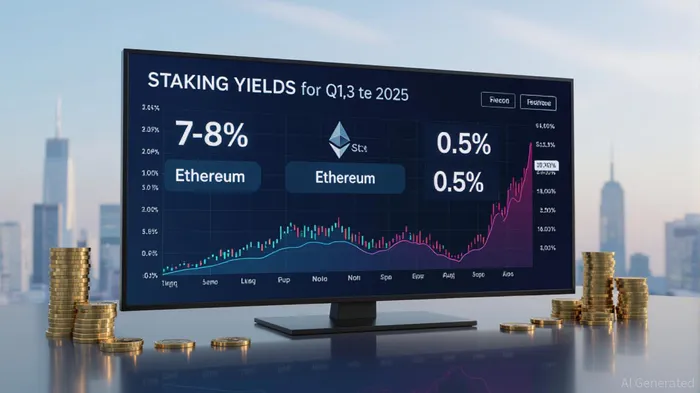
Institutional capital is reshaping the crypto landscape, and SolanaSOL-- (SOL) has emerged as the most compelling beneficiary of this reallocation. With $1.72 billion flowing into Solana treasuries in Q3 2025 alone, the blockchain’s unique combination of high-performance infrastructure and attractive staking yields is redefining corporate treasury strategies [1]. Thirteen publicly traded firms now hold 1.44% of Solana’s total supply, generating annualized income of $12–14 million through 7–8% staking rewards—a stark contrast to Ethereum’s 4.8% yield [1][3]. This shift is not speculative; it is a calculated response to macroeconomic pressures and the need for yield preservation in a low-interest-rate environment.
The Yield Imperative: Staking and ETFs as Catalysts
Solana’s institutional appeal is rooted in its ability to deliver risk-adjusted returns. The REX-Osprey Solana Staking ETF (SSK), approved in July 2025, has already attracted $164 million in inflows, with potential for $3–6 billion if additional ETFs gain regulatory clearance [1][4]. This momentum mirrors the BitcoinBTC-- and EthereumETH-- ETF success stories, but with a critical edge: Solana’s staking yields are nearly double Ethereum’s, making it a more efficient capital allocation vehicle [3].
Corporate treasuries are further amplifying this trend. Sharps Technology’s $50 million Solana purchase at a 15% discount to market price exemplifies strategic asset reallocation [4]. Meanwhile, Pantera Capital’s $1.25 billion plan to convert a public company into a Solana accumulation platform underscores the asset’s institutional legitimacy [3]. These moves are not isolated; they reflect a broader shift toward blockchain-based reserves as companies seek to optimize balance sheets in a post-stablecoin era.
Technical Superiority and Regulatory Tailwinds
Solana’s technical architecture is a key enabler of this institutional adoption. The Alpenglow upgrade, which optimizes network throughput, and the Firedancer validator client, which enhances decentralization, have positioned Solana to process 65,000 transactions per second (TPS) at sub-cent fees [2]. This scalability is critical for institutional-grade applications, from tokenized securities to cross-border payments. Partnerships with Stripe, SpaceX, and BlackRockBLK-- further validate Solana’s utility as a global infrastructure layer [1].
Regulatory clarity is another tailwind. The U.S. SEC’s decision on a spot Solana ETF, expected by October 16, 2025, could unlock billions in capital [2]. Additionally, the proposed GENIUS Act aims to normalize blockchain assets as corporate reserves, reducing legal ambiguity for institutional investors [1]. These developments are creating a flywheel effect: improved infrastructure attracts more institutions, which in turn accelerates regulatory acceptance.
Market Implications: A 15x Multiplier Model
The convergence of these factors suggests a significant price re-rating for Solana. A 15x institutional inflow multiplier model—based on Ethereum’s ETF-driven growth—indicates that a $5 billion inflow could push Solana’s price to $335 by Q4 2025 [1]. This projection is supported by Solana’s TVL growth, which reached $10.26 billion in August 2025, and its expanding use cases in corporate finance [4].
Critically, Solana’s supply dynamics differ from Ethereum’s. With a more decentralized issuance model and lower supply concentration, Solana is better positioned to absorb large institutional inflows without triggering inflationary pressures [3]. This makes it an attractive alternative to Ethereum for institutions prioritizing yield and capital efficiency.
Conclusion: A New Bull Cycle Begins
Solana’s institutional adoption is not a fad—it is a structural shift driven by yield generation, technical innovation, and regulatory progress. As corporate treasuries and ETFs continue to allocate capital to Solana, the blockchain is poised to break the $300 price threshold, unlocking a new bull cycle. For investors, the key takeaway is clear: Solana is no longer a speculative asset but a foundational pillar of institutional capital reallocation.
**Source:[1] Solana's Institutional Revolution: Can Strategic Capital, [https://www.ainvest.com/news/solana-institutional-revolution-strategic-capital-reallocation-etf-momentum-push-sol-300-2508/][2] Institutional Allocations to Solana: A New Era of Corporate, [https://www.ainvest.com/news/institutional-allocations-solana-era-corporate-treasury-dynamics-2508/][3] Institutional Adoption and the Next Phase of Solana's Growth, [https://www.bitget.com/news/detail/12560604939666][4] Solana 2025 Surge: +43% Returns & AI Trading Insights, [https://tickeron.com/trading-investing-101/solana-sol-skyrockets-with-43-annualized-return-in-2025-catalysts-correlations-and-ai-trading/]

Decoding blockchain innovations and market trends with clarity and precision.
Latest Articles
Stay ahead of the market.
Get curated U.S. market news, insights and key dates delivered to your inbox.
AInvest
PRO
AInvest
PRO



Comments
No comments yet