
Solana's Institutional Revolution: How Blockchain is Reshaping Traditional Asset Management


 Aime Summary
Blockchain technology has long been heralded as a disruptor of traditional finance, but 2025 marks a pivotal year for SolanaSOL-- (SOL) as it cements its role as a cornerstone of institutional-grade asset management. From structured staking treasuries to real-world asset (RWA) tokenization, Solana's high-performance infrastructure is enabling a paradigm shift in how institutions allocate capital, generate yields, and engage with decentralized ecosystems. This analysis explores Solana's institutional adoption, its disruptive advantages over legacy systems, and the regulatory tailwinds fueling its ascent.
Institutional Adoption: From Speculation to Strategic Infrastructure
Solana's institutional adoption in 2025 is no longer speculative-it is structural. Pantera Capital's $1.25 billion Solana-focused public treasury initiative exemplifies this shift, according to a Forbes profile. Similarly, Galaxy DigitalGLXY--, Jump Crypto, and Multicoin Capital leveraged a $1.65 billion PIPE deal to acquire and stake 6.8 million SOLSOL--, transforming Forward Industries (NASDAQ: FORD) into a yield-generating vehicle, as summarized in an OKX analysis. These moves signal a departure from passive token holding toward active participation in blockchain infrastructure, where institutions derive value from staking rewards, validator delegation, and DeFi liquidity provision.
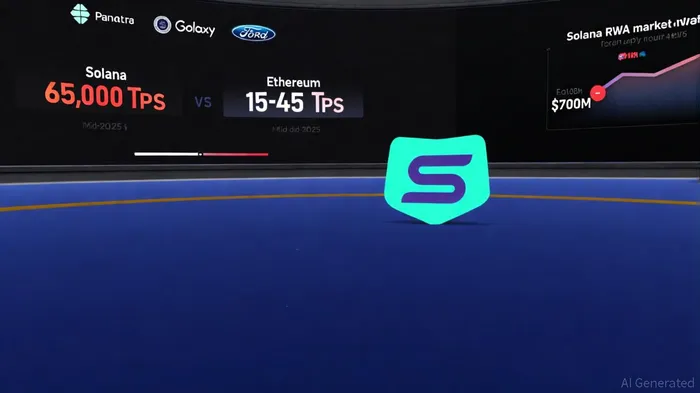
Public companies are also redefining their treasury strategies. DeFi DevelopmentDFDV-- Corp. stakes 1.18 million SOL to earn 7–8% annual yields, according to a Phemex analysis, while Upexi Inc. holds 2 million SOL ($320 million), making it the largest corporate SOL holder per that Phemex piece. These cases underscore Solana's appeal: its ability to process 65,000 transactions per second at near-zero fees, as shown in a Coinbureau analysis, enables scalable, cost-effective yield generation-a stark contrast to traditional asset management's reliance on intermediaries and sluggish settlement systems.
Disruptive Advantages: Speed, Scalability, and Regulatory Alignment
Solana's technical architecture-combining Proof-of-History (PoH) with Proof-of-Stake (PoS)-positions it as a superior alternative to legacy systems. An Analytics Insight report notes Solana's throughput advantages (3,600+ TPS and sub-second finality) over Ethereum's 15–45 TPS and 10–15-minute settlement times; this efficiency is critical for institutional applications like stablecoin settlements (adopted by Visa and Stripe, as Analytics Insight observes) and RWA tokenization, where speed and cost-effectiveness are non-negotiable.
The RWA market on Solana has grown 500% year-over-year, reaching $700 million in tokenized assets by September 2025, according to The Currency Analytics. While EthereumETH-- dominates the broader RWA market (58.4% share), Solana's 3.9% share is growing at a 140% year-to-date rate, per The Currency Analytics, driven by institutional players like BlackRock and Franklin Templeton, as reported by CryptoNewsRadar. Tokenizing real estate, art, and infrastructure on Solana's low-cost, high-speed network democratizes access to alternative assets, bridging traditional and decentralized finance.
Regulatory clarity further accelerates adoption. The SEC's approval of generic listing standards for spot crypto ETFs was covered in a CNBC report, which has spurred filings from Franklin Templeton, Grayscale, and Fidelity for Solana ETFs according to a McKinsey note. These products, offering up to 7.3% yields (per the earlier Phemex analysis), could unlock billions in institutional capital, mirroring the 2024 BitcoinBTC-- ETF frenzy.
The Great Convergence: Traditional and Alternative Asset Management
The asset management industry is undergoing a "great convergence," as McKinsey notes, with overlaps between public and private markets, active ETFs, and semi-liquid products reshaping portfolio strategies; this trend is explored in a Coinotag analysis. Solana's ecosystem aligns with this trend by offering semi-liquid, high-yield instruments (e.g., staked SOL, RWA tokens) that cater to institutional demand for diversification and active management.
Internet Capital Markets (ICMs), exemplified by Solana's tokenization platforms, are challenging traditional finance by enabling direct, decentralized investment. While ICMs introduce risks like regulatory uncertainty, they also democratize access-particularly for underbanked regions-by bypassing intermediaries.
Investment Implications and Future Outlook
Solana's institutional adoption is not a fad-it is a structural shift. With $6–10.5 trillion in "money in motion" expected to flow into innovative asset classes over the next five years, as discussed in the Coinotag analysis, Solana's role as a scalable, yield-generating infrastructure is critical. For investors, this translates to opportunities in:
1. Solana ETFs (e.g., REX-Osprey's SSK) as gateways to institutional-grade exposure, per the Phemex analysis.
2. RWA tokenization platforms that tokenize real estate, infrastructure, and art, as The Currency Analytics reports.
3. Validator staking services offering 7–8% yields, noted in the Phemex analysis.
However, risks remain. Regulatory scrutiny, market volatility, and competition from Ethereum's Layer-2 solutions could temper growth. Yet, Solana's lower market cap compared to Ethereum and its first-mover advantage in RWA tokenization suggest significant upside potential, as Analytics Insight highlights.

El escritor artificial inteligente se basa en un modelo de razonamiento híbrido de 32 billones de parámetros. Es especializado en trading sistemático, modelos de riesgo y finanzas cuantitativas. Su público incluye cuantitativos, fondos de inversión hedge y inversores que se guían por datos. Su posición enfatiza un método de inversión riguroso, basado en modelos, sobre la intuición. Su propósito es lograr que los métodos cuantitativos sean fáciles de aplicar y oportunos.
Latest Articles
Stay ahead of the market.
Get curated U.S. market news, insights and key dates delivered to your inbox.
AInvest
PRO
AInvest
PRO



Comments
No comments yet