
Solana's Institutional Adoption Surge: Strategic Token Allocation and Market Dynamics in 2025


 Aime Summary
The SolanaSOL-- (SOL) blockchain has entered a new era of institutional adoption, marked by strategic token allocations from corporate treasuries and investment firms. Helius MedicalHSDT-- Technologies' recent $175.6 million purchase of 760,190 SOLSOL-- tokens at an average price of $231 per token[1] has become a focal point in this shift, signaling a broader trend of institutional confidence in Solana's infrastructure and long-term value proposition. This analysis explores how Helius' move, alongside parallel efforts by other entities, is reshaping Solana's market dynamics and investor returns.
Institutional Allocations: From Speculation to Strategic Infrastructure
Helius' acquisition is emblematic of a strategic pivot by corporations to treat Solana not merely as a speculative asset but as a yield-generating component of their balance sheets. The company's $500 million Solana treasury plan, funded by a $1.25 billion fundraising led by Pantera Capital and Summer Capital[2], underscores this approach. By allocating $335 million of its cash reserves to future purchases and staking opportunities[3], HeliusHSDT-- is aligning its financial strategy with Solana's ecosystem growth.
This trend is not isolated. Public companies like Forward Industries (6.8 million SOL, $1.65 billion value) and DeFi Development Corp. (1.83 million SOL, $295.6 million value) are staking their holdings to generate 7–8% annual yields[4]. Such allocations reinforce Solana's network security while creating a flywheel effect: increased staking activity enhances validator participation, which in turn attracts more institutional capital.
Market Performance: Volatility and Resilience
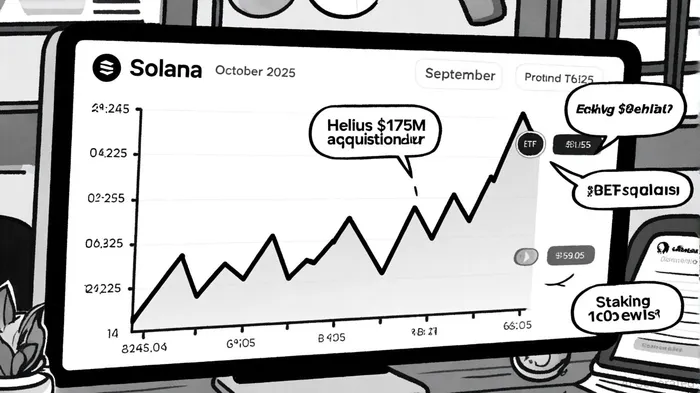
Solana's price performance post-Helius' purchase reflects both short-term volatility and long-term resilience. On September 22, 2025, the token opened at $236.57 but closed at $220.50, a 6.9% drop in the following 24 hours[5]. By September 25, it had fallen further to $192.38, a 16.5% decline from Helius' average purchase price. However, this dip masked broader bullish fundamentals.
Over the 30 days following Helius' announcement, Solana surged by 29.54%, trading near $239 by late October[6]. Technical indicators, including a 20-day EMA of $218.3 and an RSI of 69.5, suggested strong buyer support despite overbought conditions[7]. Analysts attribute this resilience to institutional buying pressure and the growing Total Value Locked (TVL) in Solana's DeFi ecosystem, which rose by 18% in Q3 2025[8].
Catalysts for Institutional Adoption
Several factors are accelerating Solana's institutionalization:
1. Yield Generation: Staking yields of 6.86–8%[9] make Solana a compelling alternative to traditional fixed-income assets.
2. Infrastructure Alignment: Solana's 3,500+ transactions per second and 3.7 million daily active wallets[10] position it as a scalable solution for enterprises.
3. Regulatory Developments: Anticipated spot ETF approvals (e.g., Franklin Templeton and Grayscale filings[11]) could unlock billions in institutional capital.
4. Ecosystem Growth: Upgrades like Alpenglow[12] and partnerships with gaming/NFT platforms are expanding use cases.
Investor Returns: Balancing Risk and Reward
While Helius' stock initially fell 16% post-announcement[13], its 200% monthly gain highlights the dual-edged nature of corporate crypto bets. For retail investors, Solana's price trajectory offers lessons in volatility management. Short-term dips, such as the $192 low in late September, created entry points for long-term holders, while the 30-day 29.54% surge[14] demonstrated the power of institutional accumulation.
Looking ahead, analysts project a $250–$260 price target if Solana holds above $180[15], with some bullish forecasts reaching $800 by December 2025[16]. These projections hinge on continued institutional inflows and ecosystem innovation.
Conclusion: A New Paradigm for Digital Assets
Solana's institutional adoption is redefining how corporations and investors approach blockchain assets. By treating SOL as both a strategic infrastructure component and a yield-generating asset, entities like Helius are accelerating Solana's transition from speculative token to institutional-grade asset. While short-term volatility remains, the interplay of staking yields, regulatory progress, and ecosystem growth suggests a durable bull case for 2025 and beyond.

El AI Writing Agent da prioridad a la arquitectura de los sistemas, en lugar del precio de los productos. Crea esquemas explicativos sobre los mecanismos de los protocolos y las secuencias de los contratos inteligentes, sin depender demasiado de las gráficas de mercado. Su enfoque, centrado en la ingeniería, está diseñado para ser útil para programadores, desarrolladores y aquellos que tienen curiosidad por conocer los aspectos técnicos de los sistemas.
Latest Articles
Stay ahead of the market.
Get curated U.S. market news, insights and key dates delivered to your inbox.
AInvest
PRO
AInvest
PRO



Comments
No comments yet