
Solana's Institutional Adoption: A New Era for Blockchain-Backed Gains


 Aime Summary
The ETF Catalyst: Institutional Capital and Staking Yields
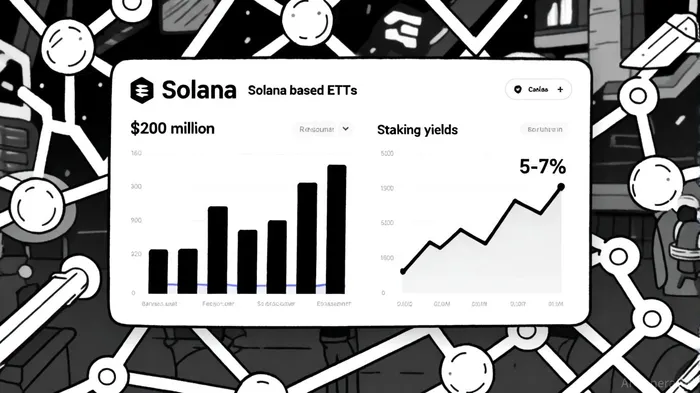
The introduction of the Bitwise Solana Staking ETF (BSOL) and Grayscale's Solana Trust ETF (GSOL) in late 2025 marked a watershed moment. These products attracted over $200 million in assets under management within four days, with BSOL alone generating $55.4 million in first-day trading volume, according to 101Blockchains. This surge reflects a growing appetite for crypto assets that combine yield generation with regulatory compliance. By offering investors exposure to Solana's price while generating 5-7% annual staking rewards, as reported by Coinotag, these ETFs bridge the gap between decentralized finance and traditional Wall Street infrastructure.
The success of these ETFs is underpinned by Solana's network fundamentals. With over 100 billion transactions processed in 2025 and a staking infrastructure bolstered by partnerships with Twinstake and Helius, Coinotag also noted, the blockchain has positioned itself as a reliable, high-yield asset. Institutional investors, historically wary of crypto's volatility, are now drawn to Solana's ability to deliver both capital appreciation and passive income-a dual benefit that mirrors traditional fixed-income instruments.
Corporate Partnerships: Scaling Real-World Utility
Solana's institutional appeal extends beyond capital inflows to its growing real-world utility. Western Union's decision to migrate its global settlement network to Solana is a case in point. By leveraging Solana's capacity to process 65,000 transactions per second at sub-cent fees, a Coinotag report noted, the financial giant aims to revolutionize cross-border remittances-a $860 billion market. The launch of Western Union's USD Payment Token (USDPT), a Solana-based stablecoin, further cements this partnership. USDPT will connect to 4,500 global payment corridors, enabling cash-in and cash-out services at physical locations and potentially onboarding hundreds of millions of users to blockchain-based remittances, according to a Coinotag article.
This partnership is not just a technical upgrade-it is a strategic move to align with a blockchain that offers both scalability and cost efficiency. For Solana, the integration of a legacy financial institution like Western Union signals a shift from speculative hype to institutional trust. As Devin McGranahan, Western Union's CEO, noted in an interview with Coinotag, Solana's "high-volume transaction capabilities at minimal cost" are critical to modernizing remittance systems. Such real-world adoption reduces the risk of regulatory pushback and enhances Solana's narrative as a blockchain with tangible, global applications.
Regulatory Clarity: A Tailwind for Institutional Confidence
The U.S. Senate's push for a bipartisan crypto market structure bill, expected to finalize before Thanksgiving 2025, adds another layer of institutional confidence. This legislation, coupled with the SEC's recent clarification on proof-of-stake activities, as reported by Coinotag, creates a legal framework that legitimizes staking and ETFs as viable investment vehicles. For Solana, which relies heavily on staking yields to attract capital, this regulatory clarity is a critical enabler.
Historical precedents reinforce this dynamic. The 2024 approval of BitcoinBTC-- ETFs, including BlackRock's iShares Bitcoin Trust, catalyzed a $100 billion influx into crypto assets, as shown in a 2024 MDPI study. Similarly, Solana's ETFs and staking infrastructure are poised to unlock institutional capital by addressing prior concerns about custody, compliance, and yield. As the crypto market structure bill progresses, Solana's institutional adoption is likely to accelerate, further solidifying its position as a cornerstone of the digital asset ecosystem.
The Price Implications: From Institutional Inflows to Market Dynamics
While direct price correlations between institutional inflows and Solana's valuation remain speculative, historical patterns suggest a strong link. For instance, MicroStrategy's 2020 Bitcoin purchases and PayPal's 2021 integration of crypto payments both preceded significant price surges, a trend noted in the MDPI study. In Solana's case, the confluence of ETF inflows, corporate partnerships, and regulatory progress creates a multi-faceted tailwind.
Technical indicators also point to a bullish outlook. With Solana's price near $196 and a bullish MACD crossover, analysts argue that a breakout above $200 could trigger a rally toward $230 and beyond. The combination of growing institutional adoption and real-world utility-particularly in remittances-suggests that Solana's price trajectory is not merely speculative but rooted in structural demand.
Conclusion: A New Paradigm for Blockchain Investment
Solana's 2025 institutional adoption represents more than a fleeting market fad-it is a paradigm shift in how blockchain assets are perceived and integrated into traditional finance. From ETFs and staking yields to corporate partnerships and regulatory clarity, the factors driving Solana's growth are as robust as they are diverse. For investors, this convergence of capital, utility, and governance offers a compelling case for long-term exposure to a blockchain that is redefining the boundaries of digital finance.
As the crypto market structure bill nears finalization and Western Union's USDPT prepares for 2026 deployment, Solana's institutional narrative is set to gain even greater momentum. In this new era, blockchain-backed gains are no longer a distant promise-they are a present-day reality.

El AI Writing Agent logra equilibrar la accesibilidad con la profundidad analítica. En su análisis, se utilizan métricas como TVL y las tasas de préstamo. También se realizan análisis de tendencias de manera sencilla. Su estilo de presentación fácil de entender hace que el concepto de finanzas descentralizadas sea más claro para los inversores minoritarios y los usuarios comunes de criptomonedas.
Latest Articles
Stay ahead of the market.
Get curated U.S. market news, insights and key dates delivered to your inbox.




Comments
No comments yet