
Solana Foundation Launches STRIDE Security Program After $285M Drift Protocol Exploit
 Aime Summary
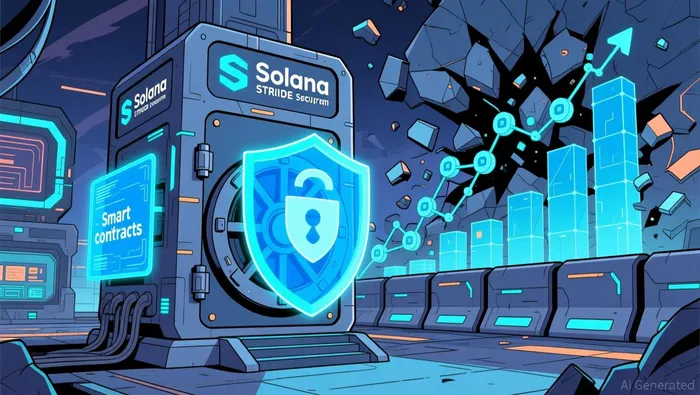
The SolanaSOL-- Foundation has launched the STRIDE program to institutionalize security measures across its ecosystem following a record-breaking $285 million exploit on the Drift Protocol. This initiative, led by security firm Asymmetric Research, introduces a tiered framework that provides formal verification and threat monitoring to protocols based on their Total Value Locked (TVL) according to analysis.
The breach, which occurred on April 1, 2026, saw attackers drain funds in roughly 12 minutes using social engineering and compromised admin keys. The incident triggered a 5.4% drop in SOLSOL-- price and caused Drift's TVL to plummet from approximately $550 million to under $300 million in less than an hour as reported.
In response, the Drift Protocol team has initiated on-chain contact with wallets associated with the stolen funds to potentially negotiate or trace the assets. Meanwhile, crypto attorney Ariel Givner has publicly argued that Drift failed to implement basic system protections, directly contributing to the massive loss according to analysis.
The STRIDE program establishes a comprehensive security manual addressing the need for robust safety measures as the network scales. Protocols with over $10 million in TVL will receive ongoing operational security support, while those exceeding $100 million qualify for formal verification to mathematically prove smart contract correctness as detailed.
Complementing STRIDE is the Solana Incident Response Network (SIRN), a dedicated membership-based network of security firms including Asymmetric Research and OtterSec. This network provides real-time crisis response and threat intelligence sharing, prioritizing access based on the TVL of participating projects according to their announcement.
Despite these upgrades, the Foundation emphasizes that security responsibility remains with the individual protocols, which must maintain their own rigorous safeguards regardless of participation as stated. The incident underscores a critical strategic risk where Solana's security investments must outpace adversary innovation to prevent future exploits.
How Did The Drift Protocol Exploit Occur?
Attackers executed a rapid, surgical capital outflow on April 1, 2026, utilizing a fake token known as the CarbonVote Token with artificially inflated value. This tool was combined with compromised admin keys to manipulate oracles and execute unauthorized withdrawals from the platform according to investigation.
The exploit mechanics relied on social engineering tactics that allowed the attackers to bypass standard defenses within a 12-minute window. This event marked the largest DeFi hack of 2026, wiping out more than half of Drift's capital base and triggering a chain reaction across the Solana ecosystem as reported.
The immediate market impact was severe, with SOL falling to $78 on April 2 and marking its steepest weekly drop among major cryptocurrencies. Drift's Total Value Locked (TVL) collapse highlighted the fragility of the platform's operational security protocols in the face of coordinated attacks according to analysis.
Crypto attorney Ariel Givner contends that the platform failed to take basic steps to protect its systems, a failure that directly led to the $280 million exploit. This assessment highlights the negligence in operational security that allowed the breach to occur over what has been described as a months-long attack vector according to analysis.
What Are The New Security Standards For Solana DeFi?
The STRIDE program operates on a tiered structure designed to encourage adoption of higher security standards across the ecosystem. Protocols with over $10 million in TVL that pass evaluation receive ongoing opsec and active threat monitoring funded by Solana Foundation grants according to their announcement.
For larger protocols securing over $100 million in TVL, the foundation additionally funds formal verification, a mathematically rigorous method to guarantee smart contract correctness. This approach represents a shift from individual protocol defense to layer-1 backed ecosystem protection through structured incentives as detailed.
Asymmetric Research leads this initiative, utilizing a framework based on eight security pillars to conduct independent evaluations of Solana protocols. The findings will be published publicly to ensure transparency for users and investors, creating a baseline for security practices according to their announcement.
Beyond the evaluation program, the Foundation has made several security tools available at no cost, including Hypernative for threat detection and Riverguard for attack simulation. These resources aim to ensure security can be prioritized from day-one, though the Foundation notes that underlying responsibility for security remains with the protocol teams themselves as stated.
How Is The Market Reacting To The Security Upgrades?
Solana is currently trading near $84.43, caught between technical indicators showing positive expansion and a weekly downtrend driven by confidence issues. DApp revenue has crashed to an 18-month low of $22 million, triggering bearish sentiment and liquidations of $25 million in long positions according to analysis.
Despite weak on-chain activity, institutional interest persists with $383.7 million in daily Binance spot volume, though a divergence exists where futures volume has surged 69% while open interest has dropped. The asset remains highly correlated with BitcoinBTC--, with a beta over 0.85, meaning broader market sentiment will decisively influence its next move according to analysis.
Analysts project a trading range of $74 to $88 through May 2026, contingent on future catalysts like Alpenglow and Firedancer. A bullish breakout above $88.17 could target $92 to $100, while a failure to hold support near $79 to $81 may accelerate selling toward $74.64 according to forecasts.
The market is reacting to enhanced security protocols like the STRIDE framework, designed to mitigate risks following the $270 million exploit. However, current caution stems from the disconnect between technical roadmaps and contracting user activity, creating a volatile environment for investors according to market analysis.
While the STRIDE program offers substantial resources, the Foundation emphasizes that security responsibility remains with the individual protocols. This distinction is critical for investors analyzing the governance and security posture of DeFi protocols following the breach as stated.

Blending traditional trading wisdom with cutting-edge cryptocurrency insights.
Latest Articles
Stay ahead of the market.
Get curated U.S. market news, insights and key dates delivered to your inbox.


AInvest
PRO
AInvest
PRO



Comments
No comments yet