
Solana Faces Centralization Criticism as Morgan Stanley Files for ETFs and Mobile Ecosystem Expands
 Aime Summary
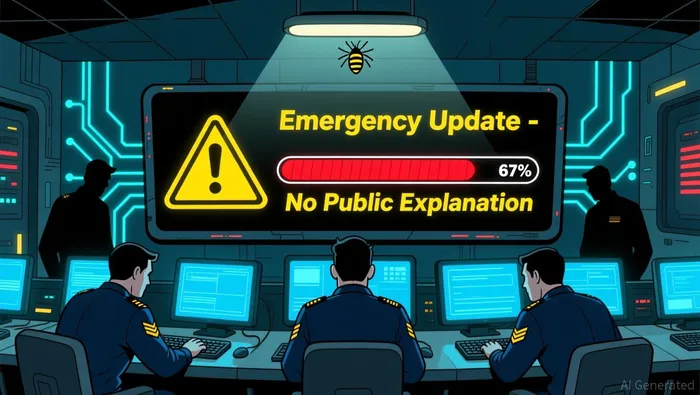
Solana’s recent emergency network update, distributed without public explanation, has drawn criticism for reinforcing centralization concerns and lacks transparency around the root cause of the issue according to reports.
Morgan Stanley has filed with the SEC to launch exchange-traded funds tied to BitcoinBTC-- and SolanaSOL--, signaling a broader strategy to deepen its presence in the digital asset market as Reuters reports.
Solana Mobile’s SKR governance token is set to launch on January 21, 2026, with a key airdrop aimed at decentralizing mobile app store management through token staking according to Yahoo Finance.
Why Is Solana Under Scrutiny for Its Emergency Updates?
Solana’s latest emergency network update has raised questions about governance and transparency, with critics arguing that the rapid deployment of patches without prior explanation mirrors concerns from a similar event in May 2025 according to reports. Competing chain advocates have highlighted that such actions underscore a centralized control dynamic, where a small group of developers or validators can push critical changes without community input. While some defenders have pointed to the need for discretion in handling critical vulnerabilities, the lack of client diversity in the network—particularly with most clients being forks of Anza’s Agave—has further fueled these concerns according to reports.
Why Are Institutional Players Like Morgan StanleyMS-- Entering the Solana Space?
Morgan Stanley’s filing for ETFs linked to Bitcoin and Solana reflects growing institutional confidence in digital assets and their integration into traditional financial products as Reuters reports. This move aligns with broader trends of regulated exposure to cryptocurrencies, which are becoming more accessible to a wider range of investors. The ETFs will offer investors a transparent and liquid option for investing in Solana, reinforcing its position in the institutional market. As of early 2026, Solana’s ecosystem has demonstrated robust growth in decentralized finance (DeFi), stablecoins, and tokenized equities, further attracting institutional capital according to TradingView.
How Does Solana Mobile’s SKR Token Challenge Traditional App Store Models?
Solana Mobile’s SKR token aims to decentralize mobile app store governance by allowing users to stake tokens and elect independent node operators—known as “Guardians”—to vet applications according to Yahoo Finance. This model is designed to challenge dominant app store systems like those of Apple and Google, which charge high fees and exercise significant control over app approvals. The SKR token’s launch includes a 20% airdrop on January 21, 2026, with additional distributions planned to incentivize user participation. The token’s supply will grow at 10% in the first year, decreasing annually to 2%, and newly issued tokens will reward both Guardians and stakers according to Yahoo Finance.
What Are the Key Structural Challenges and Opportunities for Solana’s DEX Ecosystem?
Despite record decentralized exchange (DEX) volume on Solana in 2025, the network has faced liquidity fragmentation and oracle failures during market stress events according to AI Invest. For instance, the USX stablecoin temporarily lost its $1 peg due to liquidity drains on platforms like OrcaORCA-- and RaydiumRAY--. These challenges highlight the need for more resilient infrastructure, including AI-driven liquidity solutions and institutional partnerships. Projects like Yala have already implemented 1:1 redemption plans, while AI-integrated trading platforms like AURA DEX are being tested to improve scalability and execution efficiency according to AI Invest.
What Role Do DeFi Aggregators Play in Solana’s Growing Ecosystem?
DeFi aggregators like JupiterJUP-- and Raydium are central to Solana’s decentralized finance ecosystem. Jupiter Aggregator processes over $1 trillion in volume and dominates 90% of aggregator activity on the network according to AI Invest. Raydium’s hybrid AMM/order book model captures 15.9% market share and processes $51.9 billion in volume. Both platforms are expanding beyond speculative trading through innovations like JupUSD and LaunchLab token issuance, diversifying their revenue streams and deepening their role as infrastructure layers in Solana’s DeFi ecosystem according to AI Invest.
How Has Solana’s Network Performance and App Ecosystem Evolved in 2025?
Solana’s ecosystem saw $2.39 billion in app revenue in 2025, with seven major applications each generating over $100 million and smaller apps collectively contributing more than $500 million according to Yahoo Finance. The network processed 33 billion non-vote transactions and supported 3.2 million daily active wallets. Average transaction fees dropped to $0.017, reinforcing Solana’s position as a low-cost blockchain. Stablecoin supply on Solana closed at $14.8 billion, more than doubling year-on-year, with $11.7 trillion in stablecoin transfers processed during the year. Tokenized equities also debuted with $1 billion in supply and $651 million in volume, while decentralized exchange volume reached $1.5 trillion according to Yahoo Finance.
What’s Next for Solana’s Network Diversity and Governance?
Calls for greater client diversity and decentralized governance have intensified, with the network still far from co-founder Anatoly Yakovenko’s vision of four distinct clients according to reports. While Jump Crypto’s Firedancer is now live on the mainnet, many existing clients are forks of Anza’s Agave and not fully independent. Syndica’s Sig is expected to become the third mainnet client, though its launch timeline remains uncertain. These developments will be critical in addressing centralization concerns and ensuring long-term network resilience according to reports.

Blending traditional trading wisdom with cutting-edge cryptocurrency insights.
Latest Articles
Stay ahead of the market.
Get curated U.S. market news, insights and key dates delivered to your inbox.




Comments
No comments yet