
Solana ETFs Record Zero Primary Flows While Institutional Inflows Persist
 Aime Summary
- US SolanaSOL-- ETFs recorded zero net primary-market flows across all six products for five consecutive sessions ending August 4, indicating a pause in authorized participant activity rather than a lack of investor interest.
- Cumulative net flows reached $1.122 billion through August 4, with $449.3 million attributed to seed capital, demonstrating sustained institutional allocation through regulated channels .
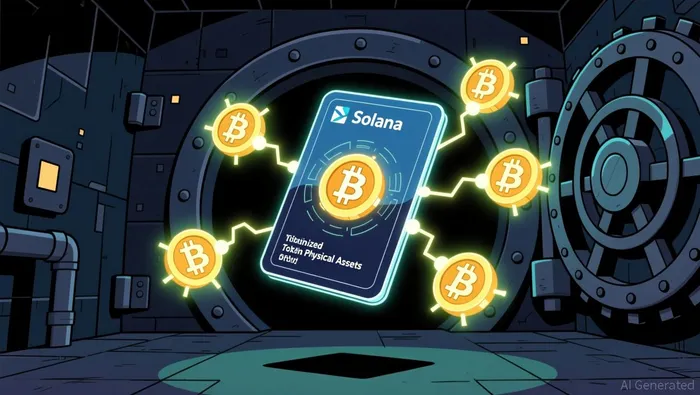
- Solana-based platforms are tokenizing vaulted physical assets to enable instant digital trading, leveraging the network's low transaction costs to facilitate high-frequency micro-transactions.
- Infrastructure providers like Sumex and Hadeswap are expanding Solana's utility by integrating cross-chain swap aggregation and AMM models for NFT liquidity, (Hadeswap integrates AMM model).
The pause in primary-market flow metrics requires subsequent creation data to determine if long-term demand is shifting . For now, the market shows a clear split between retail traders reducing exposure due to price weakness and institutional channels continuing to accumulate regulated Solana products .
Despite Solana's price falling nearly 55% from its January all-time high and trading below key moving averages, ETF inflows have been steady . Total net inflows reached $674 million, with a seven-day streak including a $16.6 million single-day high . This suggests funds and advisors are allocating through regulated products to gain exposure without managing custody or exchange interactions .
This trend aligns with broader patterns of institutions separating broad crypto risk from targeted altcoin exposure . The divergence between zero net-flow entries and assets held illustrates that daily net creations measure different activity than exchange trading volume . Issuer data reflects this: Bitwise reported approximately $596.37 million in net assets for BSOL as of August 2, while 21Shares reported roughly $3.09 million in assets for TSOL with nonzero trading volume .
Institutional capital showed selective allocation in early August, with Bitcoin and Ethereum spot ETFs also recording significant inflows. On August 4, institutional investors directed $211.49 million into BitcoinBTC-- spot ETFs, alongside $53.75 million for EthereumENS-- and $1 million for Solana . This signaling indicates sustained demand for regulated digital asset products despite broader market uncertainty .
Previous sessions highlighted divergent sentiment across major digital assets. On July 29, Solana spot ETFs posted $19.06 million in net inflows, while Ethereum spot ETFs experienced $18.65 million in net outflows . This mixed flow data suggests that professional investors are increasingly selective in their short-term positioning .
How Is Solana Being Used To Tokenize Physical Assets?
Solana-based platforms are transforming the physical collectibles market by tokenizing vaulted items, allowing for instant digital trading while the physical asset remains in secure custody . This model now spans cards, wine, spirits, and watches, with Collector Crypt alone reporting over 130,000 tokenized cards and $1.6 billion in total volume .
The traditional physical collectibles market is operationally complex, involving authentication, insurance, shipping, and dispute management for every transaction . For high-value items like PSA 10 graded cards, these friction points can deter liquidity . Solana-based platforms mitigate this by creating onchain claims on vaulted assets .
Collector Crypt allows users to open randomized packs, trade assets, or redeem physical cards, while Phygitals offers one-to-one backing of graded cards held in professional vault custody . Key drivers for this adoption include Solana’s technical infrastructure, with transaction costs at a fraction of a cent and fast confirmation times .
This cost efficiency allows applications to support lower-priced cards and repeated actions within a single session, which would be prohibitive on higher-fee networks . Solana currently accounts for approximately 75% of onchain trading card game volume .
The ecosystem has expanded beyond simple tokenization to include integrated consumer products . Solflare Packs, integrated with Solana wallets, allows users to purchase and reveal cards without leaving the wallet interface . Other platforms like Jupiter Gacha and Rarible’s Gacha Station utilize Collector Crypt inventory to offer authenticated physical cards through digital pack mechanics .
What New Infrastructure Is Supporting Solana Liquidity?
Sumex, a non-custodial crypto SuperApp, has integrated The Change into its cross-chain swap infrastructure . This partnership aims to strengthen Sumex's aggregation engine, which currently supports over 3,000 digital assets across EVM-compatible networks, Solana, Tron, Stellar, Sui, and TON .
By aggregating liquidity from more than 20 routing providers, Sumex offers broader asset coverage and execution routes . The integration allows users to access competitive rates while viewing estimated network fees and completion times before transactions .
Sumex’s strategy focuses on unifying CeFi and DeFi portfolio management under one interface, reducing complexity for users who previously had to compare prices across fragmented services . The platform also supports private swaps and is planning additional privacy-focused capabilities .
Hadeswap is a decentralized NFT trading platform on the Solana blockchain that integrates NFT trading with DeFi liquidity pools . Unlike traditional platforms relying on standard listings, Hadeswap uses an AMM model, allowing users to instantly buy, sell, and swap NFTs .
This mechanism addresses liquidity issues common in the NFT sector by enabling users to sell floor NFTs directly into pools without waiting for buyers . The platform charges no platform fees during its initial launch and offers optional royalties .
Powered by Solana’s technology, it provides efficient trades with low gas costs . The ecosystem is driven by the HADES utility token, which supports governance, staking, and liquidity rewards .
Grayscale Investments announced rebalancing for its multi-asset funds for the second quarter of 2026. The Smart Contract (GSC) Fund sold existing components to purchase BNB, which now holds a 30.6% weight alongside EtherETH-- and Solana . This reallocation aligns with index methodologies and reflects shifting institutional preferences .

Blending traditional trading wisdom with cutting-edge cryptocurrency insights.
Latest Articles
Stay ahead of the market.
Get curated U.S. market news, insights and key dates delivered to your inbox.


AInvest
PRO
AInvest
PRO




Comments
No comments yet