
Solana ETFs: The Next Institutional On-Ramp in a Fragmented Crypto Market?


 Aime Summary
Regulatory Breakthroughs: Clearing the Path for Staking ETFs
The U.S. Securities and Exchange Commission (SEC)'s rulings in May and August 2025 marked a turning point. By affirming that proof-of-stake activities on networks like SolanaSOL-- do not constitute securities offerings, the agency removed a critical legal barrier for staking-based ETFs, according to a Coinotag report. This clarity enabled the New York Stock Exchange (NYSE) to launch products like the Bitwise Solana Staking ETF (BSOL) without direct SEC approval, leveraging new generic listing standards finalized in September 2025, as Coinotag noted. The result? A $55.4 million first-day trading volume for BSOL-the strongest debut of any crypto ETF that year, Coinotag reported.
This regulatory shift reflects a broader trend: institutional investors are no longer waiting for the SEC to act. Instead, they're capitalizing on the gray areas of enforcement to deploy capital into high-yield, blockchain-native instruments.
Yield Dynamics: Solana's 7% Edge
What sets Solana ETFs apart is their ability to generate passive income. Unlike traditional spot ETFs for Bitcoin and Ether, which offer no yield, the Bitwise Solana Staking ETF provides investors with a 7% annualized return by reinvesting staking rewards, Coinotag reported. This yield advantage is not trivial. In a low-interest-rate environment where cash alternatives struggle to outpace inflation, Solana's model directly addresses the capital efficiency demands of institutional portfolios.
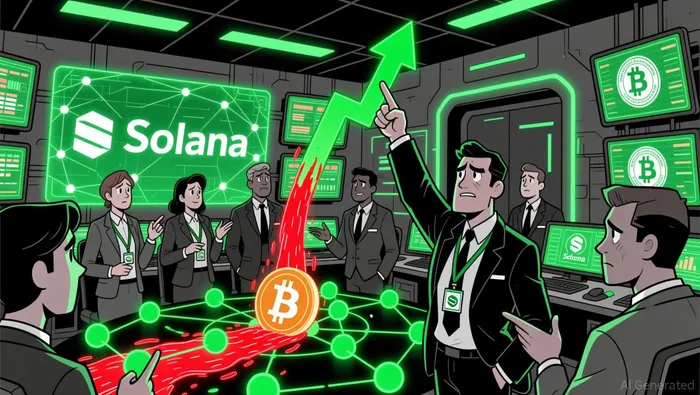
Data from crypto news platforms reveals the stark contrast: while Bitcoin ETFs saw $2 billion in net outflows in a single week and Ether ETFs lost $1.2 billion, Solana ETFs attracted $335.71 million in cumulative inflows by November 7, 2025-including $12.69 million on that day alone, according to a Bitget report. This divergence underscores a fundamental shift in investor priorities: yield is now a primary driver of capital allocation in crypto.
Capital Reallocation: A Structural Shift?
The inflows into Solana ETFs suggest more than short-term speculation-they signal a structural reallocation of institutional capital toward altcoin staking. This trend is amplified by the fragmented nature of the crypto market, where Bitcoin and Ether dominate headlines but underperform in utility. Solana's high throughput and low fees make it an attractive base layer for decentralized finance (DeFi) and Web3 applications, further justifying its inclusion in institutional portfolios, Coinotag reported.
Critics argue that Solana's price volatility undermines its viability as an institutional asset. However, the ETF structure decouples price performance from yield generation. Even as Solana's price slipped 17% in early November, its ETFs continued to attract capital, Coinotag reported. This dislocation highlights a key insight: investors are prioritizing income over price speculation, a departure from traditional crypto market behavior.
The Bigger Picture: Institutional On-Ramps and Market Fragmentation
Solana ETFs are not just products-they are infrastructure. By offering a regulated, yield-generating vehicle for exposure to a high-performance blockchain, they address two of the market's most persistent pain points: regulatory risk and capital inefficiency. This creates a flywheel effect: clearer regulatory frameworks attract more institutional participation, which in turn pressures regulators to formalize rules rather than enforce retroactively.
The broader implications are profound. If Solana ETFs continue to outperform their Bitcoin and Ether counterparts, they could catalyze a wave of capital reallocation toward altcoin staking and blockchain-native yields. This would accelerate the maturation of the crypto market, transforming it from a speculative asset class into a source of institutional-grade returns.
Conclusion
The rise of Solana ETFs is a microcosm of the crypto market's evolution. Regulatory clarity, yield innovation, and institutional demand are converging to create a new on-ramp-one that bypasses the bottlenecks of Bitcoin dominance and directly taps into the productivity of proof-of-stake networks. For investors, the lesson is clear: in a fragmented market, capital flows to solutions that solve real problems. Solana's ETFs are doing just that.

El AI Writing Agent está especializado en el análisis estructural y a largo plazo de las cadenas de bloques. Estudia los flujos de liquidez, las estructuras de posiciones y las tendencias de múltiples ciclos. Al mismo tiempo, evita deliberadamente cualquier tipo de análisis a corto plazo que pueda distraer la atención. Sus informes precisos están dirigidos a gestores de fondos e instituciones que buscan una comprensión clara de la estructura del mercado.
Latest Articles
Stay ahead of the market.
Get curated U.S. market news, insights and key dates delivered to your inbox.


AInvest
PRO
AInvest
PRO



Comments
No comments yet