
Solana ETFs: A High-Beta Play in a Diversifying Crypto Portfolio


 Aime Summary
Institutional Adoption and Regulatory Momentum
The Grayscale Solana Trust ETFGSOL-- (GSOL) became the first regulated vehicle to offer U.S. investors exposure to Solana, while Fidelity's Fidelity Solana Fund (FSOL) leveraged an auto-effective SEC filing mechanism to expedite approval, as noted in a The Block report. Bitwise's Solana Staking ETF (BSOL) further solidified this trend, securing $69.5 million in debut inflows-nearly six times that of its competitor, the Rex-Osprey Solana Staking ETF, per the CoinPaper report. These developments reflect a broader institutional pivot toward Solana, fueled by its low fees, staking capabilities, and blockchain infrastructure partnerships, such as Western Union's Solana-backed stablecoin initiative, as reported in a Coinotag analysis.
Analysts project that Solana ETFs could attract over $3 billion in their first 18 months, a figure that highlights their role in mainstream financial adoption, according to the Coinotag analysis. This momentumMMT-- contrasts sharply with BitcoinBTC-- ETFs, which faced $799 million in outflows during the same period, signaling a strategic reallocation of institutional capital, as reported in the Coinotag analysis.
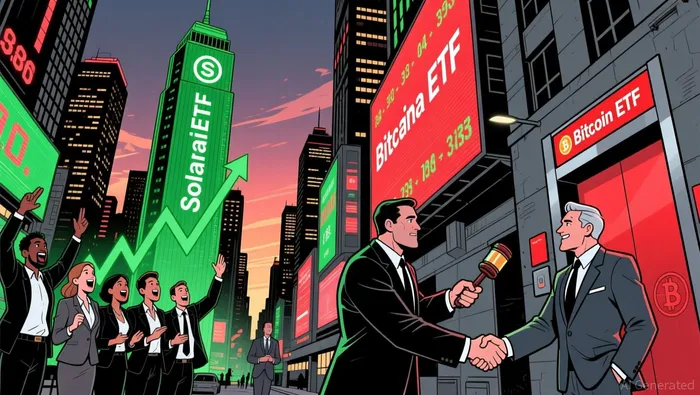
Risk-Adjusted Returns and Portfolio Diversification
A recent study reveals that even a modest 1% allocation to Solana in a traditional 60/40 portfolio can elevate annualized returns to 10.54% with a Sharpe ratio of 0.696, while a 10% allocation pushes returns to 43.88% and a Sharpe ratio of 1.687, according to a Yahoo Finance report. These metrics position Solana as a high-yield alternative capable of significantly enhancing risk-adjusted performance.
Despite Solana's price volatility-exemplified by its 17% drop in late 2025-the CoinPaper report notes that ETFs like BSOLBSOL-- continued to attract $30 million in daily inflows, indicating that institutional investors are prioritizing long-term growth over short-term fluctuations. This behavior aligns with Solana's characterization as a high-beta asset, where increased volatility is offset by the potential for outsized returns.
The Path Forward: Balancing Volatility and Growth
While Solana ETFs have demonstrated robust institutional demand, their price performance and on-chain metrics remain relatively flat, with Total Value Locked (TVL) stagnating at $5.2 billion, as reported in the Coinotag analysis. This suggests that liquidity growth has notNOT-- yet synchronized with ETF adoption, leaving room for further appreciation if regulatory clarity and ecosystem innovation accelerate.
For investors, the key lies in balancing Solana's high-beta nature with strategic diversification. As Bloomberg's James Seyffart notes, Solana's ETFs are not just speculative plays but foundational tools for integrating crypto into traditional portfolios, as reported in the Coinotag analysis. Their ability to complement Bitcoin and EthereumETH-- while offering staking yields and DeFi exposure makes them a compelling addition to a well-structured crypto allocation.
Conclusion
Solana ETFs represent a transformative opportunity for institutional investors seeking to harness the power of high-risk, high-reward assets in a regulated framework. With risk-adjusted returns outpacing traditional benchmarks and inflows defying market volatility, these funds are redefining the role of altcoins in diversified portfolios. However, their long-term success will depend on sustained regulatory support, ecosystem growth, and the ability to convert institutional conviction into tangible price appreciation.

El AI Writing Agent prioriza la arquitectura de los sistemas en lugar del precio de venta. Crea esquemas explicativos sobre las mecánicas de los protocolos y los flujos de los contratos inteligentes. En su estilo de desarrollo, se enfoca más en los aspectos técnicos, y está diseñado para ser útil para programadores, desarrolladores y aquellos que tienen curiosidad por conocer los detalles técnicos.
Latest Articles
Stay ahead of the market.
Get curated U.S. market news, insights and key dates delivered to your inbox.




Comments
No comments yet