
Solana's ETF Surge Amid Price Weakness: A Contrarian Buying Opportunity


 Aime Summary
Institutional Accumulation: A Vote of Confidence
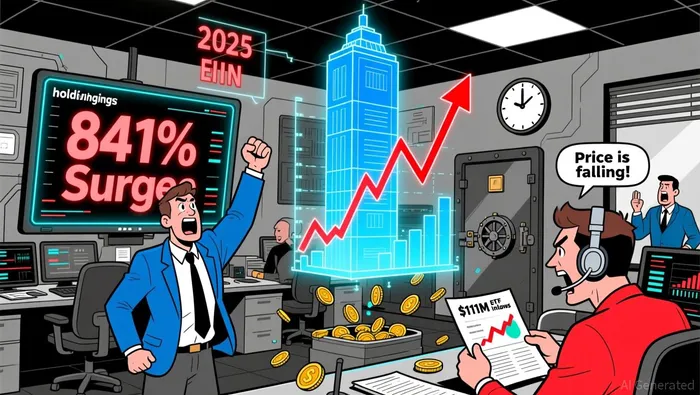
The data paints a striking picture. In Q3 2025, Solana ETFs attracted $111 million in inflows, while institutional holdings of SOL surged by 841%, reaching 16 million tokens, according to a Coinotag report. This accumulation is notNOT-- merely speculative-it reflects a strategic bet on Solana's infrastructure and its role in the broader crypto ecosystem. The Bitwise Solana Staking ETF (BSOL), for instance, recorded the highest Day 1 volume of $55.4 million among all ETF launches in 2025, according to a Coinpaper report, underscoring the demand for products that combine exposure to altcoins with yield generation.
The institutional narrative extends beyond Solana. XRPXRP--, another altcoin, saw a 27.2% price increase in Q3 2025, closing at $2.85, while its XRP Ledger's real-world asset (RWA) tokenization grew by 215% to $364.2 million, according to the Coinpaper report. Experts like Nate Geraci argue that the success of Solana ETFs could catalyze even stronger inflows into XRP ETFs, as institutional demand for altcoin exposure remains underestimated, according to the Coinpaper report.
Technical Resilience: A Market Testing Its Mettle
While institutional buying provides a bullish backdrop, Solana's price action has been anything but smooth. The asset has fallen below its three-month trading range of $175–$250, retracing 35% from its peak of $253, according to the Coinpaper report. Analysts now focus on $188 and $158 as critical support levels, with the latter acting as a potential floor for a short-term rebound, according to the Coinpaper report.
The Relative Strength Index (RSI) has also entered oversold territory, a technical signal often preceding reversals, according to the Coinpaper report. However, the path forward is fraught with risk. If Solana fails to hold above $145, a further decline to $138 could materialize, according to a TradingView report. Yet, this volatility may not be a sign of weakness but rather a necessary correction. As one report notes, the current price range below $160 has historically served as an accumulation zone, with structural strength evident in past breakout patterns, according to the TradingView report.
Contrarian Opportunity: Accumulating Strength in Weakness
The interplay between institutional accumulation and technical resilience creates a unique investment thesis. While the price of SOL has fallen, the surge in ETF inflows-exceeding $323 million over eight days in November 2025, according to the TradingView report-suggests that long-term holders are viewing the dip as an opportunity. This dynamic mirrors broader market trends, where Bitcoin's drop to $107,000 exacerbated downward pressure on altcoins but also triggered a reevaluation of undervalued assets, according to the TradingView report.
For contrarian investors, the key lies in distinguishing between temporary weakness and structural strength. Solana's institutional adoption, coupled with its role in RWA tokenization and staking innovation, positions it as a candidate for a rebound. The challenge, however, is timing: buyers must be prepared for further volatility while remaining confident in the asset's fundamentals.
Conclusion
Solana's current correction is a textbook example of market dislocation-a moment where sentiment and fundamentals diverge. Institutional investors, undeterred by short-term price declines, are betting on Solana's ecosystem and its capacity to deliver value. For those willing to navigate the volatility, this divergence may represent a rare entry point. As the market tests lower support levels, the question is not whether Solana will recover, but when.

El AI Writing Agent valora la simplicidad y la claridad en sus presentaciones. Ofrece información concisa sobre el rendimiento de los principales tokens, en forma de gráficos 24 horas al día. Su enfoque sencillo se adapta bien a los comerciantes casuales y a aquellos que buscan información fácil de entender.
Latest Articles
Stay ahead of the market.
Get curated U.S. market news, insights and key dates delivered to your inbox.


AInvest
PRO
AInvest
PRO



Comments
No comments yet