
Solana's ETF Prospects: Navigating Institutional Skepticism in a Maturing Market


 Aime Summary
The SolanaSOL-- (SOL) ecosystem has long been a darling of the altcoin crowd, but 2025 marks a pivotal moment as institutional investors and regulators turn their attention to its potential. With a spot ETF likely to receive SEC approval in October, a JPMorgan report projects modest inflows, and the market is now grappling with a critical question: Will Solana's ETF attract meaningful inflows, or will it falter under the weight of institutional skepticism and structural challenges?
JPMorgan's Cautious Outlook: A Reality Check
JPMorgan's recent analysis paints a sobering picture for Solana's ETF prospects. The bank estimates that the product will attract only $1.5 billion in inflows during its first year, a fraction of the $20+ billion projected for EthereumETH-- ETFs. This disparity stems from several factors. First, JPMorganJPM-- notes that Solana's on-chain activity has shown signs of fatigue, with transaction volumes plateauing amid a surge in memecoinMEME-- trading and speculative behavior. Second, the rise of diversified crypto index funds-such as the S&P Dow Jones Indices Digital Markets 50-poses a direct threat to Solana's standalone ETF, as investors may prefer broader exposure over single-asset bets.
The market has already priced in much of this skepticism. Following JPMorgan's report, SOLSOL-- dropped 5%, and the Grayscale Solana Trust (GSOL) saw its premium collapse from over 750% to near zero. These movements suggest that retail optimism may have already been baked into the asset, leaving little room for surprise-driven rallies.
Broader Adoption Trends: A Silver Lining for Solana
Despite these headwinds, Solana's fundamentals are undeniably strong. The network's 2025 roadmap includes transformative upgrades like Firedancer, a new validator client that slashes transaction finality times to 150 microseconds, according to a Walbi report, and Alpenglow, which aims to double block space and throughput, according to a CryptoRank report. These improvements position Solana as a viable infrastructure layer for traditional finance, with institutions increasingly exploring its use cases in high-frequency trading and asset settlement.
Regulatory clarity has also played a role in Solana's ascent. The U.S. GENIUS Act and the EU's MiCA framework have created a more hospitable environment for institutional adoption, enabling banks to offer crypto custody and tokenized asset services, according to a DigiCash analysis. Meanwhile, major asset managers like Bitwise have launched regulated products-such as the Solana ETP-further bridging the gap between crypto and traditional markets.
Market Structure Challenges: Competition and Investor Fatigue
The broader crypto market's maturation has introduced new structural challenges for Solana. While BitcoinBTC-- and Ethereum ETFs have become cornerstones of institutional portfolios, altcoins face an uphill battle. JPMorgan notes that repeated product launches-such as the flurry of memecoin ETF proposals-have eroded investor confidence. This "launch fatigue" could limit Solana's ability to capture attention, especially as diversified index funds gain traction.
Moreover, the success of Bitcoin ETFs has shifted institutional focus toward strategic, low-volatility allocations. With nearly half of institutional asset managers considering Ethereum exposure, Solana's niche positioning as a "speed-first" blockchain may struggle to justify its risk premium.
Institutional Confidence and Infrastructure: A Path Forward
Despite these challenges, Solana's ecosystem is not without solutions. Advanced custody solutions and the tokenization of real-world assets are addressing security and accessibility concerns. Additionally, the projected $5–8 billion in inflows for altcoin ETFs by mid-2025 suggests that institutions are willing to diversify beyond Bitcoin and Ethereum, provided the risk-reward profile aligns.
However, regulatory fragmentation and market volatility remain hurdles. Institutions must navigate a patchwork of compliance frameworks and adopt robust risk management strategies to mitigate exposure. For Solana, this means demonstrating not just technical superiority but also a clear use case for institutional-grade applications.
Conclusion: A Tenuous but Plausible Path
Solana's ETF approval in October 2025 is a technical inevitability, but its commercial success hinges on overcoming institutional skepticism and structural competition. While JPMorgan's $1.5 billion forecast may seem modest, it reflects a realistic assessment of market dynamics in a post-Ethereum ETF world. For Solana to thrive, the network must leverage its 2025 upgrades to cement its role in traditional finance and differentiate itself from both memecoins and index funds.
As the crypto market continues to evolve, Solana's ETF will serve as a litmus test for altcoin adoption. Whether it becomes a niche play or a mainstream asset will depend on how well the ecosystem addresses these challenges-and how quickly institutions recognize its potential. 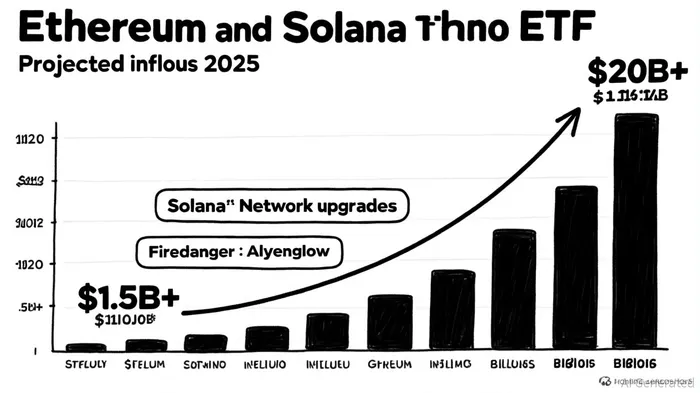

El escritor inteligente que mezcla la conciencia macroeconómica con el análisis de gráficos selectivo. Destaca las tendencias de precios, el valor de mercado de Bitcoin y las comparaciones de inflación, al tiempo que evita depender demasiado de indicadores técnicos. Su voz equilibrada sirve a los lectores que buscan interpretaciones motivadas por el contexto de los flujos de capital global.
Latest Articles
Stay ahead of the market.
Get curated U.S. market news, insights and key dates delivered to your inbox.




Comments
No comments yet