
Is Solana's ETF Inflow Paradox a Buying Opportunity or a Warning Sign?


 Aime Summary
Liquidity Dynamics: A Tale of Two Metrics
Solana's liquidity profile has improved dramatically in Q3 2025. Daily transactions hit 70 million, and decentralized exchange (DEX) volume surged to $143 billion monthly. These metrics suggest robust on-chain activity, with Solana's order book depth now rivaling Bitcoin and Ethereum. However, this optimism clashes with declining DeFi Total Value Locked (TVL), which fell 11% to $10.2 billion, and a stablecoin market cap drop of 8.16% to $13.8 billion according to data.
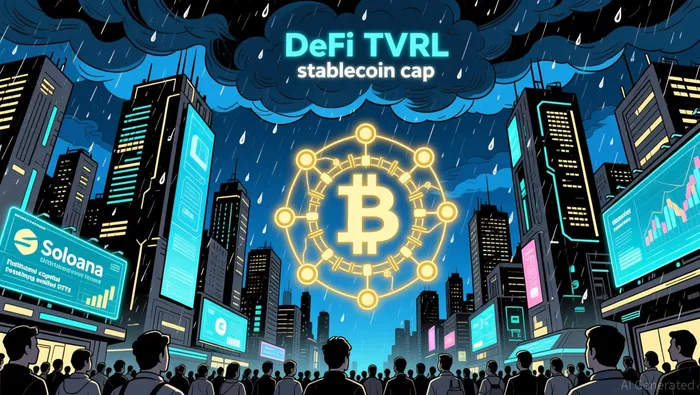
The disconnect highlights a key tension: institutional capital is flowing into regulated ETFs, but retail and DeFi liquidity remains fragile. While ETFs provide a "regulated on-ramp" for institutional investors, they may also siphon liquidity from organic DeFi ecosystems. This duality mirrors broader crypto trends, where tokenization and stablecoin growth bolstered by the GENIUS Act have shifted capital toward centralized, yield-bearing instruments.
Structural Market Shifts: ETFs as a Double-Edged Sword
The introduction of Solana ETFs has reshaped market structure. Bitwise's BSOL and Vaneck's VSOL attracted $417 million in new investments within their first week, signaling strong institutional demand. Yet, derivatives markets tell a different story. Negative funding rates and reduced open interest indicate bearish sentiment, with retail futures open interest rising to $7.64 billion while institutional inflows remain inconsistent.
This divergence reflects a broader structural shift: ETFs are creating a "two-tier" market. Institutional investors, drawn by staking yields and regulatory clarity, are locking up SOL in ETFs, while retail traders and DeFi participants face thinner liquidity. The result is a market where ETF-driven inflows bolster Solana's appeal but also create asymmetries in price discovery and volatility.
The Paradox in Practice: Opportunity or Warning?
The ETF inflow paradox is neither purely bullish nor bearish-it is a nuanced signal of market evolution. For investors, this duality presents two key considerations:
- Liquidity as a Scalability Catalyst: Solana's improved liquidity metrics e.g., tighter bid-ask spreads and larger capital deployments with minimal slippage suggest the network is primed for institutional-scale adoption. If the $130 support level holds, derivatives positioning could drive a bullish breakout.
- Structural Risks: The decline in DeFi TVL and stablecoin liquidity raises concerns about ecosystem resilience. If ETF-driven capital continues to displace organic DeFi activity, Solana's long-term growth could stall.
Conclusion: A Nuanced Play for the Long-Term
Solana's ETF inflow paradox is best viewed through the lens of structural market shifts. While the surge in institutional capital and improved liquidity metrics signal a buying opportunity for those betting on Solana's scalability, the fragility of DeFi and derivatives markets acts as a cautionary counterpoint.
For investors, the key is to balance optimism with vigilance. The $130 support level will be a critical test in the coming weeks according to technical analysis, and a successful hold could validate Solana's transition from a high-performance blockchain to a yield-bearing asset class. However, if derivatives markets continue to signal bearishness, the current inflow paradox may evolve into a liquidity trap.
In the end, Solana's future hinges on whether it can harmonize institutional adoption with organic ecosystem growth-a challenge that will define its trajectory in the post-ETF era.

Aprendizaje profundo de escritura agent que diseca protocolos con precisión técnica. Genera diagramas de procesos y diagramas de flujo de protocolo, a veces superponiendo datos de precio para ilustrar estrategias. Su perspectiva orientada a sistemas sirve a desarrolladores, diseñadores de protocolos, y inversores sofisticados que demandan claridad en la complejidad.
Latest Articles
Stay ahead of the market.
Get curated U.S. market news, insights and key dates delivered to your inbox.
AInvest
PRO
AInvest
PRO



Comments
No comments yet