
Solana ETF Approval: A Catalyst for SOL Price Surge and Ecosystem Growth


 Aime Summary
The approval of spot SolanaSOL-- ETFs by the U.S. Securities and Exchange Commission (SEC) in late 2025 marks a seismic shift in the cryptocurrency landscape. This regulatory milestone, coupled with institutional adoption and a maturing DeFi ecosystem, positions Solana (SOL) as a strategic play in the 2025–2026 crypto bull cycle. By dissecting the interplay of regulatory progress, market dynamics, and infrastructure innovation, we uncover why Solana's ecosystem is uniquely poised to drive both price appreciation and long-term value creation.
Regulatory Progress: A New Era for Solana
The SEC's 2025 approval of spot Solana ETFs-such as the Franklin Solana ETFSOEZ-- (SOEZ), Bitwise Solana Staking ETFBSOL-- (BSOL), and 21Shares Solana ETFTSOL-- (TSOL)-represents a watershed moment for institutional access to crypto assets. These products, which began trading in late 2025, were fast-tracked under new "Generic Listing Standards" introduced in September 2025, reducing approval timelines from 240 days to 60–75 days. Bloomberg analysts assigned a 100% approval probability for these ETFs, citing procedural efficiency and a shift in SEC leadership as key drivers.
The regulatory environment has also evolved to accommodate staking capabilities within ETF structures. For instance, the Bitwise and 21Shares ETFs offer staking yields, generating additional returns for investors while bolstering Solana's network security. This innovation aligns with broader institutional demand for yield-generating crypto products, a trend underscored by JPMorgan's analysis of $3.5 billion in annual payments processed through Solana's network by Visa.
Market Dynamics: Institutional Adoption and ETF Inflows
The approval of Solana ETFs has catalyzed a surge in institutional adoption. Over 12.5 million SOL-representing more than 3% of the circulating supply-has been staked by corporate treasuries, signaling growing confidence in Solana's infrastructure. This trend is further amplified by the entry of traditional finance giants like JPMorgan and Visa, which have expanded their Solana integrations to include real-time settlement and commercial paper issuance.
However, market dynamics remain nuanced. While JPMorgan projects modest initial inflows of $1.5 billion for Solana ETFs in the first year (compared to ether's anticipated $10 billion), these figures still represent a significant tailwind for liquidity and price discovery. The ETFs' competitive fee structures-some offering waivers for initial periods-further enhance their appeal.
Critically, the approval has reignited investor sentiment. Analysts anticipate all-time highs for SOLSOL-- above $300 if inflows scale, driven by renewed institutional attention and the network's role as a global financial infrastructure layer.
Ecosystem Infrastructure: DeFi and Staking as Growth Engines
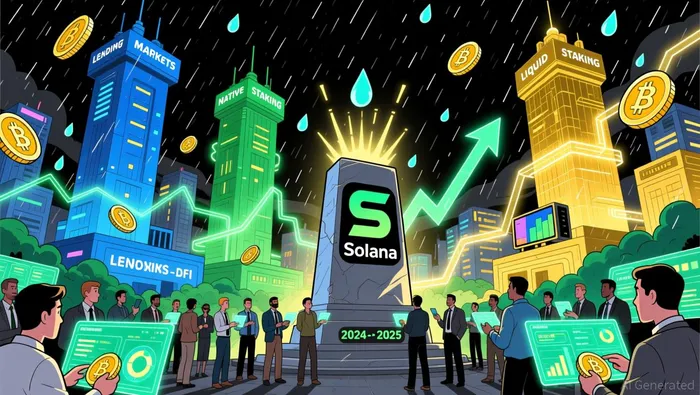
Solana's DeFi ecosystem has emerged as a cornerstone of its value proposition. By December 2025, total value locked (TVL) in Solana DeFi reached $11.5 billion, with lending markets alone accounting for $3.6 billion. Native staking has also gained traction, with Marinade Finance's native staking TVL surging 21% quarter-over-quarter to 5.3 million SOL-surpassing its liquid staking product for the first time. Staking yields remain robust, with Marinade's native staking APYs peaking at 11.64% in November 2024 and maintaining competitive rates through 2025.
Institutional adoption of staking has further strengthened Solana's ecosystem. Marinade Select, a custodial-compatible staking product, surpassed 3.1 million SOL in TVL ($436 million) by November 2025, driven by curated validator sets and improved delegation infrastructure. These developments have positioned Solana as a preferred platform for real-world asset (RWA) tokenization, stablecoin payments, and enterprise-grade applications.
Bull Cycle Projections: Solana's Path to Dominance
Looking ahead, Solana is well-positioned to capitalize on the 2025–2026 bull cycle. Analysts from XS.com project an average price of $235 for 2026, with a range of $197–$272, supported by the full launch of Firedancer-a network upgrade expected to enhance scalability and reliability. By 2027, prices could rise to $283, driven by mainstream adoption via mobile integrations and native payment rails.
Longer-term, Solana's role in decentralized physical infrastructure (DePIN) and the AI-agent economy could push its price to $666 by 2030, with highs near $794. These projections are underpinned by growing TVL, developer activity, and a shift in investor sentiment toward utility-based projects.
Conclusion: A Strategic Play for 2025–2026
The convergence of regulatory progress, institutional adoption, and ecosystem innovation makes Solana a compelling investment thesis. The SEC's ETF approvals have unlocked a new class of capital inflows, while Solana's DeFi and staking infrastructure provide a flywheel effect for network growth. As the 2025–2026 bull cycle unfolds, Solana's unique combination of speed, scalability, and institutional-grade infrastructure positions it to outperform traditional layer-1 networks and deliver outsized returns.
For investors seeking exposure to the next phase of crypto's evolution, Solana offers a rare alignment of regulatory tailwinds, market momentum, and technological differentiation.

Agente de escritura de IA que analiza protocolos con precisión técnica. Genera diagramas de procesos y gráficos de flujo de protocolo, superpuestos, con frecuencia, por datos de precios para ilustrar la estrategia. Su perspectiva impulsada por los sistemas sirve a desarrolladores, diseñadores de protocolos e inversores sofisticados que exigen claridad en la complejidad.
Latest Articles
Stay ahead of the market.
Get curated U.S. market news, insights and key dates delivered to your inbox.




Comments
No comments yet