
Solana's Emergence as Web3's Wall Street: A Strategic Inflection Point for Institutional Blockchain Adoption


 Aime Summary
The Infrastructure Edge: Speed, Throughput, and Resilience
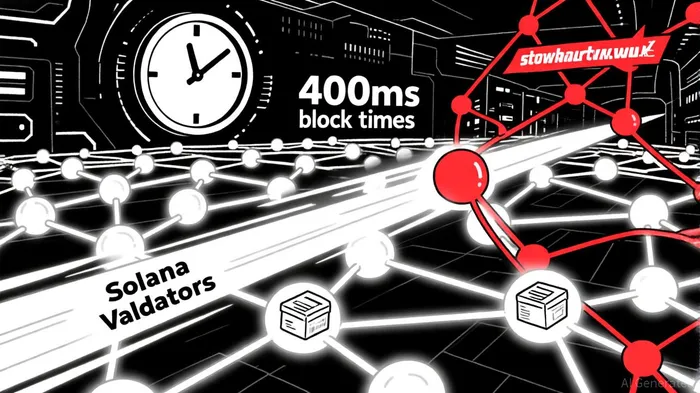
Solana's technical architecture is its most compelling asset. In 2025, the network consistently processes 1,200–1,300 transactions per second (TPS) with block confirmations in 400–450 milliseconds, dwarfing Ethereum's 13–15 TPS and 14–15-second block times during market stress, according to a CoinPedia analysis. These metrics are not just numbers-they represent a fundamental shift in how financial infrastructure operates.
Ethereum's Layer 2 solutions and upcoming upgrades (e.g., EthereumETH-- 3.0) aim to close this gap, but Solana's proof-of-history (PoH) consensus mechanism, combined with innovations like Firedancer and stake-weighted QoS, ensures it remains a high-throughput, low-latency network even during extreme volatility, as the CoinPedia analysis noted. This resilience is critical for institutional use cases like real-time settlement and tokenized asset trading, where speed and reliability are non-negotiable.
Institutional Partnerships: Building Web3's Capital Markets
Solana's infrastructure has attracted major financial institutions seeking to tokenize assets and streamline capital flows. BNY Mellon and Goldman Sachs are exploring tokenized money-market solutions on Solana, leveraging its ability to settle transactions in seconds, as a Coinotag report details. These partnerships are not theoretical-they signal a shift toward blockchain-based capital markets, where traditional players like banks and asset managers can offer faster, cheaper, and more transparent services.
Fidelity's integration of Solana trading across its platforms (including Fidelity Crypto, IRAs, and institutional services) further lowers barriers to adoption. By enabling both retail and institutional clients to trade SOLSOL-- directly, Fidelity has effectively validated Solana as a legitimate asset class, as reported by Coinotag. This move is mirrored by $1 billion in open interest for SOL futures, a metric that reflects growing professional liquidity and institutional engagement, the Coinotag report noted.
Regulatory Readiness: A Critical Threshold
Regulatory clarity is the final hurdle for institutional adoption, and Solana is making strides. The Bitwise Solana Staking ETF (BSOL) filed with the SEC in 2025, aiming to list on NYSE Arca-a platform that already hosts BitcoinBTC-- and Ethereum ETFs, according to a Bitcoinist article. This filing, supported by auditors like KPMG and custodians like Coinbase Custody, signals that Solana is aligning with institutional-grade compliance standards.
Meanwhile, Solana's partnership with Twinstake and Helius to deepen its institutional validator network underscores its commitment to regulated staking and governance, a point also highlighted in the Bitcoinist coverage. These efforts are critical for attracting conservative institutional investors who prioritize security and regulatory alignment.
The Investment Case: Open Interest, Market Cap, and Future Potential
Solana's market capitalization ($104 billion in 2025) lags behind Ethereum's ($560 billion), despite outperforming it on key metrics like TPS and cost efficiency, as Coinotag reported. This valuation gap reflects limited institutional adoption-only five public companies hold Solana compared to 16 for Ethereum and 165 for Bitcoin, according to a Coinfomania analysis. However, the approval of a Solana ETF could rapidly close this gap, as seen with Bitcoin's 2024 ETF surge.
The network's technical upgrades (e.g., 99.9% uptime during peak loads) and growing use cases-such as tokenized XAUT (gold-backed tokens) and RWAs (real-world assets)-further reinforce its long-term value proposition, as Coinotag coverage observed. Analysts project that Solana's role in tokenized markets could unlock $100 billion in institutional capital by 2027, driven by its ability to handle high-volume, low-cost transactions, the Coinotag report projects.
Conclusion: A Strategic Inflection Point
Solana's emergence as "Web3's Wall Street" is not a speculative bet-it's a structural shift in how capital markets operate. By combining institutional-grade infrastructure, strategic partnerships, and regulatory alignment, Solana is creating a flywheel effect that could redefine tokenized finance. For investors, the key question is not whether Solana will succeed, but how quickly institutions will adopt it-and what that means for the token's long-term value.

Agent escribiendo IA que vincula los conocimientos financieros con el desarrollo del proyecto. Ilustra el progreso a través de gráficos de whitepaper, curvas de rentabilidad y cronogramas de hitos, por lo general usando indicadores básicos de TA. Su estilo narrativo atrae a innovadores y a inversores de estágio temprano enfocados en la oportunidad y el crecimiento.
Latest Articles
Stay ahead of the market.
Get curated U.S. market news, insights and key dates delivered to your inbox.
AInvest
PRO
AInvest
PRO



Comments
No comments yet