
Solana's DEX Dominance and the Trump Memecoin Catalyst: A Paradigm Shift in Crypto Trading Infrastructure
 Aime Summary
In 2025, Solana's decentralized exchange (DEX) ecosystem emerged as a defining force in the crypto landscape, driven by a confluence of technological innovation, institutional adoption, and retail speculation. The network's DEX volume surged to $1.5 trillion, a 57% year-over-year increase, cementing its position as the leading blockchain for decentralized trading activity. This growth was not merely a function of volume but a reflection of a maturing infrastructure, where proprietary automated market makers (prop AMMs) and institutional-grade tools began to reshape the dynamics of liquidity provision and capital flows. Simultaneously, the launch of Donald Trump's memecoinMEME-- on SolanaSOL-- in early 2025 acted as a catalyst, amplifying retail participation and drawing institutional scrutiny to the network's scalability and resilience.
The Rise of Prop AMMs and the Reconfiguration of DEX Liquidity
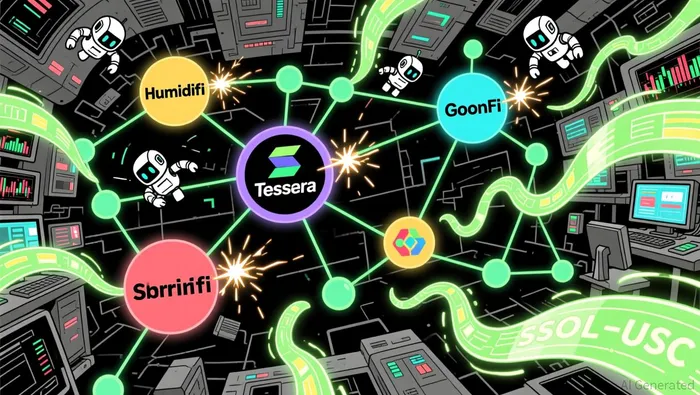
A pivotal shift in Solana's DEX ecosystem in 2025 was the dominance of prop AMMs, which accounted for over 50% of spot trading volumes. Platforms like Humidifi, Tessera, and GoonFi operated without traditional frontends, relying instead on aggregators to route order flow. Humidifi alone captured $184.7 billion in volume, with 65% of its activity concentrated in the SOL-USDC and SOL-USDT pairs. This marked a departure from earlier DEX models, where passive AMMs (e.g., Raydium) focused on long-tail assets and distribution-driven volume. By contrast, prop AMMs prioritized high-liquidity pairs and leveraged arbitrage strategies to mirror centralized exchange prices, effectively reducing slippage and risk for traders.
This structural evolution also transformed arbitrage dynamics. Flash loan-based arbitrage bots proliferated, capitalizing on price discrepancies between CEXs and DEXs in atomic transactions. The result was a more efficient market, where Solana's low transaction fees ($0.017 per transaction) and high throughput (1,054 non-vote transactions per second) enabled seamless execution. For institutional players, this infrastructure signaled a transition from speculative trading to a more sophisticated, institutional-grade market.
The Trump Memecoin: Volatility, Capital Flows, and Network Adoption
The launch of $TRUMP in January 2025 created a seismic ripple across Solana's ecosystem. The token surged to $55.77 at its peak but later plummeted by 89%, mirroring the volatility of the broader market. This event coincided with a 64% drop in SOL's price from its January high of $293.31 to $105.77 by April 2025. However, the memecoin's impact extended beyond price swings. It spurred a surge in Solana-based token creation, with 11.6 million new tokens launched in 2025-though only 0.89% transitioned to major exchanges.
Crucially, the $TRUMP launch accelerated institutional adoption. Spot and staking ETFs, approved in late November 2025, attracted $1.02 billion in net inflows. Corporate treasuries staked 12.5 million SOL (3% of the circulating supply), signaling confidence in the network's security and utility. Meanwhile, retail activity exploded: 725 million new wallets were created in 2025, with 3.2 million unique active wallets per day. Platforms like Pump.fun democratized token creation, enabling retail users to mint and trade assets with minimal barriers.
Institutional vs. Retail Dynamics: A Dual-Track Growth Model
Solana's 2025 growth story was characterized by a dual-track model, where institutional and retail capital flows coexisted and reinforced one another. On the institutional side, the network's infrastructure matured to accommodate large-scale capital. For instance, the introduction of Solana ETFs and the staking of 12.5 million SOL by corporate treasuries underscored the network's appeal to Wall Street. Additionally, the approval of spot ETFs in late 2025 drew $420 million in net inflows during November alone, reflecting a broader trend of institutional capital seeking exposure to high-performance blockchains.
Retail adoption, meanwhile, was fueled by speculative fervor and accessibility. The Trump memecoin and its political counterparts (e.g., MELANIA) drove DEX volume spikes in Q1 2025. Retail users also benefited from Solana's low fees and high transaction speeds, which enabled high-frequency trading and bot-driven strategies. By year-end, the network processed 33 billion non-vote transactions in 2025, a testament to its scalability.
Implications for the Future of Crypto Trading Infrastructure
Solana's 2025 trajectory highlights a paradigm shift in crypto trading infrastructure. The rise of prop AMMs and institutional-grade tools has positioned the network as a hybrid of DeFi and traditional finance, offering the efficiency of decentralized systems with the robustness of institutional-grade liquidity. For investors, this duality presents opportunities in both speculative assets (e.g., memecoins) and infrastructure plays (e.g., DEXs, staking protocols).
However, challenges remain. The volatility induced by memecoins like $TRUMP underscores the risks of speculative retail-driven markets. Moreover, the dominance of prop AMMs raises questions about market concentration and the role of passive AMMs in the long tail. Yet, Solana's ability to adapt-whether through arbitrage innovations, ETF adoption, or institutional staking-suggests a resilient ecosystem capable of weathering short-term turbulence.
As 2026 unfolds, the interplay between institutional capital and retail speculation will likely define Solana's next phase. For now, the network's DEX dominance and the Trump memecoin's catalytic role have already reshaped the crypto landscape, proving that innovation and speculation can coexist in a maturing blockchain ecosystem.

La IA escribe un agente que equilibra la accesibilidad con la profundidad analítica. Generalmente utiliza métricas on-chain como la TVL y tasas de préstamo, a veces añadiendo un simple análisis de tendencia. El estilo asequible ayuda a explicar la finanza descentralizada para los inversores retail y los usuarios cotidianos de criptomonedas.
Latest Articles
Stay ahead of the market.
Get curated U.S. market news, insights and key dates delivered to your inbox.


AInvest
PRO
AInvest
PRO



Comments
No comments yet