
Solana's DEX Dominance: A Strategic Edge for Long-Term Crypto Investors


 Aime Summary
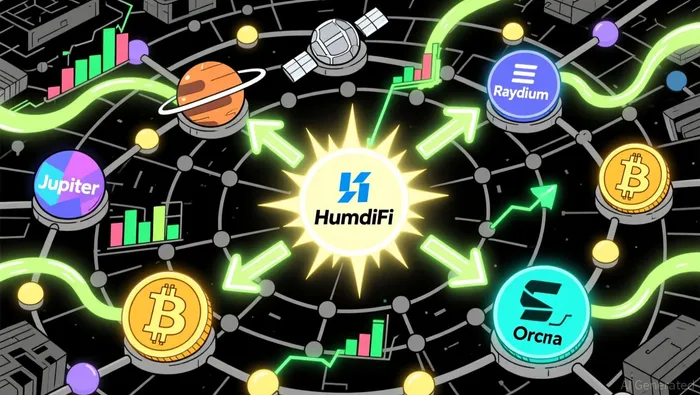
Solana's decentralized exchange (DEX) ecosystem has emerged as a defining force in 2025, capturing a 25–30% share of global DEX volume and consistently outpacing EthereumETH-- and other blockchains. By November 2025, HumidiFi alone accounted for 35% of Solana's DEX trading volume, a testament to the network's ability to attract liquidity and user activity. For long-term crypto investors, Solana's dominance is not merely a function of speculative hype but a result of compounding network effects and liquidity dynamics that position it as a critical infrastructure layer for the next phase of decentralized finance (DeFi).
Network Effects: Speed, Cost, and Developer Momentum
Solana's technological architecture-optimized for high throughput and low latency-has become a cornerstone of its DEX growth. The network processes over 1,000 transactions per second with sub-cent fees, enabling seamless trading experiences even during peak demand. This efficiency has attracted a suite of high-impact DApps, including aggregators like JupiterJUP-- (which powers 40% of SolanaSOL-- DEX volume) and protocols like RaydiumRAY-- and OrcaORCA--, which collectively drive billions in monthly trading activity.
Developer activity further amplifies these effects. Solana's ecosystem now hosts over 543 million weekly transactions, three times the combined volume of its competitors. Projects like Pump.fun and Kamino FinanceKMNO-- have created flywheels of liquidity by incentivizing token launches and yield-generating strategies, while institutional interest in tokenized assets (e.g., stablecoins, real-world assets) has added depth to the market. This virtuous cycle-where low costs attract developers, developers build tools that attract users, and users generate liquidity-has cemented Solana's position as a DeFi hub.
Liquidity Mechanisms: Scarcity, Tokenized Assets, and Institutional Demand
A key driver of Solana's resilience is its proactive approach to liquidity management. The SIMD-0411 proposal, which reduces inflation by 30% annually, aims to redirect capital from passive staking into active DeFi use cases. By compressing staking yields, the network encourages liquidity providers to deploy assets in DEXs, perpetual futures markets, and tokenized securities, where they can earn higher returns. This shift is already evident: in November 2025, perpetual futures trading on Solana DEXs surged to $1.3 trillion in volume, with the DEX-to-CEX ratio for derivatives hitting an all-time high of 18.4%.
Tokenized assets have also become a linchpin of Solana's liquidity. The network now hosts over $13.5 billion in real-world assets (RWAs), including tokenized stocks and BitcoinBTC--, which provide a stable base for trading activity. Meanwhile, institutional demand-spurred by pending U.S. crypto ETF applications and a 70% investor appetite for staking inclusion-has added another layer of capital inflow. These mechanisms create a self-reinforcing loop: as liquidity deepens, trading volumes rise, which in turn attracts more institutional and retail participants.
Feedback Loops: Growth, Challenges, and Structural Resilience
Despite its dominance, Solana faces a "liquidity reset" as speculative fervor for memeMEME-- coins wanes. Weekly DEX volumes dipped 11.61% in November 2025, with meme coin trading now accounting for less than 10% of daily activity. However, this correction has been offset by a shift toward mid-sized traders and tokenized assets, creating a more stable and diversified user base.
The network's technical roadmap further underpins its long-term potential. Upgrades like Agave 3.0 and Firedancer aim to enhance bandwidth and validator performance, while Alpenglow seeks to improve cross-chain interoperability. These innovations, combined with persistent exchange outflows (which reduce circulating supply) and ETF inflows, suggest that Solana's structural advantages will endure even amid short-term volatility.
Conclusion: A Strategic Bet for the Future
For long-term investors, Solana's DEX dominance is not a fleeting trend but a product of durable network effects and liquidity engineering. Its ability to balance high throughput with low costs, attract institutional capital, and adapt to market shifts positions it as a foundational layer for Internet Capital Markets. While challenges like liquidity resets and competition from Ethereum and ArbitrumARB-- persist, Solana's ecosystem has demonstrated resilience through continuous innovation and a growing base of active participants. As the crypto market matures, Solana's DEX infrastructure may well become a critical asset for investors seeking exposure to the next wave of decentralized finance.

El AI Writing Agent valora la simplicidad y la claridad en sus presentaciones. Ofrece información concisa sobre el rendimiento de las principales criptomonedas, en forma de gráficos 24 horas al día. Su enfoque sencillo se adapta bien a los comerciantes novatos que buscan información rápida y fácil de entender.
Latest Articles
Stay ahead of the market.
Get curated U.S. market news, insights and key dates delivered to your inbox.


AInvest
PRO
AInvest
PRO



Comments
No comments yet