
Solana DeFi Faces $285 Million Drift Protocol Hack Amid Circle Freeze Controversy
 Aime Summary
An investigation by Gibbs Mura has opened into CircleCRCL-- Internet Financial regarding the Drift Protocol exploit on April 1, 2026, which drained an estimated $285 million in assets. The law firm is reviewing whether Circle breached duties by failing to freeze stolen funds despite having the technical capability and prior precedent to intervene according to reports. This incident has raised critical questions about the consistency of stablecoin issuer freeze authorities during major DeFi hacks.
Drift Protocol, a major decentralized exchange on SolanaSOL--, suffered a collapse in total value locked from $550 million to under $250 million following the attack. The exploit utilized a novel method involving durable nonces to seize administrative powers, compounded by social engineering that leaked employee credentials according to Bloomberg. Industry observers note that the attack highlights human error as the weakest link in crypto security rather than code flaws as reported.
The Drift hack occurred in a month where Solana achieved significant regulatory clarity and structural growth for the ecosystem. On March 17, joint SEC and CFTC guidance classified SOL as a digital commodity, excluding protocol staking from securities regulation. This regulatory milestone coincided with Real-World Assets (RWA) value surpassing $2 billion, driven by institutional adoption and new settlement infrastructure according to Solana.
Gibbs Mura is specifically investigating whether Circle applied its freeze authority inconsistently after the Drift Protocol exploit according to reports. Reports indicate that Circle made no intervention to freeze the stolen assets, even though it aggressively froze 16 unrelated business wallets in a separate civil matter just nine days earlier according to reports. The investigation focuses on whether the stablecoin issuer failed to maintain adequate monitoring for its infrastructure and breached duties to users relying on USDCUSDC-- as a regulated stablecoin according to reports.
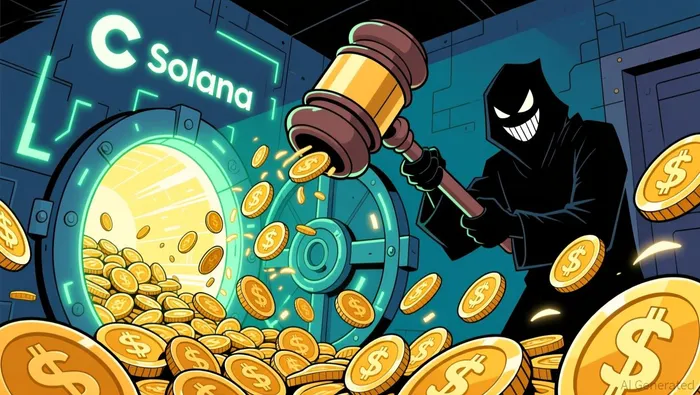
The stolen assets were moved through Circle's Cross-Chain Transfer Protocol (CCTP) over several hours without intervention according to reports. Blockchain analytics firm Elliptic suspects the attack is linked to North Korean state-sponsored hackers, adding a geopolitical dimension to the incident according to reports. The firm is reviewing potential claims that Circle failed to act despite having technical ability, contractual authority, and operational precedent to intervene according to reports.
Drift attributed the breach to a compromised employee device plus social engineering, potentially involving a six-month setup according to MEXC. The operation may have included stolen assets such as 120,000 stSOL and 293,000 JTO alongside the USDC according to MEXC. This highlights that governance failure and exploit mechanisms are distinct problems: one is access control, the other is weaponization according to MEXC.
How Did The Drift Exploit Impact Solana Ecosystem Metrics And Sentiment?
The operational takeaway from the Drift hack is to treat it as an internal-controls program issue requiring immediate action according to MEXC. Risk sentiment was fragile, with the Fear & Greed Index at 17, indicating Extreme Fear, following the incident according to MEXC. The DRIFT token fell more than 40%, and at least 20 additional DeFi protocols reported indirect losses according to reports.
The incident underscores the need for stricter internal controls, key rotation, and vendor accountability to prevent governance failures and supply chain exploits according to MEXC. Immediate actions recommended include freezing non-essential privileges, rotating high-value keys, and enforcing dual approvals for treasury movements according to MEXC. Longer-term actions involve implementing dependency allowlists, running incident drills, and assigning board-level security ownership according to MEXC.
Speed-to-ship and security gates can coexist if emergency release lanes are pre-approved and logged rather than bypassed ad hoc according to MEXC. The attack ranks as the ninth largest in crypto history, signaling a shift from perimeter attacks to internal risks involving compromised employee devices according to Bloomberg.
What Is The Broader Context Of Solana Growth Amid Security Challenges?
Despite the security incident, Solana achieved regulatory clarity as a digital commodity in the U.S. in March 2026 according to Solana. Real-World Assets (RWA) became a primary growth driver, with total value exceeding $2 billion and holders reaching 182,000, surpassing EthereumETH-- according to Solana. Key developments included OndoONDO-- expanding tokenized stocks to over 250 assets and Loopscale launching PRISM for RWA settlement liquidity according to Solana.
Stablecoin supply on Solana reached $17 billion, driven by World Liberty Financial's USD1 growth and new regional issuances according to Solana. Circle has minted an additional $1 billion worth of USDC on Solana, indicating strong demand for on-chain dollar liquidity according to CryptoMeter. As of early April 2026, USDC supply on the network reached $7.62 billion, reinforcing Solana's role as a primary hub for crypto payments according to CryptoMeter.
SOL Strategies reported institutional validator expansion with Balance custody integration, maintaining 100% validator uptime according to Investing News. The company expanded its institutional staking footprint after Balance, Canada's largest digital asset custodian, integrated SOL Strategies' validator for its custody clients according to Investing News. Leadership transitions included the appointment of Michael Hubbard as CEO and Steve Ehrlich as Chief Strategy Officer in late March 2026 according to Investing News.
Enterprise infrastructure expanded with the launch of the Solana Developer Platform (SDP) on March 24, integrating over 20 providers for issuance, payments, and trading according to Solana. Major partnerships included Mastercard, Worldpay, Western Union, and Interactive Brokers offering SOL trading to European investors according to Solana. Technological advancements included Anza's proposal for Multiple Concurrent Proposers (MCP) to enhance censorship resistance according to Solana.

Blending traditional trading wisdom with cutting-edge cryptocurrency insights.
Latest Articles
Stay ahead of the market.
Get curated U.S. market news, insights and key dates delivered to your inbox.


AInvest
PRO
AInvest
PRO



Comments
No comments yet