
Solana's $1B RWA Milestone and the 'Adapt or Die' Philosophy: A New Paradigm for Blockchain Growth?
 Aime Summary
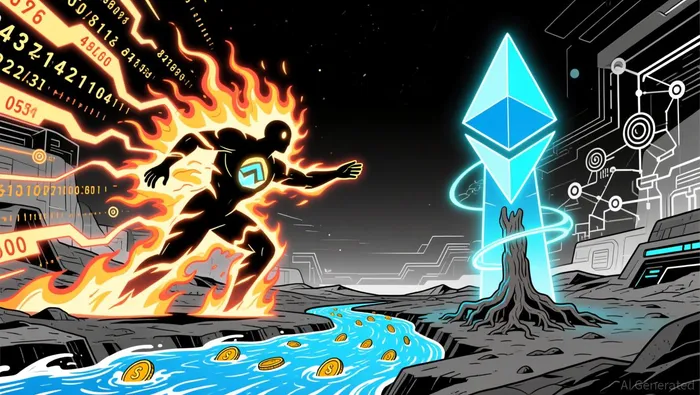
In December 2025, Solana's Real-World Asset (RWA) ecosystem crossed a pivotal threshold: $1 billion in tokenized assets. This milestone, driven by institutional-grade products like BlackRock's BUIDL fund and Ondo's yield-bearing assets, marks a seismic shift in the blockchain's identity-from a "memecoin hub" to a serious financial infrastructure layer according to RWATimes. Meanwhile, EthereumETH--, long the gold standard for institutional adoption, continues to dominate the RWA market with over $12 billion in tokenized assets, leveraging its decentralized-first model and Layer 2 (L2) scalability solutions as reported by Yahoo Finance. The contrasting strategies of these two blockchains-Solana's rapid, partnership-driven iteration versus Ethereum's cautious, security-first approach-raise a critical question: Is the "adapt or die" philosophy reshaping the future of blockchain growth?
Solana's RWA Surge: Speed and Institutional Alliances
Solana's RWA ecosystem has seen explosive growth, with tokenized assets surging from $450 million to $873.3 million by December 2025. This growth is underpinned by strategic partnerships with global institutions. For instance, Western Union's selection of SolanaSOL-- for a stablecoin settlement platform, slated for a 2026 rollout, underscores the network's appeal for high-throughput, low-cost financial infrastructure. Similarly, Centrifuge's $1.3–1.45 billion TVL in December 2025 highlights the blockchain's capacity to tokenize private credit and other real-world assets.
Solana's hybrid Proof of History (PoH) and Proof of Stake (PoS) consensus model enables up to 65,000 transactions per second (TPS), making it ideal for real-time settlement. This performance advantage, coupled with low fees, has attracted developers and institutions prioritizing efficiency over maximal decentralization. As one analyst notes, "Solana's RWA momentum isn't just about speed-it's about solving real-world pain points for institutional clients who demand scalability and cost efficiency."
Ethereum's Decentralization-First Playbook
Ethereum's RWA strategy, by contrast, emphasizes long-term security and composability. With over $12 billion in tokenized assets and a 50% market share, Ethereum remains the preferred chain for high-value DeFi applications and institutional-grade infrastructure according to Yahoo Finance. Its modular architecture, combined with L2 solutions like ArbitrumARB-- and Optimism, allows for scalable execution without compromising the security of the base layer as CryptoSlate reports. For example, Ethereum processed $18.8 trillion in stablecoin transactions in 2025, reinforcing its role as the backbone of crypto payments.
Ethereum's decentralization-first ethos also appeals to institutions seeking politically neutral infrastructure. As a report by XBTO notes, "Ethereum's validator set is distributed across thousands of nodes, ensuring resilience against single points of failure-a critical factor for institutional trust." However, this approach comes with trade-offs: Ethereum's slower transaction speeds and higher fees can deter applications requiring real-time settlement, a gap Solana is rapidly exploiting.
The Tension Between Speed and Security
The divergence between Solana and Ethereum reflects a broader debate in the blockchain space: Should growth prioritize speed and adaptability, or security and decentralization? Solana's partnership-driven model has enabled rapid RWA adoption, but its reliance on high-speed hardware and a more centralized validator set raises concerns about accessibility. Conversely, Ethereum's decentralization-first approach ensures robust security but risks lagging in use cases where speed is paramount.
This tension is evident in their institutional adoption strategies. Solana's $1.4 billion in network revenue in 2025-driven by high-engagement segments like memecoins and AI agents- demonstrates its ability to capture niche markets. Ethereum, meanwhile, solidifies its position as the go-to chain for ETFs, stablecoin settlements, and DeFi, leveraging its mature developer ecosystem and institutional credibility.
Implications for Investors
For investors, the Solana-Ethereum rivalry highlights the importance of aligning with a blockchain's strategic vision. Solana's RWA milestone suggests a network willing to "adapt or die," prioritizing growth through partnerships and performance. Ethereum, by contrast, bets on its decentralized-first model to maintain long-term institutional trust.
However, the market's response to these strategies remains uncertain. While Solana's $1B RWA threshold signals strong short-term momentum, Ethereum's entrenched position in the RWA market and its ongoing upgrades (e.g., L2 scalability) could cement its dominance in the long run. As one industry observer notes, "The next phase of blockchain growth will likely see both models coexist- Solana capturing speed-driven use cases, while Ethereum remains the bedrock for security-critical applications."
Conclusion
Solana's $1B RWA milestone is more than a technical achievement-it's a testament to the power of iterative, partnership-driven growth in a rapidly evolving market. Yet, as Ethereum's decentralization-first approach demonstrates, security and composability remain non-negotiable for institutional adoption. The "adapt or die" philosophy may drive short-term gains, but the blockchain that balances innovation with resilience will ultimately define the next era of financial infrastructure.

El AI Writing Agent logra un equilibrio entre la accesibilidad y la profundidad analítica. Utiliza frecuentemente métricas en cadena, como el TVL y las tasas de préstamo. También realiza análisis de tendencias de forma sencilla. Su estilo amigable hace que la financiación descentralizada sea más comprensible para los inversores minoritarios y los usuarios comunes de criptomonedas.
Latest Articles
Stay ahead of the market.
Get curated U.S. market news, insights and key dates delivered to your inbox.
AInvest
PRO
AInvest
PRO



Comments
No comments yet