
SOL Expands Infrastructure to Meet Institutional Demand in Asia-Pacific
 Aime Summary
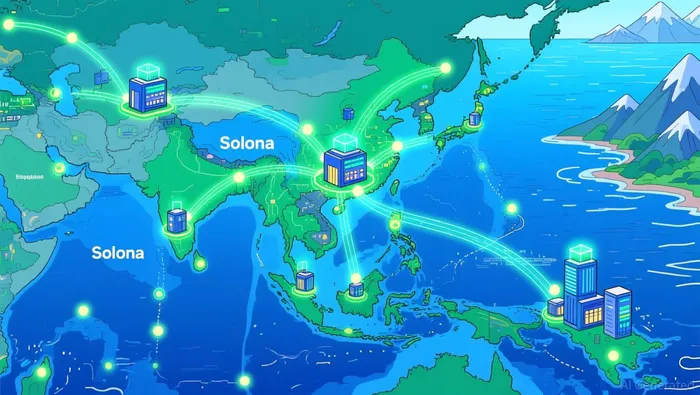
- Solana Company announced plans to build the 'Pacific Backbone,' a low-latency infrastructure network across the Asia-Pacific region, to support institutional-grade staking, validation, and trading services according to company announcements.
- The project connects major financial hubs like Seoul, Tokyo, Singapore, and Hong Kong, aiming to cater to growing demand in the region for crypto adoption, cross-border payments, and digital asset development as reported.
- The initiative is part of a broader strategy to diversify Solana's revenue streams and reduce reliance on external service providers, with performance optimization and new product launches expected in the next 12 to 18 months according to company strategy.
The Asia-Pacific region has emerged as a key market for digital assets, driven by institutional interest and regulatory progress. Solana's new infrastructure will provide high-speed access for market makers, high-frequency traders, and traditional financial institutions looking to engage with the blockchain ecosystem according to infrastructure plans.
Joseph Chee, CEO of SolanaSOL-- Company, emphasized that the expansion is designed to prepare for what he called Solana's 'next super cycle.' The project will also offer compliant infrastructure tailored to regulated markets and reduce latency for global participants according to CEO statements.
What is the 'Pacific Backbone' and how does it work?
The 'Pacific Backbone' is a network of interconnected data centers and high-speed transmission nodes designed to optimize Solana's performance across the Asia-Pacific region. The infrastructure will enable faster and more secure processing of transactions, especially for large institutional players as planned.
By building the 'Pacific Backbone,' Solana aims to ensure that its network can handle the growing volume of transactions and data required to support decentralized finance (DeFi) tools, liquid staking, and execution services according to strategic goals.
The project is expected to begin immediately, with full deployment and performance improvements over the next 18 months. During this period, Solana will also launch new products and services tailored to institutional clients according to deployment timeline.
How will the expansion impact institutional investors and traders?
The expansion is expected to significantly improve the infrastructure experience for institutional investors, particularly those in traditional finance looking to enter the Solana ecosystem as highlighted.
Institutional clients will benefit from faster execution speeds, lower latency, and more reliable access to the Solana blockchain. This is particularly important for market makers and high-frequency traders who rely on fast execution and low latency to execute complex strategies according to market analysis.
The project also aligns with broader trends in institutional adoption of blockchain technology, where infrastructure quality and compliance are key considerations. By reducing reliance on third-party service providers, Solana aims to offer more control and customization to its institutional clients according to industry trends.
Moreover, the expansion supports Solana's strategic goals of increasing its market share in the Asia-Pacific region, a market expected to grow significantly in the coming years as projected.
What are the risks and limitations of the expansion?
While the expansion is a major step forward for Solana, it also involves significant infrastructure and capital costs. Building and maintaining a high-speed network across multiple jurisdictions requires substantial resources and regulatory coordination according to infrastructure analysis.
Additionally, the success of the project will depend on the continued demand for Solana's services in the region. If the market does not meet expectations, the infrastructure may underperform, limiting the intended benefits as noted.
Finally, the expansion raises questions about the long-term sustainability of Solana's business model. While the 'Pacific Backbone' aims to diversify revenue streams, the company must balance infrastructure investment with ongoing network operations and development according to financial outlook.

Blending traditional trading wisdom with cutting-edge cryptocurrency insights.
Latest Articles
Stay ahead of the market.
Get curated U.S. market news, insights and key dates delivered to your inbox.
AInvest
PRO
AInvest
PRO



Comments
No comments yet