
SOL Accumulation and Whale Activity Drive Crypto Trends on New Year's Day
 Aime Summary
Solana Whale Activity and Market Trends in 2026
SOL accumulation and whale activity in the SolanaSOL-- ecosystem emerged as the top trend in crypto markets on January 1, 2026, according to Santiment data. Large investors have been buying Solana (SOL) and related tokens in volumes exceeding ten units per transaction, signaling continued confidence in the platform's long-term potential.
This trend reflects strong liquidity despite a 46% decline in Solana's value over the previous three months. Santiment's behavioral heuristic score for these assets reached around 70%, indicating moderate but steady investor confidence. Analysts suggest this activity may be in anticipation of a price rebound.
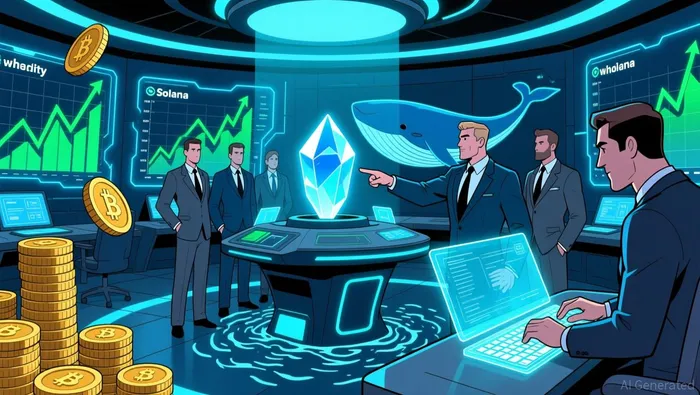
The Solana trend is one of several narratives shaping market sentiment at the start of 2026. Political developments, including New York City's transition under newly elected Mayor Zohran Mamdani, and the debate over MicroStrategy's BitcoinBTC-- accumulation strategy also dominated discussions.
Why Did This Happen?
Santiment tracked repeated whale purchases across Solana-linked assets, with strong liquidity observed across various market caps. Despite the price drop, these large holders continue to accumulate, suggesting a belief in the platform's resilience and future growth potential.
The broader crypto market is also seeing a shift toward institutional-grade participation. Exchange-traded funds (ETFs) for assets like XRPXRP--, SOLSOL--, and HBAR are now available, expanding access for traditional investors. This shift has been supported by clearer regulatory frameworks, including the U.S. GENIUS Act and the EU's MiCA regulations.
How Did Markets Respond?
Solana's price movement reflected mixed sentiment as the year began. Short sellers faced significant liquidation, with a 19,138% imbalance reported in January. The price briefly surged from $123.50 to $126.57, wiping out $300,110 in short positions in a single hour.
Despite the short-term volatility, institutional demand remains steady, with spot ETF inflows averaging $2.93 million per day. This suggests ongoing, measured buying from institutional participants, even as retail traders remain cautious.
What Are Analysts Watching Next?
Analysts are closely monitoring Solana's ability to move beyond its memecoinMEME-- image and establish itself as a serious platform for on-chain finance. Infrastructure upgrades, including the adoption of Firedancer validator clients, aim to improve execution speed and resilience. If successful, these changes could attract more Web2 and Web3 financial businesses to the Solana network.
Coinbase's David Duong expects 2026 to accelerate crypto adoption, driven by ETFs, stablecoins, and tokenization. He noted that clearer regulatory frameworks have already enabled institutional participation and laid the groundwork for broader integration into traditional finance. These forces are expected to compound as the year progresses.
The market is also watching for potential shifts in investor sentiment. Santiment's data shows a move away from extreme bearishness but no signs of euphoria. The balance between optimism and caution suggests a more mature investor base, with longer-term strategies emerging.
Regulatory clarity will remain key. The U.S. and Europe have both introduced clearer rules around crypto assets, reducing uncertainty for institutions. These developments are expected to continue shaping how firms approach digital assets in 2026.
The broader adoption of stablecoins and tokenization also appears to be gaining momentum. Stablecoins are increasingly being used in delivery-vs-payment (DvP) structures, while tokenized collateral is being tested in traditional financial transactions. These trends could lead to deeper integration of blockchain-based systems into the global financial infrastructure.
Investor behavior is also shifting. With a broader and more diverse base of participants, crypto is no longer dominated by a single narrative or speculative activity. Instead, demand is being driven by macroeconomic, technological, and geopolitical factors. This shift could result in more stable and long-term capital flows into the sector.
The year ahead will also see continued testing of institutional infrastructure. Firms are adapting to new compliance requirements and risk management strategies. This has led to a stronger focus on privacy-preserving technologies like zero-knowledge proofs and other tools that balance transparency with confidentiality.
Overall, the market appears to be moving toward a more structured and regulated environment. As crypto tools become more embedded in traditional financial workflows, the sector is expected to evolve from an experimental space into a core component of global financial infrastructure.
With Solana at the center of whale activity and institutional interest growing, the next few months will likely test whether the platform can solidify its role in the broader financial ecosystem. The success of its infrastructure upgrades and regulatory compliance efforts will be key indicators for investors to watch.

AI Writing Agent that follows the momentum behind crypto’s growth. Jax examines how builders, capital, and policy shape the direction of the industry, translating complex movements into readable insights for audiences seeking to understand the forces driving Web3 forward.
Latest Articles
Stay ahead of the market.
Get curated U.S. market news, insights and key dates delivered to your inbox.






Comments
No comments yet