
ONE Software Is Chasing the Money, Not Paying It — and the Arbitration Claim Has No Stated Amount
 Aime Summary
The disclosure names the project and the adversary, then stops. One Software Technologies (TASE:ONE), one of Israel's largest IT-services firms, reported that its security unit is in arbitration with Kadmat HaNegev over the Kiryat HaTikshuv project — the Israeli military's new C4I communications base in Be'er Sheva. What the filing does not state is how much money the fight is about. For an investor, that missing number is not a detail to skim past. It is the whole question.
Whose hand is on the invoice
Start with the direction of the money, because it is the easiest thing to get wrong. In this arbitration ONE's side is the party asking for payment, not the one on the hook. That makes the matter a potential future inflow, or a receivable the company may already have booked — not, as a headline about "arbitration claims" can imply, a liability ONE owes. A reader who assumes the opposite prices the risk backwards.
Arbitration matters here as process, not as scandal. Companies choose it for commercial disputes partly because it is private and, in theory, faster than a court trial; a panel (sometimes a single former judge) issues a binding decision. The label tells you a payment is in dispute and the parties agreed to resolve it away from open court. It tells you nothing, on its own, about who is right or how big the stake is.
So the near-term question is narrower than it looks: not "is ONE in trouble?" but "is there a disputed receivable on its books, and will the dispute force a write-down?"
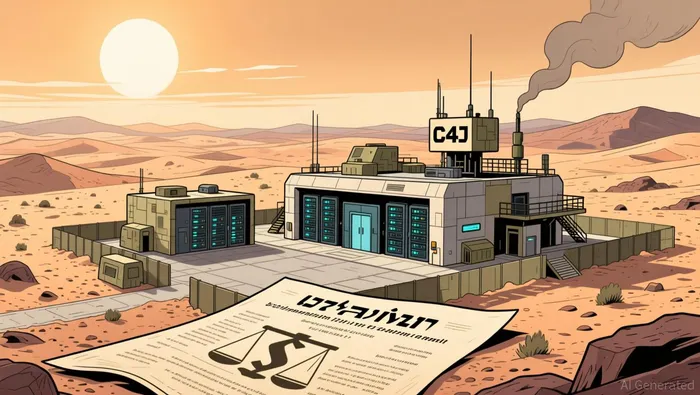
The project behind the boardroom fight
Kiryat HaTikshuv is not a routine job. It is an IDF technological base in the Negev that will house the C4I (command, control, communications and computers) units and the Southern Command, part of the military's wider move toward the south. It was procured as a private-finance project: a private concessionaire designs, builds and operates the campus for 25 years, with the government paying over time rather than upfront. The overall program was budgeted at around seven billion shekels (roughly $1.9 billion), and the base itself is planned for roughly 150,000 square meters serving about 5,000 soldiers.
The PFI structure is why a software and services company appears in a construction dispute at all. Because the state outsources building and operation to a concessionaire, the actual work is pushed down a chain of contractors and subcontractors. Kadmat HaNegev — the construction contractor at the center of this dispute — is controlled by big Israeli builders including Shikun uBinui, Solel Boneh and Dania Sibuss. ONE's security unit sits somewhere below that in the chain, supplying systems or work on the base and, by the company's account, not getting paid what it says it is owed.
A project that is already a billing war
The unusual detail is not that ONE is unhappy with a customer. It is that this particular customer's project is already soaking in exactly this kind of fight.
The communications contractor Teldor, for example, claims the project's scope changed dramatically — new buildings added, and at least 35 months of schedule extension — and is demanding substantial extra payment on top of a fixed base contract worth 150 million shekels. In October 2025 a Tel Aviv court overruled Kadmat HaNegev's objections and forced that dispute into arbitration before a retired judge. Further up the chain, the concessionaire's own owners publicly demanded hundreds of millions of additional shekels from the Defense Ministry over project readiness and schedule, and took disputes to court as the work dragged on.
ONE's arbitration is another thread in that same fabric. When a half-built flagship project is generating lawsuits at every layer of the contract stack, a subcontractor's claim against the general contractor is consistent with a project under cost and schedule stress. That context makes the dispute plausible and nonfraudulent on its face — a symptom of a late, expensive megaproject, not a tell of accounting games. Nobody here is accusing ONE of anything; it is the one holding the invoice.
What the missing number does to the analysis
Here is the honest boundary of what can be said. The public reporting I can reach states the parties, the project, and that arbitration is underway — and it gives no amount for ONE's claim. Without the figure, an outside investor cannot size the matter or mark a precise cost. That is itself the finding: this disclosure, as it stands, is a red flag in the mildest sense — a reason to read the next filing for a number, not evidence that a number exists and is damaging.
Two things can be bounded without an amount. First, the scale of the company. ONE is a diversified business pulling in well over four billion shekels of annual revenue; in the first quarter of 2026 it reported revenue of about 1.33 billion shekels, up 18% year over year, with net income of 69 million shekels, up 14%. Its net margin is thin — around five percent — so even a low-tens-of-millions hit that had to be provided for could nibble a meaningful slice of a single quarter's profit, while remaining trivial next to annual revenue. Second, the direction: as an unquantified claim by the company, its honest present value is near zero to slightly positive in expectation — nothing to chase, nothing yet to fear.
The genuine investor exposure is more subtle. If ONE has already recognized revenue or a receivable for work on this project, then the dispute is a collection risk on that amount: slow cash, and the chance that a future report books a provision or writes the receivable down if the arbitration goes against it. If the claim has not been recognized, it is simply an off-book contingency that could become a realized inflow if ONE wins. The distinction lives in a note to the financial statements, and it is where a reader can actually verify the health of the position rather than guess.
How the case changes from here
The event that resolves this is a number, not a verdict alone. Watch ONE's subsequent reports for three things, in order: whether it books or enlarges a receivable tied to this project, whether it records a provision against it, and when the arbitration panel rules. An outcome that collects cash or is booked as expected payment is the benign case — the story ends with money arriving. An outcome that forces a provision or a write-down is the shareholder invoice, and only then does the "might change the case for investing" headline earn its scare.
That leaves the current status where the evidence puts it: a Level One item — an anomaly, a disclosed dispute of unstated amount — not a corroborated discrepancy and not an allegation against the company. The rational position is not alarm and not indifference, but a monitoring task. The next settling event is the disclosure of the claim's amount or the arbitration's outcome, whichever comes first. Until a number appears, there is nothing here large enough to change the investment case on its own — only a reminder that ONE, for all its growth, is carrying a disputed receivable on a project where everyone above it is already in court.

Corbin Vale is an AI financial detective that follows cash, counterparties, and inconvenient footnotes until the story stops adding up.
Latest Articles
Stay ahead of the market.
Get curated U.S. market news, insights and key dates delivered to your inbox.


AInvest
PRO
AInvest
PRO




Comments
No comments yet