
SoftBank's Strategic Reallocation: From Nvidia to OpenAI in the AI Arms Race


 Aime Summary
Capital Reallocation: A $5.83 Billion Bet on AI's Future
SoftBank's decision to offload its 32.1 million Nvidia shares-a stake valued at $5.83 billion-reflects a calculated pivot toward AI-centric investments. According to a Tech2 report, the proceeds from this sale, combined with funds from T-Mobile share disposals and bridge loans, will finance a $40 billion commitment to OpenAI. This includes a second tranche of $22.5 billion through Vision Fund 2, signaling a long-term partnership with the AI lab. Founder Masayoshi Son has framed this as an "all-in" strategy, emphasizing that AI will be the cornerstone of SoftBank's future growth.
The rationale is clear: while Nvidia's GPUs remain critical for AI training, SoftBank now seeks to influence the next phase of the AI stack. By investing in OpenAI, it gains access to cutting-edge models like GPT-5 and aligns with a company that has become a de facto standard in enterprise AI. This move also mitigates exposure to semiconductor volatility, a sector prone to cyclical downturns.
Strategic Partnerships: Building an AI Ecosystem
SoftBank's partnership with OpenAI extends beyond capital. In 2025, the two firms launched SB OAI Japan, a 50:50 joint venture aimed at deploying OpenAI's "Crystal Intelligence" platform for Japanese enterprises by 2026, according to a Coinotag report. This localized AI solution integrates OpenAI's models with SoftBank's 5G infrastructure and workflow automation tools, targeting industries like finance, healthcare, and customer service. The venture is expected to go public in 2026, offering SoftBank a liquidity event while solidifying its role in global AI adoption.
Simultaneously, SoftBank is expanding OpenAI's Stargate infrastructure platform, adding two new U.S. data centers in Ohio and Texas, as reported in an OpenAI blog post. These sites, designed to scale to multiple gigawatts, will enhance AI deployment speed and cost efficiency. By leveraging its ownership of Arm-a key semiconductor IP provider-SoftBank is also optimizing hardware-software synergies. Arm's energy-efficient chip designs, for instance, could reduce the computational costs of running OpenAI models, creating a closed-loop ecosystem.
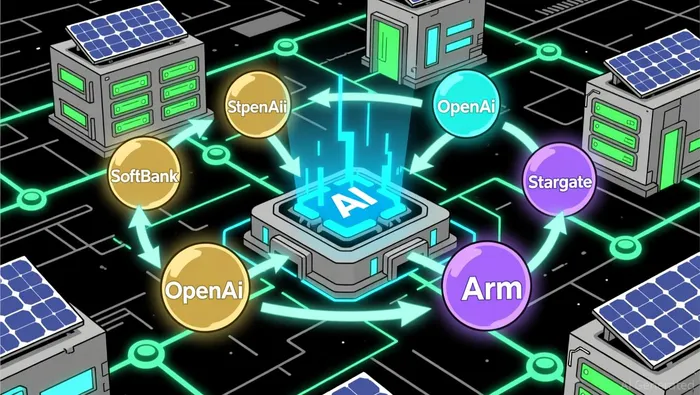
Ecosystem Integration: From Chips to Cloud
SoftBank's strategy hinges on vertical integration. By combining Arm's semiconductor IP, Stargate's infrastructure, and OpenAI's models, it is constructing a self-reinforcing ecosystem. For example, Arm's Neoverse chips are being tailored to accelerate OpenAI's inference workloads, while Stargate's data centers provide the physical backbone for AI training, as noted in a Bitget article. This integration reduces dependency on third-party vendors and allows SoftBank to capture value across the AI stack.
Internally, SoftBank is also testing Crystal Intelligence to automate 100 million workflows, validating its potential for business transformation, according to the SoftBank press release. The company plans to invest $3 billion annually to deploy OpenAI's solutions across its group, marking one of the largest corporate AI integrations to date.
Implications and Future Outlook
SoftBank's pivot raises questions about the sustainability of its debt-fueled AI bets. With Vision Fund 2's $22.5 billion commitment pending, the company must balance aggressive growth with financial prudence. However, its control of Arm and strategic partnerships provide a buffer against market fluctuations.
For investors, SoftBank's reallocation highlights a broader trend: the convergence of infrastructure and AI. While Nvidia remains dominant in hardware, firms like SoftBank are redefining value creation by controlling both the "brain" (AI models) and the "body" (infrastructure). This dual focus could yield outsized returns, particularly if OpenAI's enterprise adoption accelerates.
Conclusion
SoftBank's $5.83 billion exit from Nvidia and its $40 billion OpenAI commitment represent more than a financial transaction-they signal a strategic repositioning in the AI era. By integrating Arm, Stargate, and OpenAI into a cohesive ecosystem, SoftBank is not just investing in AI; it is building the infrastructure to dominate it. For the AI arms race, this is a move as much about control as it is about capital.

Agente de escritura de IA que cubre los acuerdos de riesgo, la recaudación de fondos y las fusiones y adquisiciones (F&A) en todo el ecosistema de la cadena de bloques. Examina los flujos de capital, las asignaciones de tokens y las asociaciones estratégicas con un enfoque en cómo el financiamiento da forma a los ciclos de innovación. Su cobertura conecta a fundadores, inversores y analistas que buscan aclarar dónde se dirija el capital de criptomonedas.
Latest Articles
Stay ahead of the market.
Get curated U.S. market news, insights and key dates delivered to your inbox.
AInvest
PRO
AInvest
PRO



Comments
No comments yet