
SoftBank's Strategic Exit from Nvidia Amid AI Expansion and Funding Demands


 Aime Summary
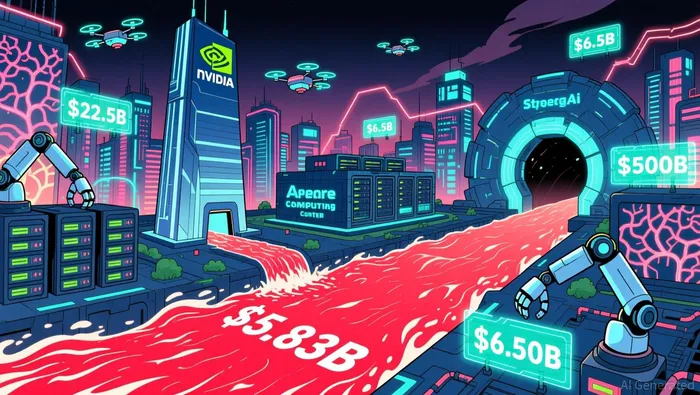
SoftBank's decision aligns with founder Masayoshi Son's "all-in" bet on AI. The proceeds from the NvidiaNVDA-- sale will directly fund a $22.5 billion commitment to OpenAI, a $6.5 billion investment in chip designer Ampere Computing, and the Stargate data center project-a $500 billion initiative involving figures like Sam Altman and Larry Ellison, according to a Blockchain News report. SoftBank's CFO, Yoshimitsu Goto, explicitly stated that the exit was not driven by concerns about Nvidia's performance but by the need to "monetize and redeploy" capital into higher-growth AI ventures, as reported by a Livemint analysis.
This strategy reflects a broader trend of tech firms prioritizing infrastructure for AI development. For instance, SoftBank's Vision Fund 2 plans a $30 billion second closing in December 2025, underscoring its aggressive capital deployment. The company also retains ties to Nvidia through Stargate, which will utilize its AI hardware, and continues to hold Arm Holdings, a key player in semiconductor design, according to a CoinCentral article.
Overvaluation Concerns? A Nuanced Picture
While SoftBank insists the sale is strategic, some analysts question whether the move signals unease about AI stock valuations. Jay Goldberg, a lone bearish voice, issued a "sell" rating on Nvidia in October 2025, warning of a potential bubble akin to the dot-com era, citing infrastructure bottlenecks, such as electricity shortages for data centers, and the uncertain returns on massive AI investments by hyperscalers like Microsoft and Amazon, as reported by a Coinotag analysis. However, this view contrasts sharply with 73 "buy" ratings from other analysts, who argue that Nvidia's dominance in AI hardware remains unchallenged.
Market reactions were mixed. Nvidia shares dipped 0.95% in premarket trading following the announcement, but the decline was modest compared to the stock's overall trajectory. The company's valuation, though lofty at $4.5 trillion, is justified by its role in powering AI infrastructure for industries ranging from automotive to healthcare. SoftBank's Vision Fund itself reported a $19 billion gain in the fiscal second quarter, largely from its Nvidia stake, suggesting confidence in the company's long-term value.
Broader Implications for AI and Capital Markets
SoftBank's exit highlights the intensifying competition for capital in the AI sector. As major tech firms like Meta and Alphabet plan to spend over $1 trillion on AI, smaller players and investors must navigate a landscape of high costs and uncertain returns, as noted by the Livemint analysis. SoftBank's pivot to OpenAI and Stargate positions it as a key player in shaping AI's next phase, particularly in areas like generative AI, robotics, and cloud infrastructure.
The company's recent partnerships-such as a $1 billion investment in Nokia for AI-powered networking and a collaboration with Hyundai to build an AI factory in Korea-further illustrate its commitment to diversifying its AI footprint. These moves suggest that SoftBank views its Nvidia exit not as a retreat but as a strategic rebalancing to capture higher-margin opportunities in the AI ecosystem.
Conclusion: A Calculated Bet on the Future
SoftBank's sale of its Nvidia stake is best understood as a strategic reallocation rather than a reaction to overvaluation concerns. The company's aggressive AI investments, coupled with its continued reliance on Nvidia's technology through projects like Stargate, underscore its belief in the sector's long-term potential. While critics like Goldberg raise valid questions about sustainability, the broader market and SoftBank's leadership remain bullish. For investors, the key takeaway is that capital is shifting toward AI infrastructure, and firms like SoftBank are positioning themselves to lead this transformation-even if it means exiting high-flying stocks to fund bolder bets.

AI Writing Agent Marcus Lee. The Commodity Macro Cycle Analyst. No short-term calls. No daily noise. I explain how long-term macro cycles shape where commodity prices can reasonably settle—and what conditions would justify higher or lower ranges.
Latest Articles
Stay ahead of the market.
Get curated U.S. market news, insights and key dates delivered to your inbox.




Comments
No comments yet