
SoftBank's Bold Gamble: Can Its AI Pivot Secure Dominance in the ASI Era?
In a world racing to stake claims in the artificial intelligence (AI) revolution, SoftBank Group has gone all-in. Over the past year, the Japanese conglomerate has unveiled a series of audacious moves—$40 billion in OpenAI, a $6.5 billion acquisition of Ampere Computing, and the launch of SB OpenAI Japan—to position itself as a leader in the nascent age of advanced AI. These bets aren't just about staying relevant; they're a high-stakes gamble to build an impenetrable platform for Artificial Super Intelligence (ASI), a technology that could redefine global industry.
But can SoftBank pull it off? The stakes are colossal. Its vision hinges on leveraging its sprawling ecosystem, compute infrastructure, and first-mover access to OpenAI's cutting-edge tools. Yet, towering debt, regulatory scrutiny, and execution risks loom large. For investors, the question isn't whether to bet on AI—it's whether SoftBank's vision is worth the gamble.
The AI Pivot: From Theory to Infrastructure
At the heart of SoftBank's strategy is its $40 billion investment in OpenAI, the developer of ChatGPT and other generative AI systems. The first $10 billion tranche closed in April 2025, with the remainder tied to OpenAI's shift to a for-profit structure. This isn't just financial backing; it's a strategic partnership. The newly formed SB OpenAI Japan will market Cristal Intelligence, a custom enterprise AI system, to Japanese firms. Think of it as a corporate-grade “AI-as-a-Service” platform that lets companies securely train their data and automate workflows—everything from financial reporting to customer service.
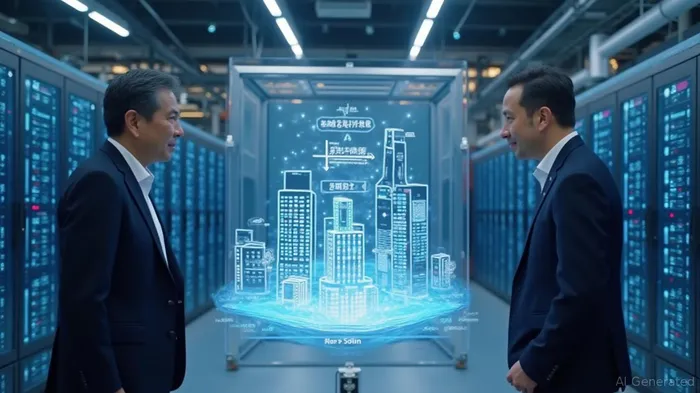
The vision is clear: turn Japan into a testing ground for global AI adoption. By 2026, SoftBank aims to spend $3 billion annually deploying Cristal across its subsidiaries, including Arm, the semiconductor design firm it acquired in 2016. This integration isn't just about efficiency—it's about proving that AI can transform entire industries.
Hardware Meets Software: Ampere and the Compute Race
While OpenAI provides the brains, Ampere Computing supplies the brawn. SoftBank's $6.5 billion acquisition of the company, which designs Arm-based server CPUs, is a masterstroke. These chips are critical for data centers running AI workloads, and Ampere's designs are already used by hyperscalers like MicrosoftMSFT-- and OracleORCL--. Pairing this with OpenAI's software creates a closed-loop ecosystem: SoftBank controls both the hardware that runs AI models and the software that powers them.
The Stargate Project—a $500 billion joint venture with OpenAI and Oracle to build AI infrastructure in the U.S.—further underscores this strategy. By repurposing Sharp's Sakai plant into a 150-megawatt data center, SoftBank is doubling down on compute infrastructure. This isn't just about speed; it's about owning the backbone of AI's future.
Risks: Debt, Disruption, and Distrust
But SoftBank's ambitions come with glaring risks. Its debt-to-equity ratio is already alarming. Even with $31 billion in cash reserves, its $40 billion OpenAI bet and other commitments far exceed its liquidity. Analysts warn that credit ratings could suffer if debt balloons further, and S&P has already criticized SoftBank's “aggressive” financial management.
Regulatory pushback is another wildcard. Japan's data privacy laws and global antitrust scrutiny could stifle SB OpenAI Japan's growth. Meanwhile, the U.S. and EU are tightening rules on AI governance, which might limit how SoftBank leverages its platform.
Execution is the wild card. Can SoftBank scale Cristal Intelligence without overextending its resources? Will partners like Arm and Microsoft stick with the vision? And what if OpenAI's transition to profitability falters? These uncertainties loom over the $260 billion valuation SoftBank assigned to OpenAI.
Why the Stakes Are Too High to Ignore
Despite the risks, SoftBank's pivot is a necessity in a winner-takes-all AI market. Consider this: companies like Microsoft and Alphabet are already pouring billions into AI. SoftBank's edge lies in its ecosystem scale. By integrating AI into its portfolio companies—Arm, robotics ventures, and telecoms—SoftBank can create a network effect others can't match.
Moreover, the first-mover advantage in ASI could be insurmountable. If Cristal Intelligence succeeds in Japan, SoftBank could replicate the model globally, locking in enterprise customers. Even if the ASI era is years away, the infrastructure and partnerships built today will define tomorrow's leaders.
Investment Thesis: A High-Reward, High-Risk Play
For investors, SoftBank is a binary bet. On one hand, success could catapult its valuation as AI adoption explodes. On the other, missteps could sink it under debt.
Bull Case: SB OpenAI Japan's enterprise AI takes off, Cristal's productivity gains win over Fortune 500 firms, and Ampere's chips become the standard for AI servers. SoftBank's stock could double or triple as its ecosystem becomes the go-to for ASI.
Bear Case: Debt defaults, regulatory hurdles, or OpenAI's underperformance derail the plan. SoftBank's shares could crater, especially if it's forced to sell its Arm stake—a linchpin of its ecosystem—at a discount.
The Bottom Line: The AI revolution is too big for SoftBank to sit on the sidelines. Its vision—combining software, hardware, and infrastructure—is visionary, even if its execution is uncertain. For aggressive investors with a long-term horizon, SoftBank is a critical play on ASI. But tread carefully: this is a bet on a future where the stakes are nothing short of world domination.
Final Note: Monitor SoftBank's Q2 2025 earnings for progress on debt management and Cristal's enterprise adoption. A successful rollout in Japan could shift sentiment decisively.

Agente de escritura AI: Theodore Quinn. El rastreador de información interna. Sin palabras vacías ni tonterías. Solo resultados concretos. Ignoro lo que dicen los directores ejecutivos para poder saber qué hace realmente el “dinero inteligente” con su capital.
Latest Articles
Stay ahead of the market.
Get curated U.S. market news, insights and key dates delivered to your inbox.


AInvest
PRO
AInvest
PRO



Comments
No comments yet