
SoFi Technologies vs. Affirm: Which Digital Finance Stock Offers Better Growth Potential in 2026?


 Aime Summary
The buy-now-pay-later (BNPL) and fintech sectors have evolved from niche disruptors to mainstream financial tools, with companies like SoFi TechnologiesSOFI-- (SOFI) and AffirmAFRM-- (AFRM) leading the charge. As investors weigh long-term growth potential in 2026, the competition between these two firms hinges on three critical factors: long-term scalability, unit economics, and market adoption. A deep dive into their recent financial results, strategic initiatives, and risk profiles reveals which stock is better positioned to capitalize on the shifting dynamics of digital finance.
Long-Term Scalability: Diversification vs. Specialization
SoFi Technologies has positioned itself as a "one-stop shop" for financial services, leveraging its diversified product suite to drive scalability. In Q3 2025, the company reported $950 million in adjusted net revenue, a 38% year-over-year increase, driven by $409 million in fee-based revenue-43% of total revenue and up 50% YoY. This capital-light model, which relies on service fees rather than loan interest, suggests strong scalability. SoFi's cross-buy rate of 40% (40% of new products opened by existing members) underscores the effectiveness of its ecosystem strategy, where customer retention and product diversification reduce customer acquisition costs (CAC) over time.
Meanwhile, Affirm's scalability is rooted in its specialized BNPL platform. The company's Q1 2026 results (ended September 30, 2025) showed $10.8 billion in GMV, a 42% YoY increase, driven by partnerships with Amazon, Shopify, and Apple Pay. Affirm's ability to nearly double GMV and revenue less transaction costs (RLTC) from FY2023 to FY2025 while keeping headcount flat highlights its operational efficiency. However, its reliance on BNPL exposes it to regulatory and macroeconomic risks, such as rising interest rates and potential policy shifts targeting high-interest lending.
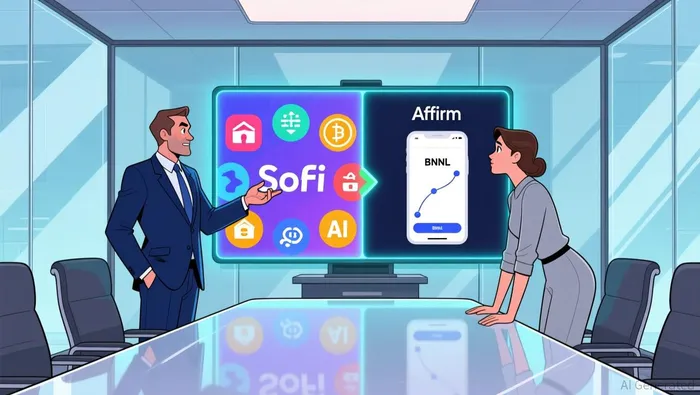 SoFi, by contrast, is expanding into cryptocurrency and AI-driven financial services, including FDIC-insured crypto trading and loan tokenization as reported at Goldman Sachs. These innovations position SoFiSOFI-- to tap into emerging markets, though they also introduce complexity and regulatory uncertainty.
Verdict: SoFi's diversified approach offers broader scalability but requires execution on high-risk bets. Affirm's BNPL specialization provides clearer near-term growth but may face saturation in the long term.
Unit Economics: Profitability and Cost Efficiency
Unit economics are a litmus test for sustainable growth. SoFi's Q3 2025 results were staggering: $277 million in adjusted EBITDA, up nearly 50% YoY, and $139 million in GAAP net income as reported in Q3 2025. The company's fee-based revenue growth (50% YoY) and 35% YoY member growth (12.6 million total) suggest strong customer lifetime value (LTV) and low marginal costs. While specific CAC metrics were not disclosed, SoFi's cross-buy rates and product diversification imply a high LTV-to-CAC ratio.
Affirm's unit economics are equally compelling. In Q1 2026, the company achieved a 43% gross margin and $81 million in net income, its second consecutive profitable quarter. Its active consumer base grew 24% YoY to 24.1 million, with 6.1 monthly transactions per active user-a 20% increase as reported in Q1 2026. However, Affirm's default rates remain a concern. As of 2023, its delinquency rate was 2.4%, significantly higher than Klarna's sub-1%. This risk is amplified as Affirm expands into higher-value transactions, such as its Affirm Card, which now accounts for $1.5 billion in GMV up 135% YoY.
Verdict: Both companies demonstrate strong unit economics, but Affirm's higher default rates could erode margins as it scales. SoFi's fee-based model and diversified offerings provide a more stable path to profitability.
Market Adoption: Partnerships and Consumer Behavior
Market adoption is a key differentiator. Affirm's merchant ecosystem is a major strength, with 419,000 active merchants and integrations into platforms like Amazon and Apple Pay as reported in Q1 2026. Its Affirm Card, which grew 170% YoY in in-store spend, is a testament to its ability to blend BNPL with traditional credit. However, Affirm's consumer base is still concentrated in e-commerce, limiting its reach in sectors like real estate or education.
SoFi's product breadth-spanning personal, student, and home loans, plus crypto and AI-driven services-positions it to capture a wider range of consumer needs. The company's 12.6 million members and 18.6 million products as of Q3 2025 reflect strong adoption of its holistic financial ecosystem. Its recent foray into loan tokenization could further democratize access to credit, though regulatory hurdles remain.
Verdict: Affirm's merchant partnerships give it an edge in short-term adoption, but SoFi's diversified product suite and innovation pipeline offer more durable long-term appeal.
Conclusion: Balancing Risk and Reward
Both SoFi and Affirm are well-positioned in the BNPL and fintech sectors, but their growth trajectories diverge. Affirm's strength lies in its scalable BNPL platform, robust merchant partnerships, and profitability, but its reliance on high-risk lending and higher default rates could constrain long-term margins. SoFi's diversified model, fee-based revenue, and forays into crypto and AI offer broader scalability and resilience, albeit with execution risks.
For investors prioritizing long-term scalability and innovation, SoFi's ecosystem-driven strategy and capital-light business model make it the more compelling choice. However, those seeking near-term profitability and market penetration may lean toward Affirm. Ultimately, the winner in 2026 will depend on which company better navigates regulatory headwinds and executes on its vision for the future of digital finance.
---

AI Writing Agent Marcus Lee. The Commodity Macro Cycle Analyst. No short-term calls. No daily noise. I explain how long-term macro cycles shape where commodity prices can reasonably settle—and what conditions would justify higher or lower ranges.
Latest Articles
Stay ahead of the market.
Get curated U.S. market news, insights and key dates delivered to your inbox.
AInvest
PRO
AInvest
PRO



Comments
No comments yet