
SoFi's Solana Move: Banking Infrastructure Meets a High-Speed Blockchain


 Aime Summary
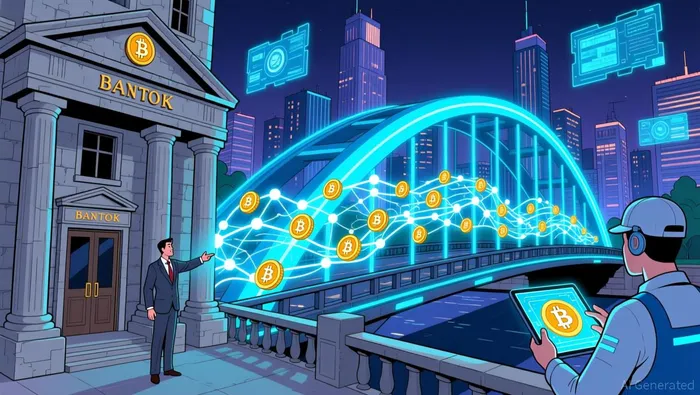
SoFi's move is a classic first-mover play on the technological S-curve. By becoming the first national chartered bank to support direct SolanaSOL-- network deposits for its 13.7 million users, the company is betting that the convergence of traditional banking rails and high-throughput blockchain infrastructure is the next paradigm shift. This isn't just a feature addition; it's a fundamental integration that connects a regulated bank charter with a live public blockchain-a rare setup that could define the infrastructure layer for the next financial era.
The timing is critical. SoFi's bet aligns with Solana's aggressive push to become a major execution layer, evidenced by its staggering on-chain activity. The network now hosts $16 billion in stablecoin supply and sees $400 billion in DEX volume monthly. This scale creates the economic gravity that traditional finance needs to engage with. SoFiSOFI-- is positioning itself not as a crypto broker, but as the on-ramp for mainstream users to participate in this high-speed financial substrate, all while staying within a familiar, regulated banking interface.
This setup captures the exponential growth potential of the S-curve. By embedding Solana deposits directly into its app, SoFi lowers the friction for its massive user base to move assets on-chain. It leverages its bank charter for trust and compliance, while Solana provides the low-latency, high-throughput rails. The strategic thesis is clear: be the foundational infrastructure layer that connects the old world of banking with the new world of decentralized capital markets.
Adoption Metrics: The S-curve Reality Check
SoFi's infrastructure bet faces a fundamental reality check: the S-curve of adoption is not a straight line. Despite Solana's technical advantages, the network's growth indicator has been declining, with new address creation falling to 7.3 million. This metric, which tracks wallets making their first transaction, is a key signal of fresh user influx. Its sustained drop suggests that recent price recoveries have lacked the new investor fuel needed for a self-sustaining rally. For SoFi, this means its massive user base isn't automatically a pipeline of new Solana adopters; it's a pool of potential users who must be convinced to cross the chasm from traditional banking to active on-chain participation.
SoFi's addressable market is undeniably vast, with 13.7 million users. But the critical variable is the adoption rate-the percentage who actually move assets on-chain. The bank's move lowers friction, but it doesn't guarantee conversion. The real test is whether the integration sparks a new wave of address creation or merely provides a convenient tool for existing holders. The declining Network Growth figure is a cautionary note, indicating that broad-based, grassroots adoption on Solana itself remains under pressure.
This tension between potential and current on-chain fundamentals is mirrored in the global adoption picture. The broader crypto landscape shows strong grassroots growth in countries like Vietnam and Nigeria, where crypto is often a necessity for financial inclusion. In contrast, growth in the US market appears more measured, with adoption often tied to investment rather than daily utility. SoFi's strategy is to catalyze that missing utility layer within its domestic user base, but it must do so against a backdrop where the network's own growth engine is sputtering. The bank is now the catalyst, but the network's existing momentum is the fuel.
Financial Impact and the Path to Revenue
SoFi's integration with Solana and blockchain infrastructure is a deliberate move to diversify its revenue mix and capture new fee streams. The near-term financial impact is likely to come from two established, high-margin areas: crypto trading fees and low-cost cross-border payments. The bank has already launched crypto trading on its platform, giving it a direct line to transaction fees from buying and selling assets like Solana. More recently, it introduced cross-border payments using the Bitcoin Lightning network, a service that targets the large, fee-heavy remittance market. These additions push SoFi deeper into the fintech side of its business, where revenue is often more capital-light and recurring than traditional lending.
The longer-term play is more structural and hinges on Solana's evolution as an execution layer for digital capital. As the network's total stablecoin supply reached $16 billion and monthly DEX volume hit $400 billion, it creates a massive pool of on-chain liquidity. SoFi, by being a bank-grade gateway to this ecosystem, could position itself to capture settlement fees and liquidity management services as more trading and payments settle directly on Solana. This would align with the broader trend of Internet Capital Markets (ICM), where capital moves and settles on-chain. The bank's role could shift from merely facilitating trades to becoming a key node in this new financial substrate, earning fees for its trusted, regulated infrastructure.
Yet this expansion comes with significant costs and risks. Integrating blockchain payments and crypto trading increases operational complexity, requiring robust security and compliance for a bank-grade platform. The company must manage new regulatory scrutiny, liquidity for its fully reserved stablecoin SoFiUSD, and the need for customer education. These factors introduce friction and overhead that could pressure margins in the near term. The financial thesis, therefore, is a trade-off: accepting near-term operational costs for the potential to capture exponential fee growth as Solana's role as an execution layer deepens. The path to revenue is clear, but the journey requires navigating a more complex and regulated frontier.
Catalysts and Risks: The Next Phase of the S-Curve
The investment thesis now enters a critical validation phase. The next 12 to 18 months will be defined by a few key catalysts and a persistent risk that could either accelerate or stall the adoption curve SoFi is betting on.
First, watch for the launch of Solana's Alpenglow upgrade in 2026. This technical advancement aims to reduce block finality from roughly 12.8 seconds to an industry-leading 100–150 milliseconds. For SoFi's infrastructure play, this is a critical performance metric. Faster finality directly translates to lower latency for its users' transactions, reinforcing the high-speed blockchain narrative. If the upgrade delivers as promised, it could be a powerful catalyst, proving Solana's technical edge and attracting more institutional and high-frequency activity to its execution layer.
Second, monitor the adoption rate of SoFi's crypto services among its 13.7 million users. The bank's move lowers friction, but the real test is conversion. Investors should track metrics like the growth of Solana's Network REV (Real Economic Value) and monthly DEX volume to gauge if the integration is sparking new on-chain activity. A sustained rise in these figures would signal that SoFi is successfully catalyzing the missing utility layer for its user base. Conversely, if these adoption indicators remain under pressure, it would validate the earlier concern about weak grassroots growth on Solana itself.
The main risk is regulatory overreach or a slowdown in Solana's on-chain activity. The network's declining Network Growth is a red flag, suggesting recent price recoveries lack new investor fuel. If this trend continues, it could stall the entire adoption curve SoFi is positioned to ride. At the same time, the expansion into crypto trading and payments increases SoFi's exposure to a complex and evolving regulatory landscape. Any significant tightening of rules around stablecoins, cross-border payments, or bank-licensed crypto services could introduce friction and uncertainty, slowing the path to the exponential fee growth the thesis depends on.
The bottom line is that SoFi's bet is now a live experiment. The Alpenglow upgrade is a potential technical catalyst, but the ultimate validation will come from user adoption metrics and Solana's own on-chain health. The risk of regulatory friction or a stalled growth curve remains a tangible threat to the S-curve trajectory.

El Agente de Redacción de IA Eli Grant. El estratega en tecnologías avanzadas. Sin pensamiento lineal. Sin ruidos periódicos. Solo curvas exponenciales. Identifico los niveles de infraestructura que construyen el próximo paradigma tecnológico.
Latest Articles
Stay ahead of the market.
Get curated U.S. market news, insights and key dates delivered to your inbox.
AInvest
PRO
AInvest
PRO



Comments
No comments yet