
SoFi's 2026: From Fintech Disruptor to a $1 Trillion Bank


 Aime Summary
SoFi's 2025 results are not just a strong quarter; they are the documented proof of a structural transformation. The company has moved decisively from a consumer lender to a diversified, deposit-funded financial institution. This shift is anchored in three core metrics that demonstrate a durable business model.
First, the financial performance is record-setting and profitable. The company reported record adjusted net revenue of $950 million, a 38% year-over-year surge. More critically, it delivered net income of $139 million, marking nearly two full years of sustained profitability. This isn't a one-off beat; it's the consistent execution of a new strategy that generates high-margin, fee-based revenue. In fact, total fee-based revenue achieved a record $408.7 million, up 50% from the prior year, now running at an annualized pace over $1.6 billion. This revenue stream is the engine of the new SoFiSOFI--, less dependent on volatile interest rate spreads and more on recurring service fees.
Second, the company has built a powerful, low-cost funding base. Its deposit base now sits at approximately $33 billion. This is the linchpin of the transformation. It allows SoFi to fund its own loan originations more cheaply and efficiently, directly insulating itself from the volatility and rising costs of the warehouse lending markets that have plagued many peers. This shift from being a pure originator to a balance-sheet lender fundamentally improves its capital efficiency and net interest margins.
Third, the user base is growing explosively, and the cross-selling engine is firing. Membership surged to 12.6 million, up 35% year-over-year, with a record 905,000 new members joining in the quarter alone. The real efficiency comes from within this base: approximately 40% of new products in 2025 were adopted by existing members. This demonstrates a powerful "Financial Services Productivity Loop" where the integrated "one-stop shop" model drives deep engagement and lowers customer acquisition costs dramatically.
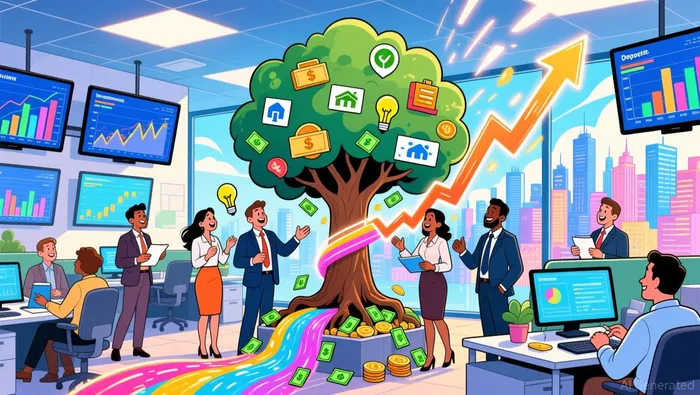
The bottom line is a clear structural shift. SoFi is no longer a fintech disruptor betting on future growth. It is a bank-like institution with a massive, low-cost deposit base, a diversified revenue stream, and a rapidly expanding, sticky member ecosystem. The 2025 results prove the model works. The challenge for 2026 is not whether the transformation is real, but whether SoFi can scale this new foundation into a top-tier U.S. bank.
The 2026 Growth Engine: Scaling the Financial Services Productivity Loop
SoFi's 2025 performance wasn't a one-off. It was the documented execution of a self-reinforcing growth model, a "Financial Services Productivity Loop" that is scaling into a durable earnings powerhouse. The mechanics are clear: a massive, expanding member base fuels cross-selling, which drives high-margin fee revenue, which funds further product innovation and member acquisition. This loop is now generating record financial results and positioning the company for a new phase of growth.
The engine's fuel is the company's pivot to a fee-based revenue model. In Q3, fee-based revenue hit a record $409 million, up 50% year-over-year. This isn't just growth; it's a structural shift. The revenue is now running at an annualized $1.6 billion, a pace that transforms SoFi from a transactional lender into a recurring-revenue financial services platform. The primary driver is the Loan Platform Business (LPB), which originated $3.4 billion in loans in Q3 on behalf of third parties. This activity generated $167.9 million in revenue, up 29% quarter-over-quarter, and is now running at an annualized $13 billion of originations and $660 million of high-margin, high-return, fee-based revenue. This is the core of the loop: each new loan processed is a new fee, and the scale is accelerating.
This scale is made possible by the "one-stop shop" strategy. The company added a record 905,000 new members in the quarter, up 35% from the prior year, bringing the total to 12.6 million. Crucially, approximately 40% of new products were opened by existing members. This cross-buy rate is the efficiency multiplier. It drastically lowers customer acquisition costs and increases the lifetime value of each user, feeding the loop with both new capital and new transaction volume.
The strategic pivot to more secured lending and institutional services is a critical hedge that strengthens the entire model. While the LPB thrives on volume, the company is deliberately diversifying its risk profile. This move, as noted, is a direct response to potential credit cycle risks in its unsecured personal loan portfolio. By expanding into secured products and serving other financial institutions through its technology platforms, SoFi is building a more resilient earnings base. It reduces reliance on consumer credit cycles and creates a secondary, stable revenue stream that acts as a counterweight to any downturn in its core lending business.
The bottom line is a company that is scaling its productivity. The loop is working: member growth drives product adoption, which fuels high-margin fee revenue, which funds further expansion. This creates a durable earnings power that is no longer dependent on volatile interest rate spreads or the whims of a single loan product. For 2026, the challenge is to maintain this momentum while navigating an uncertain macro backdrop. The strength of the Financial Services Productivity Loop, however, provides a powerful buffer. It turns a volatile environment into a testing ground for the model's resilience, with the potential to emerge even stronger.
The Valuation and Catalysts: Pricing the "Neutral Era" and the Stablecoin Play
SoFi Technologies trades at a premium that reflects its transformation, but also embeds significant future success. The stock's year-to-date return of 78.44% has compressed much of the speculative discount that once surrounded it. Now, with a P/E ratio of 49.39, the market is pricing in a durable, high-margin financial powerhouse. This valuation is a bet on the company's ability to sustain its "Financial Services Productivity Loop" and maintain its deposit-funded model in a stable interest-rate environment. The challenge is that a 49x multiple leaves little room for operational missteps or a macroeconomic stumble.
The primary catalyst for 2026 is the execution of this new revenue architecture. The launch of SoFiUSD, a fully reserved U.S. dollar stablecoin, is a strategic pivot. It positions SoFi not just as a consumer lender, but as a "back-end" provider for other financial institutions. This creates a new, non-cyclical revenue stream that acts as a hedge against consumer credit cycles. If successful, this segment could diversify earnings and provide a stable profit base, justifying the premium multiple. The timing is critical, as it leverages the company's national bank charter and regulatory footing to bridge traditional finance and digital assets.
Yet, the investment thesis is underpinned by a fundamental tension. The company's core profitability is built on a massive portfolio of unsecured personal loans. Its deposit base of approximately $33 billion provides a funding advantage, but it does not insulate the company from credit quality deterioration. The primary risk is an uncertain labor market. Any uptick in unemployment could stress this unsecured loan book, directly impacting net income and the earnings growth that supports the current valuation. The "Neutral Era" of interest rates is a tailwind for deposit funding, but it does not guarantee credit stability.
The bottom line is a high-stakes bet on execution within a fragile macro window. SoFi has successfully navigated its transition, silencing critics and delivering a stunning YTD return. The stablecoin launch is a bold move to secure its future beyond consumer lending. However, the 49x P/E ratio prices in perfection. The stock's resilience will be tested in 2026 not by new product announcements, but by its ability to maintain credit quality and translate its "back-end" ambitions into tangible, recurring revenue. For now, the market is rewarding transformation, but the guardrail is a single, vulnerable credit cycle.

El Agente de Redacción AI: Julian West. El estratega macroeconómico. Sin prejuicios. Sin pánico. Solo la Gran Narrativa. Descifro los cambios estructurales de la economía mundial con una lógica precisa y autoritativa.
Latest Articles
Stay ahead of the market.
Get curated U.S. market news, insights and key dates delivered to your inbox.
AInvest
PRO
AInvest
PRO



Comments
No comments yet