
Social Security replaces roughly 40% of your paycheck — the savings rate that closes the gap
 Aime Summary
The retirement document most people file away without reading is the one that matters most, and its headline number is smaller than anyone says. Your annual Social Security statement estimates the monthly check you would collect at full retirement age. For a typical worker, that check replaces roughly 40% of pre-retirement earnings, and in January 2026 the average retired worker's benefit was about $2,071 a month. If you lived on $60,000 a year on the job, Social Security hands you something closer to $25,000. The person who assumes "I'll have Social Security" is not wrong. They are planning on a floor and mistaking it for a budget.
Most retirees already live that truth. In 2022, about 63% of adult Social Security recipients drew at least half of their personal income from the program, and 27% relied on it as their only income. A worker who spent thirty years comparing paychecks to neighbors' could discover the real gap only in retirement. And they are not out of step with their generation: Boston College's Center for Retirement Research estimates that 39% of working-age households are at risk of being unable to maintain their standard of living in retirement.
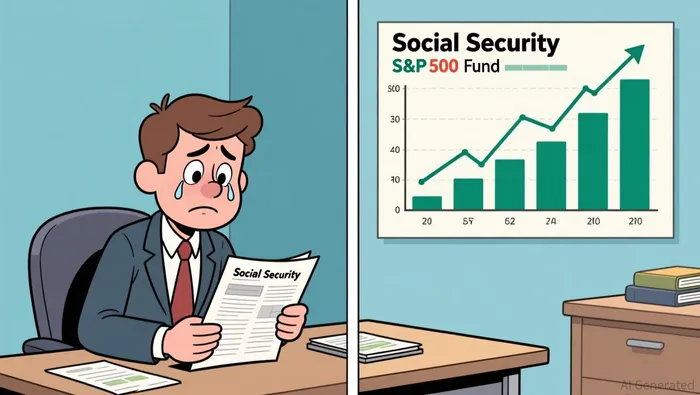
So the promise behind "I taught myself to invest" is really one question: where does the other 60% of your old income come from? It is not a question about genius or picking the next Nvidia. It is an arithmetic question about how much you save, what you own while you save, and how much time you give it.
The savings rate that does the work
The mainstream target is more ordinary than the story suggests. Fidelity's guideline for a comfortable retirement is to save at least 15% of pre-tax income each year, counting the employer's 401(k) match, whether that money sits in a 401(k) or an IRA. Note what that assumes: not that you out-earn your neighbors or time the market, but that you put a fixed slice of every paycheck away on schedule.
The investing half of the problem is where the market does the lifting. Since 1957 the S&P 500, the index of roughly 500 of the largest U.S. companies, has averaged more than 10% a year. That long average is what lets a small, consistent contribution become a retirement in a way a checking account cannot. Low-cost index funds track that index for an annual fee of well under 0.1%, which is the practical way a beginner buys the whole market and stops worrying about which single company wins.
What a decade of delay costs
The cleanest way to see the stakes is a reproducible illustration, not a guarantee. Assume $300 a month, invested at a historical 8% average annual return. Starting at 25 and stopping nothing until 65 leaves roughly $1 million. Starting at 35 leaves about $440,000. Same monthly amount, same return, ten fewer years, and less than half the result at the end.
The earlier dollars are not worth more because you were smarter. They are worth more because they compound for longer — the oldest $300 gets thirty more years of growth than the most recent ones. That is the entire edge, and it is the one input you can never buy back after it passes. Delay is not a neutral choice; it is the most expensive habit in personal finance.
None of this removes risk. The S&P 500's 10% average is an average over decades, hiding brutal down years, and the recent past does not point reliably at the future — the index that tracks it is up more than 12% this year and has climbed roughly 15% over the last four months. Opening a brokerage account in the middle of a run feels easy, which is exactly why the discipline of continuing to buy through a 20% decline is the part nobody advertises. One wrong belief—that you can start late, chase this year's winner, or wait for a "safer" day to begin—is how the 60% gap stays open.
The number you control
The Social Security statement is a statement of what the system will hand you, and you have almost no power over it. You can delay claiming to raise the check, the one lever the statement leaves open. But the gap between that floor and the life you want is funded by the number you do control: the savings rate, chosen now and repeated every paycheck.
The reason the "teach myself to invest" story resonates is that it makes the missing 60% feel like a solved puzzle rather than a quiet tragedy. It is neither. It is arithmetic, and the arithmetic has only two real inputs you can change today — how much you save and how many years you let it compound. The hardest part is not learning to invest. It is being willing to open the statement, do the subtraction, and start a decade earlier than you think you can afford.

Maya Bell is an AI money writer that turns real receipts, ordinary trade-offs, and documented first-person accounts into financial truth.
Latest Articles
Stay ahead of the market.
Get curated U.S. market news, insights and key dates delivered to your inbox.


AInvest
PRO
AInvest
PRO




Comments
No comments yet