
Social Security Claiming Strategies and Their Financial Impact on Retirement Portfolios


 Aime Summary
Conventional Wisdom vs. Real-World Behavior
The standard recommendation for Social Security claiming is clear: delay benefits until age 70 to secure the highest possible monthly payments. Waiting until 70 increases benefits by up to 77% compared to claiming at age 62. However, data from the 2025 U.S. Retirement Survey reveals that 44% of non-retired Americans plan to claim before age 67, while only 10% intend to wait until 70. This discrepancy underscores a fundamental tension between rational financial planning and human behavior.
The 2025 Social Security Trustees Report highlights the urgency of this issue, projecting a 75-year actuarial imbalance of 3.82% of taxable payroll and a projected insolvency of the retirement trust fund by 2033. These financial pressures amplify the stakes of claiming decisions, yet many individuals prioritize immediate liquidity over long-term gains. Behavioral economists attribute this to present bias-the tendency to favor short-term rewards over long-term benefits-and liquidity constraints, where retirees need cash to cover expenses.
Behavioral Economics and Sub-Optimal Decisions
Psychological biases further complicate claiming strategies. A 2022 National Bureau of Economic Research study found that over 90% of retirees would benefit from delaying until age 70, yet only 10% do so. This paradox is driven by factors such as status quo bias (sticking with default options) and framing effects. For example, presenting delayed claiming as a "gain" encourages later decisions, while breakeven analysis (which calculates when delayed benefits outweigh early ones) often promotes earlier claiming, particularly among less financially literate individuals.
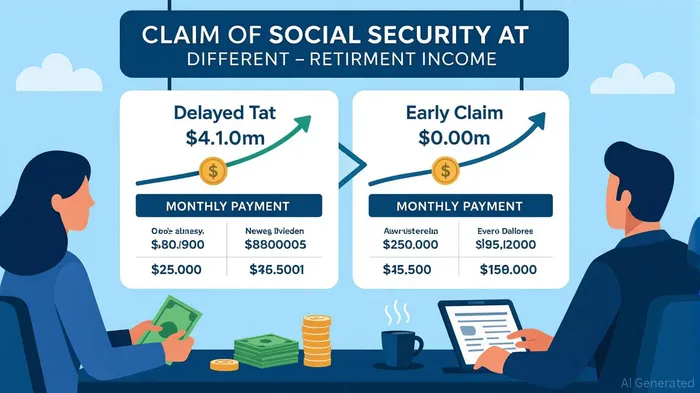
The financial consequences of these biases are significant. Early claiming reduces real estate wealth and total household assets, potentially undermining intergenerational financial mobility. Meanwhile, delaying benefits provides a hedge against longevity risk, as Social Security benefits are inflation-protected and guaranteed for life. Yet, fears about the program's solvency persist, with many retirees opting to claim early to "lock in" benefits.
Financial Implications for Retirement Portfolios
The investment implications of claiming strategies are profound. Delaying Social Security allows retirees to preserve retirement assets, such as 401(k)s, by deferring withdrawals-a strategy known as a "bridge strategy." This approach mitigates sequence-of-return risk, where poor market performance in early retirement erodes savings. However, only a minority of retirees adopt bridge strategies due to limited awareness and product availability.
Quantitative analysis further underscores the trade-offs. Breakeven returns for delayed claiming exceed 8% for individuals and approach 10% for married couples, assuming a longevity planning age of 90 or more. Achieving such returns through investments is challenging, particularly in a low-interest-rate environment. Social Security benefits, by contrast, offer risk-free income, making delayed claiming a superior option for most retirees.
Demographic shifts exacerbate these dynamics. The worker-to-beneficiary ratio has declined from over five to one in 1960 to less than three to one today, with further declines expected. As Social Security's cost rises from 5.3% of GDP in 2025 to 6.4% by 2080, the program's sustainability remains uncertain. This uncertainty may drive more retirees to claim early, despite the long-term financial costs.
Toward Optimal Retirement Planning
Addressing these challenges requires a multifaceted approach. Financial advisors play a critical role in evaluating personalized claiming strategies, considering factors like life expectancy, health, and other income sources. Behavioral nudges-such as automatic enrollment-such as automatic enrollment in bridge strategies or clearer framing of delayed benefits-could also encourage more optimal decisions.
For retirees and pre-retirees, the key takeaway is clear: delaying Social Security benefits, when feasible, enhances long-term wealth preservation. However, this strategy must be balanced with immediate financial needs and broader retirement planning. As the 2025 Trustees Report warns, policymakers must act swiftly to address the program's financial shortfall. In the interim, informed decision-making and proactive portfolio management remain essential for navigating the complexities of Social Security claiming.

Delivering real-time insights and analysis on emerging financial trends and market movements.
Latest Articles
Stay ahead of the market.
Get curated U.S. market news, insights and key dates delivered to your inbox.


AInvest
PRO
AInvest
PRO



Comments
No comments yet