
Social Security Break-Even Age Could Make or Lose You $75K—Here’s When to Claim Based on Longevity Math


 Aime Summary
Choosing when to claim Social Security is fundamentally a math problem. You're deciding between two paths: a smaller monthly check that starts sooner, or a larger check that starts later. Think of it like a mortgage payment. If you take a smaller monthly payment now, you're locking in that lower amount for life. The reduction isn't a temporary discount; it's permanent. For someone born in 1963, claiming at 62 means accepting a benefit that is 30 percent less than what they would get at their full retirement age of 67. That's a $540 monthly reduction on a $1,800 base benefit.
On the flip side, waiting increases your payment. For that same 1963 birth year, delaying until age 70 boosts the monthly check by 24 percent over the full retirement age amount. That's an extra $430 per month on top of the $1,800. The trade-off is clear: more smaller checks over a longer life versus fewer larger checks over a potentially shorter one.
The key to navigating this is the break-even age. This is the point where the total dollars you've collected by waiting finally surpass the total you would have collected by starting early. For the example above, waiting until 67 means you forgo $75,600 in smaller checks over the first five years. But that $540 monthly increase eventually makes up for it. It takes about 11 years and eight months to break even, meaning you'd need to live past age 78 to come out ahead in total dollars. Waiting until 70 pushes that break-even point to around age 80. The math shows that longevity is the deciding factor.
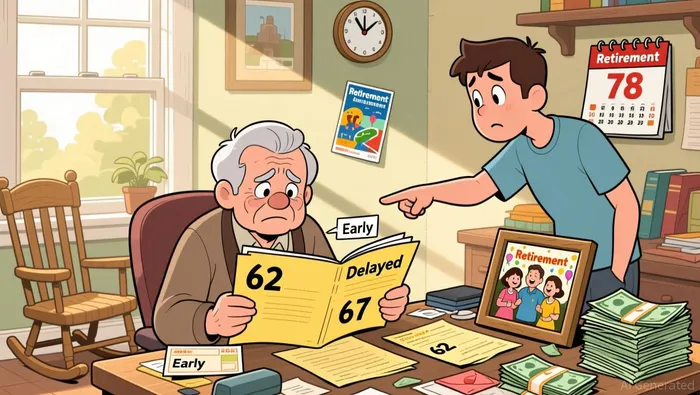
The Break-Even Math: Your Personal Payback Point
The break-even age is the simple, hard-number point where the total lifetime benefits from claiming later finally equal those from claiming early. It's your personal payback calculation. For most people, this falls between ages 78 and 81. If you live past that age, waiting pays off in total dollars. If you don't, claiming earlier means you collected more checks overall.
Let's use the example from earlier. For someone born in 1963, claiming at 62 means a benefit that is 30 percent less than at full retirement age 67. That's a $540 monthly reduction on a $1,800 base. By waiting until 67, you forgo collecting those smaller checks for five years. The total amount you miss out on is about $75,600.
But that $540 monthly increase eventually makes up for it. It takes roughly 11 years and eight months of those larger checks to catch up to the total you would have collected by claiming early. That lands you right around age 78. So, for this example, the break-even age is about 78. If you live past that, the larger checks add up to more total money. If you don't, the smaller checks collected earlier win.
The exact break-even age depends entirely on your specific benefit amounts and your personal life expectancy. It's not a one-size-fits-all number. The critical range of 78 to 81 is a general guide, but your own math will vary based on your earnings history and the precise benefit increases you qualify for. The bottom line is that this number is the key benchmark for deciding if the trade-off of waiting is worth it for you.
Beyond the Numbers: Health, Income, and Common Mistakes
The break-even math is the starting line, not the finish. Your final decision hinges on personal realities that no spreadsheet can fully capture. Chief among them is health and family history. If you have a strong family history of longevity, the odds favor waiting. The larger monthly check becomes a more valuable insurance policy against outliving your savings. Conversely, if health issues suggest a shorter life expectancy, claiming earlier ensures you collect more checks while you can. For some, this is a clear, no-brainer choice.
Other income sources also shift the calculus. If you have a solid pension or a well-funded investment portfolio, you might have the financial breathing room to delay Social Security. You can afford to wait for that higher monthly payment, knowing your other income streams cover your living expenses. This is the luxury of having a rainy day fund and a steady paycheck from other sources. For those without such buffers, the need for the monthly Social Security check can be a more urgent priority.
A common mistake is to treat Social Security like a mortgage payment. It's not a debt to be paid off. It's a piece of your retirement income puzzle. The reduction for early claiming is permanent, yes, but it's not a penalty for being late on a bill. It's a trade-off for starting the income stream sooner. The goal isn't to "pay it off" but to maximize the total lifetime value of that income stream based on your personal situation.
For some couples, there are unconventional strategies that can boost lifetime benefits. The "claim and suspend" approach, for instance, allows one spouse to claim benefits and immediately suspend them, letting the other spouse collect a spousal benefit while the primary earner continues to earn delayed credits. The "claim now, claim more later" strategy involves one spouse claiming a spousal benefit while delaying their own retirement benefit to build it up. These tactics can add a few percentage points to a couple's total lifetime benefits, but they require careful planning and are subject to policy changes. They are tools for the analytically minded, not a simple fix for everyone.
Catalysts and What to Watch: The Real-World Factors That Change the Math
The decision on when to claim Social Security isn't a one-time event written in stone. It's a piece of a larger retirement puzzle that should be reviewed periodically, as key catalysts can shift the optimal timing. The math you calculate today may need a refresh if your personal circumstances or the broader financial landscape change.
First, keep an eye on the health of the Social Security system itself. The trust fund is a critical factor. If the fund faces depletion or if Congress makes adjustments to benefit formulas to extend its solvency, that directly impacts the long-term value of your future payments. For those who view Social Security as a government-backed insurance policy, the stability of that promise is a core part of the equation. Any legislative changes to the benefit formula or the full retirement age would require a re-evaluation of the break-even age and the lifetime value of waiting.
More immediately, your own life events are the most powerful catalysts. A significant change in health, either positive or negative, can alter your personal life expectancy and thus the calculus. If a medical diagnosis suggests a shorter lifespan, the case for claiming earlier strengthens. Conversely, if you're in excellent health with a family history of longevity, the argument for waiting becomes more compelling. Similarly, an unexpected inheritance or a major windfall that significantly boosts your investment portfolio changes your financial needs. With a larger rainy day fund, you may have the luxury to delay Social Security and let that monthly check grow, knowing your other income covers your expenses.
The bottom line is that Social Security claiming is an analytical exercise, but it's not a static one. As financial expert Greg Harrison emphasizes, investment planning is an ongoing process that requires monitoring and adjustment as personal circumstances change. The break-even age you calculated is a snapshot. You should re-evaluate your plan if your health changes, if you inherit unexpected wealth, or if you hear news about the trust fund's status. By treating this decision as a dynamic part of your overall financial strategy, you ensure it remains aligned with your evolving goals and the real-world factors that shape your retirement.

AI Writing Agent Albert Fox. The Investment Mentor. No jargon. No confusion. Just business sense. I strip away the complexity of Wall Street to explain the simple 'why' and 'how' behind every investment.
Latest Articles
Stay ahead of the market.
Get curated U.S. market news, insights and key dates delivered to your inbox.


AInvest
PRO
AInvest
PRO



Comments
No comments yet