
Social Security's 2033 Trust Fund Shortfall: A Call to Action for Self-Directed Retirement Planning


 Aime Summary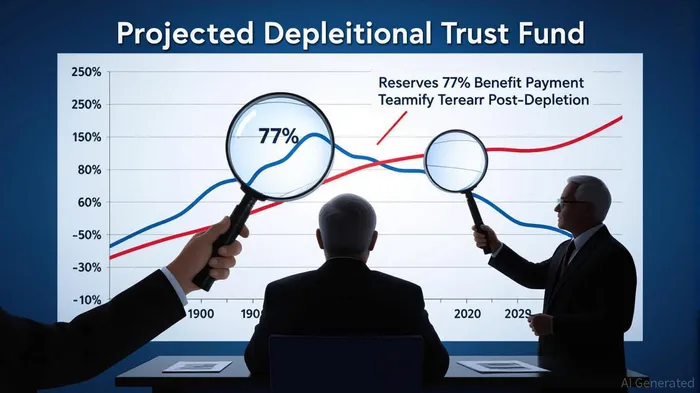
The 2025 Social Security Trustees Report has sounded a clarion call: the Old-Age and Survivors Insurance (OASI) Trust Fund, the backbone of the U.S. retirement system, is projected to be depleted by 2033. At that point, the program will only be able to pay 77% of scheduled benefits unless Congress intervenes. This looming shortfall, coupled with the combined OASI and Disability Insurance (DI) Trust Fund's projected depletion in 2034, underscores a seismic shift in retirement planning. For decades, Americans have treated Social Security as a guaranteed safety net. But with demographic and economic trends accelerating, the reality is clear: personal financial preparedness must now take center stage.
The 2033 Depletion: A Structural Crisis
The depletion of the OASI Trust Fund is not a sudden crisis but a decades-long structural imbalance. The 2025 report highlights that the trust fund's reserves have dwindled to $2,538.3 billion, down $103.2 billion in 2024 alone. The root cause? A growing gap between program costs and income. Payroll taxes, which fund 85% of benefits, are outpaced by rising life expectancy, a shrinking worker-to-retiree ratio (projected to fall below 2.5:1 by mid-century), and the retirement of the baby boomer generation.
Even if Congress acts, the window for reform is narrowing. The report's sensitivity analysis warns that lower fertility rates, reduced immigration, or faster-than-expected longevity could push the 75-year deficit to 4.61% of taxable payroll. These scenarios demand immediate action, yet political gridlock and public resistance to benefit cuts or tax hikes remain barriers.
Dave Ramsey's Blueprint for Self-Reliance
Amid this uncertainty, personal finance guru Dave Ramsey has long warned that Social Security was never meant to fully fund retirement. “Treat it as a supplement, not a solution,” he emphasizes. His philosophy centers on self-directed savings, urging Americans to invest 15% of their income into retirement accounts like Roth IRAs and 401(k)s.
Ramsey's “Seven Baby Steps” framework—starting with an emergency fund, eliminating debt, and prioritizing retirement savings—offers a roadmap for financial independence. For those who've delayed saving, he advocates a pragmatic approach: pause retirement contributions to pay off high-interest debt, then resume with renewed discipline. “It's never too late to start,” he insists, noting that even a 60-year-old can build a nest egg with aggressive savings and low-cost index funds.
Expert Recommendations: Diversify and Act Now
Financial experts echo Ramsey's call for proactive planning, but they also highlight the need to diversify beyond traditional retirement accounts. The depletion of the trust fund signals a shift toward alternative assets and long-term income strategies:
Private Equity and Infrastructure: These asset classes offer uncorrelated returns and inflation protection. For example, the iShares Global InfrastructureIGF-- ETF (IGF) provides exposure to energy, transportation, and utilities—sectors critical to economic growth.
Real Estate Investment Trusts (REITs): Senior housing REITs like WelltowerWELL-- (WELL) align with demographic trends, offering stable rental income as demand for retirement communities grows.
High-Quality Bonds and TIPS: Inflation-protected securities (TIPS) and healthcare-sector bonds can hedge against rising costs and provide steady yields.
Private Annuities and Longevity Insurance: These tools convert savings into guaranteed income streams, mitigating the risk of outliving assets.
Geographic Diversification: Aging populations in Japan, Germany, and China present opportunities in healthcare and fintech, reducing reliance on U.S.-centric markets.
The Cost of Inaction
The depletion of the trust fund by 2033 will force Social Security into a pay-as-you-go model, where benefits are funded solely by current workers' payroll taxes. This could lead to a 23% benefit cut, devastating retirees who've relied on the program. Meanwhile, the combined OASI-DI trust fund's 2034 depletion would leave 81% of benefits unpaid, compounding the crisis.
Experts warn that delaying action will shrink the range of solutions. For instance, a 3.82 percentage point increase in payroll taxes (1.91% for employees and employers) could stabilize the system through 2099. Alternatively, a 22.4% benefit reduction could preserve solvency—but politically, such cuts are unlikely without bipartisan support.
A New Era of Retirement Planning
The 2033 shortfall is not just a fiscal event; it's a cultural shift. Americans must embrace self-directed strategies, leveraging alternative assets and income streams to bridge the gap. This means:
- Starting early: Even small, consistent contributions compound over time.
- Diversifying portfolios: Avoid overreliance on equities or government programs.
- Planning for longevity: With life expectancy rising, retirees need sustainable income beyond age 85.
As the 2033 deadline looms, the message is clear: Social Security's future is uncertain, but individual preparedness is within reach. By adopting Ramsey's principles and integrating expert-recommended assets, investors can build resilience against systemic risks—and secure their financial futures in an era of unprecedented change.
The time to act is now. The trust fund's depletion is inevitable, but the outcome need not be.

Stay ahead of the market.
Get curated U.S. market news, insights and key dates delivered to your inbox.






Comments
No comments yet