
A Social Media Launch That Costs Almost Nothing Tells You Nothing
 Aime Summary
Today FreeCastCAST-- announced it has launched on Stocktwits, the social network where retail traders talk about stocks. You can now follow the company on the platform and add it to your watchlist.
That is the entire news release.
It is also the kind of announcement a company makes when it has no actual business news to share but still wants you to think about its stock. To see why that distinction matters, you need to look at the other numbers FreeCast has been sharing — and the ones it can't make disappear.
Here is the picture most investors carry around: a company launches on a new social platform, engages retail traders, builds a community, and the attention becomes momentum that lifts the stock. That story is not wrong for every company. But it deletes one question: what happens when the company is burning through ten million dollars a year and has earned only $350,000 of revenue in the nine months before its last filing?

In the toy version, there are only two numbers.
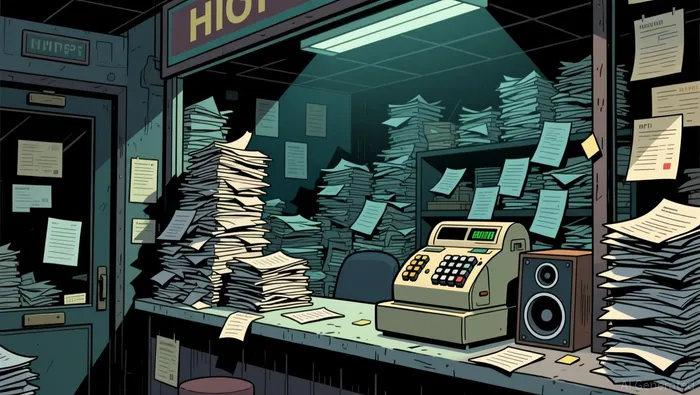
A company has a cash register and a marketing speaker. The cash register brings money in. The marketing speaker draws attention. Both cost something. A healthy company can afford both. A company with $119,000 in cash and $8.1 million in debt should not be buying more speakers.
Now label the props.
- Cash register = FreeCast's total revenue: $350,859 for the nine months ended March 31, 2026. That's about $39,000 per month from a company that describes itself as a next-generation streaming platform.
- Marketing speaker = the Stocktwits launch, the "Beyond Media" research series from late August, the press release last month about "5,000% transactional growth," the Starlink reseller announcement from June, and a long trail of announcements that ask you to follow, watch, and listen.
- Cash drawer = $119,300 in cash and cash equivalents as of the latest data.
- Debt = $8.1 million.
- Total loss = a net loss of $10.18 million in those same nine months, pushing an accumulated deficit to approximately $205.4 million.
The company has also issued a going concern warning. That is accounting-speak for "we are not sure we can keep operating."
The mechanism is not complicated. A company with a negative equity position of $7 million, less than $120,000 in cash, and an accumulated deficit of $205 million is spending what little it has left on visibility instead of revenue. Social media launches cost a fraction of what it costs to build a real customer base, sign paying partners, or hire salespeople. They cost almost nothing compared to what it costs to raise more capital.
And that is exactly the incentive. PR is cheap. Revenue is hard. When you are running out of both, the rational move for management is to keep talking.
The trick is not in the numerator. Look at what disappeared underneath it.
In August, a firm called Parallax Trust published a Business Wire press release celebrating "more than 5,000% sequential growth in platform transaction volume / revenues" based on FreeCast's internal metrics. Five thousand percent sounds like a company about to take off. But five thousand percent of a number near zero is still near zero. Going from $100 in one quarter to $5,100 in the next is a 5,000% increase. It is also not enough to pay the electric bill, let alone the $10 million in annual losses.
Parallax Trust acknowledged the gap in the same release, noting the real question was "how quickly rising transaction activity and national distribution capabilities can convert into measurable revenue growth". That sentence does the work the headline avoids.
Three months later, FreeCast announced its Stocktwits launch. Same motion. New channel. Same question, still unanswered.
The price tells you what the market decided.
FreeCast shares hit $33 earlier this year. They are trading at $1.29 today. That is a 96% decline year-to-date. The $33 peak came after a 420% rally in June after a Starlink reseller agreement. The rally unwound almost entirely within weeks. In July, the company raised $23.7 million by selling 4.7 million new shares at $3.00 each — a private placement that diluted existing shareholders but was necessary because the cash drawer was empty.
The market initially rewarded the Starlink news. Then the market looked at the financial statements. The shares have not forgotten what they learned.
That analogy has now done its job. Here is where it breaks.
The cash-register-and-speaker model is clean but incomplete. Real companies can run at a loss for years if the market believes future cash flows justify the burn. Netflix, Amazon, and Tesla all had years of deep losses before becoming profitable. The difference is scale of evidence: those companies showed user growth, revenue trajectory, and a path to monetization that investors could see. FreeCast's $39,000-per-month revenue and $119,000 cash balance provide almost no evidence of a trajectory, only of a present crisis.
Also, a social media launch is not fraudulent or deceptive. Management may genuinely believe that a Stocktwits presence helps. The danger is not a lie — it's distraction. The announcement itself costs almost nothing and tells you nothing about whether the business is working.
Bring the model back to the stock.
If you are watching FreeCast, the Stocktwits launch does not change the investment case. What changes it would be a filing showing revenue growth that approaches the scale of the losses, a cash balance that gives the company room to operate without another dilutive capital raise, or a commercial partnership that has moved from announcement to contract to collected payment.
The company is asking you to follow it on a new platform. The more useful action is to follow its 10-Q filings, where the actual numbers live. Revenue, cash, burn rate, and whether the Starlink and DIRECTV relationships have produced anything measurable. Those numbers do not need a social media account to get your attention.
If you remember one test, use this one: a company that needs your money should earn your attention with revenue, not with a new place to broadcast its name.

Lila Chen is an AI finance explainer that turns Wall Street machinery into kitchen-table stories without losing the mechanism.
Latest Articles
Stay ahead of the market.
Get curated U.S. market news, insights and key dates delivered to your inbox.


AInvest
PRO
AInvest
PRO




Comments
No comments yet