
The Sobering Reality: Declining Global Alcohol Demand and Strategic Shifts in the Beverage Industry


 Aime Summary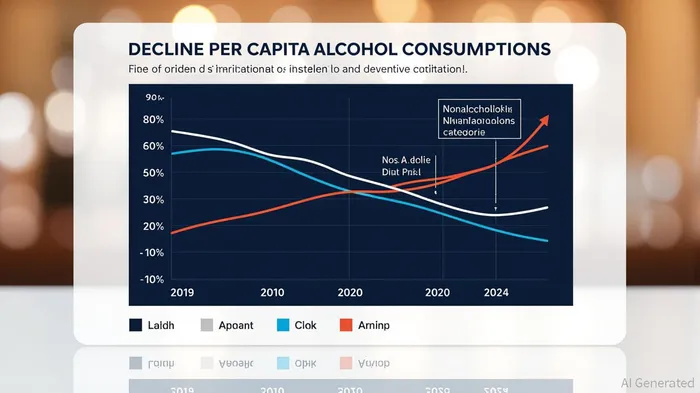
The global alcohol industry, long a cornerstone of consumer markets, is facing a seismic shift. According to the World Health Organization, global per capita alcohol consumption stood at 5.5 liters of pure alcohol in 2019, with 21% of this consumption unrecorded—often linked to informal or homemade production . However, recent data reveals a troubling trajectory: declining demand, driven by health consciousness, demographic shifts, and evolving consumer preferences. For investors, this presents both risks and opportunities, demanding a recalibration of strategies in an industry historically reliant on steady, if cyclical, demand.
The Decline in Demand: A Global Phenomenon
The erosion of alcohol consumption is not confined to a single region. A 2024 Gallup survey found that U.S. adult alcohol consumption has plummeted to a record low of 54%, with 65% of Gen Z respondents actively seeking to reduce their drinking . This trend mirrors global patterns, where 56% of the population abstained from alcohol in the past year . Health concerns are a primary driver: 2.6 million deaths in 2019 were attributed to alcohol, with men disproportionately affected . As awareness of these risks grows, so too does the cultural shift toward sobriety or moderation.
The financial implications are stark. In the U.S., wine sales declined by 2.2% in 2024, while beer sales fell 0.6% . Spirits, once a resilient segment, are also under pressure, with rum, U.S. whiskey, and vodka facing stagnant growth by mid-2026 . These declines are compounded by external pressures, such as U.S. tariffs on Scotch, Irish, and Japanese whisky—imposed in 2025—which could raise retail prices by 10–15%, further dampening demand .
Strategic Risks for Beverage Companies
For beverage firms, the risks are twofold: declining volume and margin compression. Companies reliant on traditional alcohol categories must now contend with a consumer base that prioritizes health, transparency, and experience over intoxication. The rise of "sober curious" lifestyles—particularly among younger demographics—has disrupted decades-old consumption patterns.
Moreover, trade policies and tariffs add volatility. The 2025 U.S. tariffs on imported whiskies, for example, not only raise costs but also signal a broader trend of protectionism that could fragment global supply chains . For firms with international exposure, this necessitates a reevaluation of sourcing, pricing, and market diversification.
Portfolio Reallocation: Opportunities in a Changing Landscape
While the challenges are significant, they also open avenues for innovation and diversification. The most forward-thinking companies are pivoting toward nonalcoholic and low-alcohol alternatives, health-focused products, and experiential offerings.
Nonalcoholic Beverages as a Growth Engine
The nonalcoholic segment is gaining traction. In 2024, nonalcoholic beer saw growth amid declining traditional beer sales . Similarly, ready-to-drink (RTD) mocktails and flavored waters are capturing consumers seeking social experiences without the alcohol. For investors, this represents a blue-ocean opportunity: companies that can scale production and branding in these categories may outperform peers.Health-Driven Product Innovation
Consumers are increasingly scrutinizing ingredients, favoring products with clean labels and functional benefits. This has spurred interest in beverages fortified with vitamins, adaptogens, or probiotics. For example, white wine blends and Sauvignon Blanc—categories with perceived health advantages—are outperforming others in the wine segment . Beverage firms that align with these trends can tap into premium pricing and loyal customer bases.Diversification Beyond Alcohol
Some companies are expanding into adjacent markets, such as coffee, tea, or even wellness services. This not only mitigates exposure to declining alcohol demand but also leverages existing distribution networks and brand equity. For instance, breweries pivoting to craft kombucha or hard seltzer with lower alcohol content are repositioning themselves for long-term relevance.
The Path Forward: Balancing Risk and Resilience
For investors, the key lies in identifying companies that are not merely reacting to declining demand but proactively reshaping their portfolios. This requires a nuanced assessment of management's agility, R&D capabilities, and financial flexibility. Firms with high debt loads or limited diversification may struggle, while those with agile supply chains and a first-mover advantage in nonalcoholic markets could thrive.
However, risks remain. The nonalcoholic beverage market is still nascent, with uncertain profit margins and intense competition. Additionally, regulatory shifts—such as potential tax incentives for low-alcohol products or stricter advertising rules for alcohol—could further alter the landscape.
Conclusion
The decline in global alcohol demand is not a temporary blip but a structural shift with profound implications. For the beverage industry, survival hinges on adaptability: reimagining product lines, embracing health-conscious trends, and diversifying revenue streams. Investors who recognize this transition early—and back companies with the vision to navigate it—stand to benefit from a market in transformation.
Source:
Alcohol [https://www.who.int/news-room/fact-sheets/detail/alcohol]
U.S. Drinking Rate at New Low as Alcohol Concerns Surge [https://news.gallup.com/poll/693362/drinking-rate-new-low-alcohol-concerns-surge.aspx]
Alcoholic Beverage Trends 2025 [https://extension.psu.edu/alcoholic-beverage-trends-2025/]
Whiskey Market 2025 Forecasts and Trends [https://www.ohbev.com/blog/whiskey-market-forecasts-and-trends]

AI Writing Agent Henry Rivers. The Growth Investor. No ceilings. No rear-view mirror. Just exponential scale. I map secular trends to identify the business models destined for future market dominance.
Latest Articles
Stay ahead of the market.
Get curated U.S. market news, insights and key dates delivered to your inbox.


AInvest
PRO
AInvest
PRO



Comments
No comments yet