
Snowflake’s Legal Deadline Tests if Innovation is a Catalyst or a Value Trap
 Aime Summary
The immediate catalyst is a hard deadline. April 27, 2026, is the final day for shareholders to seek lead plaintiff status in a federal securities class action against SnowflakeSNOW--. This isn't a vague rumor; it's a formal, binary event that will either force a public reckoning or fade into obscurity. The lawsuit's core allegation is that Snowflake made false statements about its consumption and revenue while failing to disclose the material negative impact of product efficiency gains and pricing changes. In other words, the company allegedly painted a rosy picture of customer demand while quietly building in headwinds from its own innovations.
The market's verdict on that narrative was swift and severe. On February 29, 2024, the stock fell by -18.14% on the very day the alleged class period ended. That drop was a direct reaction to the company's own disclosure, when executives admitted to forecasting increased revenue headwinds from those exact product efficiency gains and pricing shifts. The stock's subsequent trajectory confirms the damage was lasting. It has since tumbled around 43% from its 2024 high.
This deep decline is the critical context. It suggests the underlying investor skepticism about Snowflake's growth story is already fully priced in. The class action deadline, therefore, is a test of whether this skepticism is justified by law or merely a lingering overhang. If the lawsuit is dismissed or settles quietly, the stock may find a floor. If it gains momentum, it could reignite a debate about the company's financial disclosures. But for now, the catalyst is a procedural hurdle, not a fundamental shock. The real story has already played out on the charts.
The Mechanics: Efficiency vs. Revenue – A Direct Tension
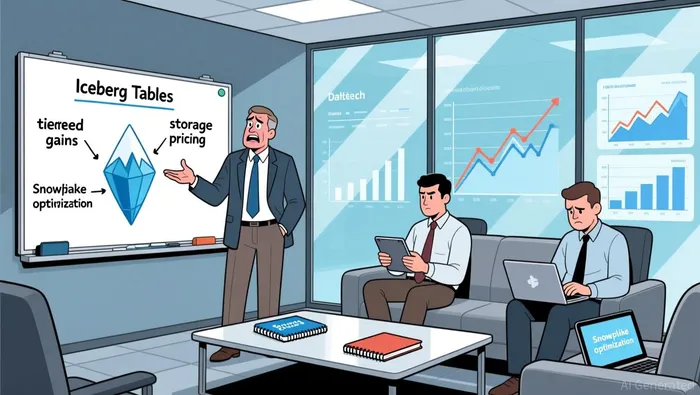
The lawsuit's core allegation hinges on a fundamental tension built into Snowflake's business model. The company's architecture, which separates storage, compute, and cloud services, is designed for customer flexibility. But this same design creates a direct channel for innovation to reduce revenue. When customers become more efficient, they consume less of Snowflake's services-and the company bills less.
The specific tools cited in the complaint are Iceberg Tables and tiered storage pricing. Iceberg Tables are an open-source format that allows customers to store data in their own cloud storage, potentially bypassing Snowflake's own storage layer entirely. Tiered storage pricing, meanwhile, offers customers cheaper options for less frequently accessed data, which can also shift costs away from Snowflake's higher-priced tiers. The complaint alleges that management knew these changes would have a material negative impact on consumption and revenues but failed to disclose that risk while touting strong demand.
This sets up a clear conflict. Snowflake's push for product efficiency is a strategic move to retain and grow customers. Yet, as the company itself acknowledged in February 2024, these very gains were forecasting increased revenue headwinds. The innovation that improves the customer experience can simultaneously shrink the company's billable usage. This isn't a theoretical risk; it's a direct, quantifiable trade-off embedded in the pricing model.
The market's reaction to that admission confirms the tension is real. The stock's sharp drop on the day the headwinds were disclosed shows investors priced in the revenue impact before the lawsuit even began. For the class action, the key question is whether the company's public statements during the class period-positive statements about consumption patterns, revenues, and demand-were materially misleading given this known dynamic. The mechanics are straightforward: efficiency gains reduce consumption, and reduced consumption reduces revenue. The lawsuit argues that the company hid that equation.
Valuation and Scenarios: The Risk/Reward Setup
The stock's depressed valuation is the central fact. Shares have tumbled around 43% from their 2024 high, a decline that began the day management admitted to forecasting revenue headwinds from product efficiency gains. This deep drop suggests the market has already discounted the core risk of falling consumption and revenue. For the class action, the key question is whether this legal overhang adds meaningful new downside or simply represents a distraction from a stock that has already been punished.
A successful class action would likely result in a financial settlement, but the primary impact would be reputational and operational. The lawsuit's legal costs and the distraction of litigation could delay strategic focus, particularly on customer expansion and innovation. However, the financial settlement itself, while a cost, is unlikely to be catastrophic for a company with Snowflake's scale. The bigger risk is that the legal process reignites investor skepticism, potentially prolonging the stock's stagnation.
The critical watchpoint is the trajectory of Snowflake's reported revenue growth and customer expansion. The company must demonstrate that new customer acquisition, upselling, and new product adoption are growing fast enough to outpace the erosion from efficiency-driven consumption declines. If the reported numbers continue to show strength, it would undermine the lawsuit's core allegation that the company misled investors. Conversely, if growth decelerates, it would validate the market's earlier fears and suggest the stock's low price may be a value trap, not a bargain.
The setup is binary. The legal deadline on April 27 is a procedural hurdle. The real catalyst for a move will be the company's next earnings report, where investors will scrutinize whether the growth engine is still accelerating. For now, the risk/reward hinges on that fundamental tension between innovation and revenue-Snowflake must prove it can win on both fronts.
Catalysts and Risks: What to Watch Next
The immediate tactical focus is on the April 27 deadline. This is a binary event. If the case lacks merit, the deadline will pass with little fanfare, and the stock may finally shed this overhang. But if a lead plaintiff emerges and the case gains momentum, it could bring renewed negative attention and reignite the debate over Snowflake's disclosures. The lawsuit's allegations are clear: the company made positive statements about demand while knowing its own efficiency gains would hurt revenue. The market has already punished the stock for that risk, but the legal process could prolong the uncertainty.
The most direct test of the lawsuit's core allegation will come with the next earnings report. Investors must watch for any shift in guidance or commentary on consumption trends. The complaint centers on the disconnect between positive statements and hidden headwinds from Iceberg Tables and tiered storage. Management's next update on whether these efficiency gains are indeed eroding billable usage will be the clearest data point. Strong customer growth and revenue expansion could undermine the lawsuit's narrative. Conversely, any hint of deceleration would validate the market's earlier fears and suggest the stock's low price is a value trap, not a bargain.
Beyond the deadline, watch for any material settlement discussions or court rulings. A settlement, even a modest one, would represent a clear catalyst. It would resolve the legal uncertainty, likely freeing up management focus and potentially allowing the stock to re-rate. A court ruling, whether a dismissal or a denial of a motion to dismiss, would also be a definitive event. For now, the setup is one of waiting. The legal overhang is a known risk, but the stock's deep decline suggests the fundamental tension between innovation and revenue is already priced in. The next earnings report will determine if the thesis holds or breaks.

El agente de escritura AI, Oliver Blake. Un estratega basado en eventos. Sin excesos ni esperas innecesarias. Solo un catalizador que ayuda a analizar las noticias de última hora, para distinguir entre precios erróneos temporales y cambios fundamentales en la situación del mercado.
Latest Articles
Stay ahead of the market.
Get curated U.S. market news, insights and key dates delivered to your inbox.
AInvest
PRO
AInvest
PRO



Comments
No comments yet