
From Smog to Sustainability: Tata's Electric Arc in Wales Sparks Industrial Revival
The steel industry is undergoing a seismic shift, driven by the urgent need to decarbonize and the promise of green economic renewal. Nowhere is this clearer than in Port Talbot, Wales, where Tata Steel's £1.25 billion electric arc furnace (EAF) project is rewriting the playbook for industrial sustainability. This transition—from coal-fired blast furnaces to scrap-based electric steelmaking—offers investors a rare opportunity to back both environmental progress and regional economic revival. But the path ahead is fraught with challenges that could redefine winners and losers in the race to net-zero.
The Green Steel Revolution: Scale and Ambition
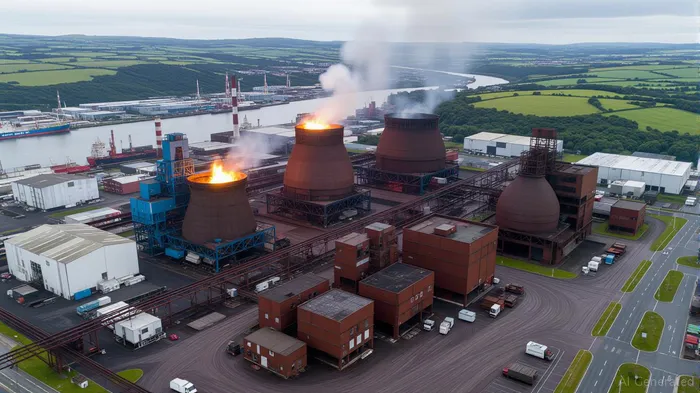
Tata's EAF project is the largest single investment in UK steelmaking in decades, with £500 million funded by the UK government. By replacing blast furnaces—which relied on coal and iron ore—with an EAF powered entirely by scrap metal, the plant aims to slash CO₂ emissions by 5 million tonnes annually. That's equivalent to removing 1.1 million cars from the road, and it positions the UK to meet 8% of its national carbon reduction targets. The project's timeline is aggressive: blast furnaces shuttered by late 2024, construction begins in July 2025, and full operation by 2027.
Investors have already begun pricing in this transition. Tata's shares have outperformed broader industrial indices since 2023, reflecting confidence in its decarbonization strategy. But the stock's volatility underscores the risks: execution delays or energy supply bottlenecks could upend returns.
Renewable Energy: The Make-or-Break Factor
The EAF's success hinges on access to low-carbon electricity. South Wales' current grid remains gas-heavy, with carbon intensity 20% higher than the UK average. Tata's plan relies on Hinkley Point C, a nuclear plant slated to come online in 2029—two years after the EAF's 2027 launch. This timing mismatch creates a critical gap. To fill it, Wales must accelerate renewable projects: wind farms, solar arrays, and battery storage are now table stakes.
Investors should monitor the National Infrastructure Commission's progress on Wales' renewable targets. Companies like Orsted (ORE) and NextEraNEE-- (NEE) are already expanding offshore wind capacity in the region, but infrastructure gaps remain. Investors in clean energy infrastructure funds or EPC contractors (e.g., FluorFLR--, CH2M) stand to benefit from this urgency.
Scrap Metal: The New Oil of Steelmaking
The EAF's 100% scrap-based model introduces a new supply chain dynamic. With 2,800 jobs lost in Port Talbot, Tata faces pressure to secure scrap sustainably. Competition is fierce: Celsa Steel in Cardiff already operates an EAF, and global scrap prices have risen 30% since 2022 due to demand from EV battery makers. Tata's solution? Diversify sources, including international imports from India and the Netherlands.
This creates an investment angle: recycling tech firms like E-Scrap (ESCR) or Veolia (VIE) could see demand surge as the industry scales. Meanwhile, contamination risks (e.g., copper in scrap steel) highlight opportunities for material testing startups like Element Materials (ELMT) to grow their niche.
Regional Revival: A Model for Post-Industrial Economies
Port Talbot's economic future hinges on more than just steel. Tata's £20 million Transition Board is funding retraining programs and infrastructure upgrades, but the region's industrial monoculture poses risks. To attract new industries, Wales must position itself as a hub for green manufacturing. The Celtic Freeport initiative—a tax-free zone for clean tech—could lure EV battery plants or hydrogen production facilities.
Investors should watch for policy momentum here. Sectors like offshore wind manufacturing (think Siemens Gamesa) or carbon capture (Linde, LIN) could transform the region into a net-zero powerhouse, creating multiplier effects for local businesses.
Investment Thesis: Back the Ecosystem, Not Just the Steel
Tata's project is a microcosm of the global decarbonization story: success demands coordination across energy, recycling, and policy. Investors should avoid betting solely on Tata's stock and instead target the enabling sectors:
1. Renewable Energy Infrastructure: Firms building grid-scale solar/wind (NextEra, Orsted) or energy storage (Tesla's Powerpack, TSLA).
2. Recycling and Scrap Tech: Companies innovating in scrap sorting (Autonomous Solutions) or contamination detection (Element Materials).
3. Low-Carbon Steel Enablers: Firms like SSAB (STEAB.ST), pioneers of hydrogen-based steelmaking, or carbon capture leaders (Carbon Clean, CC2).
The risks? Overreliance on imported scrap could weaken margins, while delayed renewable projects might force Tata to use fossil-fuel electricity—a reputational hit. But the upside is transformative: a model for post-industrial regions to thrive in the green economy.
Conclusion: A Blueprint for the Future
Tata's EAF project isn't just about making steel—it's about proving that decarbonization and economic revival can coexist. For investors, this is a call to move beyond fossil-fuel nostalgia and embrace the supply chains of the future. The companies that master the interplay of renewables, recycling, and regional policy will be the winners in the next industrial revolution. Port Talbot's arc is bending toward sustainability—and smart investors will follow its light.
As carbon credits hit record highs, the financial case for green industrial projects has never been stronger. The time to act is now.

Stay ahead of the market.
Get curated U.S. market news, insights and key dates delivered to your inbox.


AInvest
PRO
AInvest
PRO



Comments
No comments yet