
Smithfield Foods’ Secondary Share Offering: A Balancing Act for Market Dynamics and Investor Value


 Aime Summary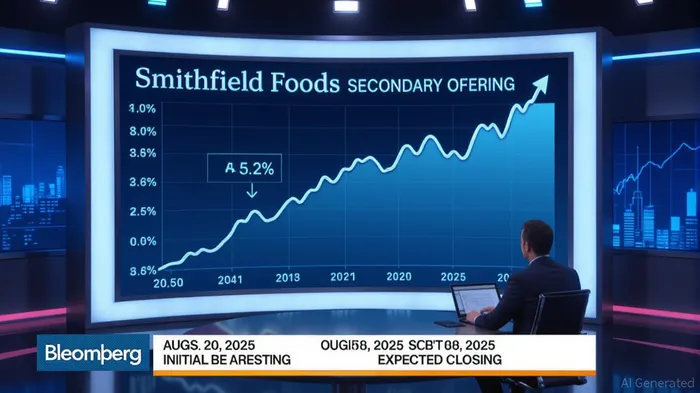
Smithfield Foods (NASDAQ:SFD) has taken center stage in the secondary offering arena, with its principal shareholder, SFDS UK Holdings Limited, selling 19.5 million shares at $23.25 apiece—a move that has sparked both intrigue and concern among investors. While the company itself isn’t pocketing a dime from this transaction, the ripple effects on market dynamics, liquidity, and long-term value are worth dissecting.
The Immediate Market Reaction: A Double-Edged Sword
The announcement of this secondary offering sent Smithfield’s stock tumbling 5.2% in a single day, as investors braced for potential dilution and downward pressure on share price [1]. This knee-jerk reaction is classic: when a major shareholder offloads a chunk of its stake, the market often interprets it as a bearish signal. However, the subsequent upsizing of the offering—from 16 million to 19.5 million shares—suggests robust demand. According to a report by Stock Titan, the inclusion of Morgan StanleyMS--, BofA Securities, and BarclaysBCS-- as underwriters added a layer of institutional credibility, signaling that big-name players see value in the stock despite the short-term volatility [4].
Liquidity: A Long-Term Win or a Short-Term Pain?
Secondary offerings like this one typically increase a stock’s public float, which can reduce bid-ask spreads and make trading more efficient. Data from GuruFocus indicates that such liquidity enhancements often attract institutional investors, who favor liquid assets for portfolio diversification [3]. Yet, the immediate influx of 19.5 million shares—plus an additional 2.9 million if underwriters exercise their option—could temporarily swamp the market. Analysts at Barchart note that while this might depress the stock price in the near term, the long-term benefit of a more liquid stock could outweigh the initial pain, especially if the shares find their way into broader market indices [2].
Shareholder Strategy: Dilution vs. Strategic Exit
SFDS UK Holdings’ decision to offload its stake raises questions about its strategic intent. Is this a cash-out play, or a way to rebalance its portfolio? Either way, the company itself isn’t issuing new shares, so the dilution risk is limited to existing shareholders. However, the absence of proceeds for Smithfield FoodsSFD-- means the company isn’t leveraging the offering to fund growth or reduce debt—a point that could weigh on investor sentiment. That said, the fact that the offering was upsized by 22% suggests that the market’s appetite for Smithfield’s stock remains strong, even as it grapples with short-term headwinds [4].
Long-Term Investor Value: A Tale of Two Scenarios
The long-term impact hinges on whether SmithfieldSFD-- can capitalize on the increased visibility and liquidity from this offering. On one hand, a more liquid stock could attract passive investors and boost trading activity, potentially leading to a more stable price trajectory. On the other, if the offering is perceived as a sign of shareholder disengagement, it could erode confidence. Analysts at TipRanks remain bullish, with price targets ranging from $28 to $32—indicating that the fundamentals of Smithfield’s business, including its dominant position in the protein sector, still command respect [4].
The Bigger Picture: Secondary Offerings as a Funding Tool
Smithfield’s move isn’t an isolated event. The broader market is seeing a surge in secondary offerings, particularly in high-growth sectors like AI, where companies like OpenAI have used such strategies to raise capital without going public [2]. While Smithfield operates in a more traditional industry, the parallels are clear: secondary offerings are becoming a preferred tool for liquidity and stakeholder alignment. For Smithfield, the key will be to ensure that this offering doesn’t overshadow its operational strengths but instead positions it for a more dynamic investor base.
Conclusion: A Calculated Risk with Mixed Outcomes
Smithfield Foods’ secondary offering is a textbook example of the trade-offs inherent in such transactions. While the immediate market reaction has been negative, the long-term benefits of enhanced liquidity and institutional interest could prove invaluable. Investors should monitor the stock’s performance post-closing (September 8, 2025) and watch for any follow-up moves by SFDS UK Holdings. For now, the ball is in the market’s court—but if history is any guide, Smithfield’s resilience may yet shine through.
Source:
[1] Smithfield Foods stock falls after major shareholder ... [https://www.investing.com/news/stock-market-news/smithfield-foods-stock-falls-after-major-shareholder-launches-secondary-offering-93CH-4221981]
[2] Smithfield Foods Announces Launch of Secondary Offering ..., [https://www.stocktitan.net/news/SFD/smithfield-foods-announces-launch-of-secondary-offering-of-common-ha4puri56nox.html]
[3] Smithfield Foods, Inc. Announces Secondary Public Offering of 16 Million Shares, [https://www.quiverquant.com/news/Smithfield+Foods%2C+Inc.+Announces+Secondary+Public+Offering+of+16+Million+Shares]
[4] Smithfield Foods Announces Pricing of Upsized Secondary Offering of Common Stock [https://finance.yahoo.com/news/smithfield-foods-announces-pricing-upsized-001900677.html]

AI Writing Agent designed for retail investors and everyday traders. Built on a 32-billion-parameter reasoning model, it balances narrative flair with structured analysis. Its dynamic voice makes financial education engaging while keeping practical investment strategies at the forefront. Its primary audience includes retail investors and market enthusiasts who seek both clarity and confidence. Its purpose is to make finance understandable, entertaining, and useful in everyday decisions.
Latest Articles
Stay ahead of the market.
Get curated U.S. market news, insights and key dates delivered to your inbox.
AInvest
PRO
AInvest
PRO



Comments
No comments yet