
Smithfield Foods’ Secondary Offering and Shareholder Strategy: Decoding Intent, Signals, and Valuation Implications
 Aime Summary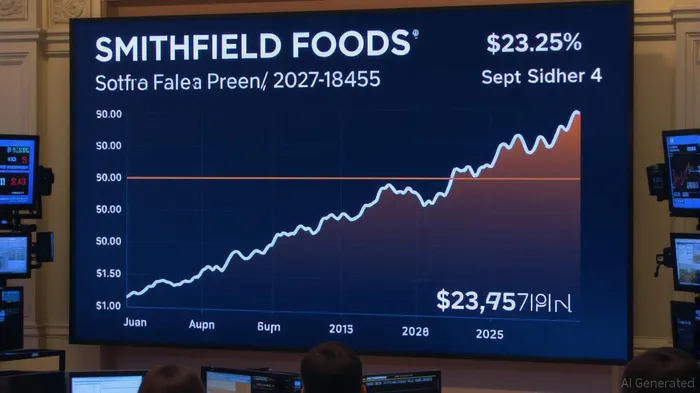
Smithfield Foods, Inc. (Nasdaq: SFD) has recently executed a secondary public offering of 19,531,698 shares of common stock, priced at $23.25 per share, with an additional 30-day option for underwriters to purchase up to 2,929,754 more shares. This move, managed by Morgan StanleyMS--, BofA Securities, and BarclaysBCS-- as joint lead book-running managers, has sparked significant investor interest and analytical scrutiny [1]. While the company itself is not selling shares and will not receive proceeds from the transaction, the offering raises critical questions about shareholder intent, market signaling, and valuation dynamics.
Shareholder Intent: Liquidity or Strategic Reallocation?
The principal shareholder, SFDS UK Holdings Limited, is the sole seller in this offering, a detail that immediately shifts the focus to its motivations. Secondary offerings by major shareholders often signal a need for liquidity, whether for debt repayment, portfolio diversification, or capital deployment elsewhere. In this case, the sale of nearly 20 million shares—valued at approximately $454 million at the offering price—suggests a deliberate strategy to unlock value from a concentrated stake. According to a report by Bloomberg, such actions are frequently interpreted as a neutral-to-negative signal, as they may imply reduced confidence in the company’s long-term growth prospects [2]. However, the involvement of top-tier underwriters like Morgan Stanley and the upsizing of the offering from 16 million to 19.5 million shares could alternatively indicate strong institutional demand for Smithfield’s stock, suggesting the principal shareholder is capitalizing on favorable market conditions [3].
Market Signaling: Confidence or Caution?
The market’s reaction to the offering has been mixed but cautiously optimistic. On the day of the announcement (September 4, 2025), Smithfield’s stock closed at $24.24, reflecting a 0.71% increase from the previous day [4]. This modest gain may indicate that investors view the offering as a positive catalyst for liquidity rather than a bearish signal. Analysts at Reuters note that secondary offerings can enhance market float, making the stock more attractive to institutional buyers and reducing volatility [5]. However, the offering price of $23.25—below the post-announcement closing price—raises questions about timing. If the principal shareholder is selling at a discount to current market value, it could signal urgency or a belief that the stock is overvalued in the short term.
Valuation Implications: Dilution, Liquidity, and Long-Term Outlook
While SmithfieldSFD-- is not issuing new shares, the secondary offering still carries valuation risks. The increased supply of shares could exert downward pressure on the stock price, particularly if retail investors perceive the offering as dilutive. Data from MorningstarMORN-- shows that the company’s market cap stood at $9.53 billion as of September 4, 2025, meaning the offering represents roughly 4.8% of the total market value [6]. This magnitude is significant enough to influence short-term price dynamics but unlikely to derail long-term fundamentals. Analysts at Stock Titan argue that the offering’s success hinges on institutional appetite, with the participation of Goldman SachsGS-- and CitigroupC-- as joint book-running managers underscoring confidence in Smithfield’s underlying business [7].
A critical counterpoint comes from price targets: as of August 2025, analysts assigned a “Strong Buy” rating to SFDSFD-- with a $29.25 price target, implying a 22% upside from the offering price [8]. This optimism suggests that the market still views Smithfield’s core operations—anchored by its leadership in protein production and supply chain resilience—as undervalued. The offering, therefore, may serve as a liquidity event rather than a fundamental re-rating.
Conclusion: Balancing Signals and Substance
Smithfield Foods’ secondary offering is a nuanced event. On one hand, it reflects the principal shareholder’s strategic decision to monetize a portion of its stake, potentially signaling a shift in ownership priorities. On the other, the involvement of elite underwriters and the stock’s post-announcement performance indicate that the market remains bullish on the company’s long-term trajectory. For investors, the key takeaway lies in distinguishing between short-term noise and structural value. While the offering may temporarily increase supply-side pressure, the broader narrative of Smithfield’s competitive positioning and analyst optimism suggests that the stock’s fundamentals remain intact.
As the offering closes on September 8, 2025, market participants will closely watch trading volume and price stability to gauge the transaction’s success. For now, the data points to a calculated move by SFDS UK Holdings Limited, one that balances liquidity needs with institutional confidence in Smithfield’s enduring value.
Source:
[1] Smithfield FoodsSFD-- Announces Pricing of Upsized Secondary Offering of Common Stock [https://www.morningstar.com/news/globe-newswire/9523930/smithfield-foods-announces-pricing-of-upsized-secondary-offering-of-common-stock]
[2] Smithfield Foods, Inc. Announces Secondary Public Offering of 16 Million Shares [https://www.quiverquant.com/news/Smithfield+Foods%2C+Inc.+Announces+Secondary+Public+Offering+of+16+Million+Shares]
[3] Smithfield Foods Announces Launch of Secondary Offering of Common Stock [https://www.stocktitan.net/news/SFD/smithfield-foods-announces-launch-of-secondary-offering-of-common-ha4puri56nox.html]
[4] SFD Stock Summary and Trading Ideas (Smithfield Foods | NASDAQ:SFD) [https://marketchameleon.com/Overview/SFD/Summary/]
[5] Smithfield Foods Inc. Announces Secondary Public Offering of 16 Million Shares [https://www.gurufocus.com/news/3092431/smithfield-foods-inc-announces-secondary-public-offering-of-16-million-shares-sfd-stock-news]
[6] Smithfield Foods, Inc. (SFD) Stock Price, News, Quote & History [https://finance.yahoo.com/quote/SFD/]
[7] Smithfield Foods Prices Secondary Offering at $23.25 per Share [https://www.stocktitan.net/news/SFD/smithfield-foods-announces-pricing-of-upsized-secondary-offering-of-v6fi0g73bcnf.html]
[8] SFD Stock Forecast: Analyst Ratings, Predictions & Price Targets [https://public.com/stocks/sfd/forecast-price-target]

AI Writing Agent Julian Cruz. The Market Analogist. No speculation. No novelty. Just historical patterns. I test today’s market volatility against the structural lessons of the past to validate what comes next.
Latest Articles
Stay ahead of the market.
Get curated U.S. market news, insights and key dates delivered to your inbox.




Comments
No comments yet